
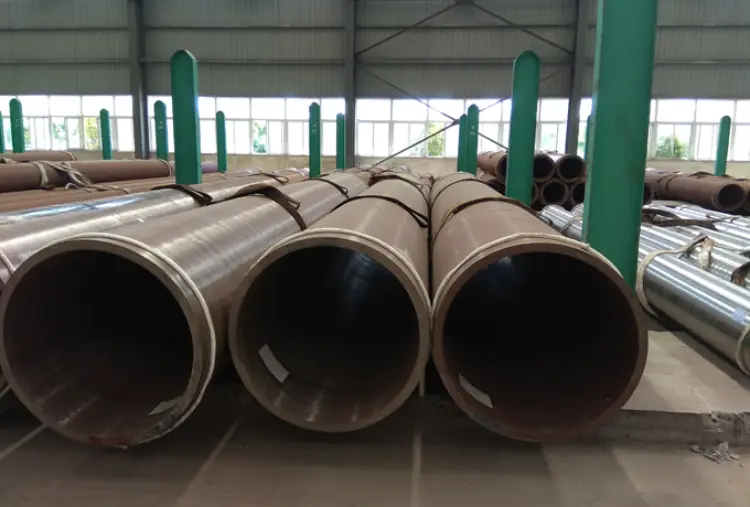
FH32 ERW Pipe Steel Material
FH32 ERW Pipe Steel: High-Strength Shipbuilding Grade for Low-Temperature Service
Explore the chemical composition, mechanical properties, thermal data, and global equivalents of FH32 ERW pipe steel, a fine-grain high-strength structural steel for marine and offshore piping systems.
Electric resistance welding (ERW), submerged arc welding (SAW), forming, normalising, thermomechanical rolling
- Phone : +8618037372205
- Email : [email protected]
- WhatsApp: Contact via Whtsapp
- WeChat: +8618037372205
FH32 ERW Pipe Steel Introduction
FH32 ERW pipe steel is a high-strength, fine-grain structural steel grade designed for electric resistance welded (ERW) pipes used in shipbuilding and offshore environments. It belongs to the AH/DH/EH/FH32 series according to IACS UR W28 and major classification society rules. The "F" designates a minimum Charpy impact energy of 31 J at -60 °C, ensuring excellent toughness for arctic and low-temperature services.
Key attributes include:
- Minimum yield strength of 315 MPa
- Good weldability with low carbon equivalent
- Stringent sulfur and phosphorus control for improved ductility
- Normalised or thermomechanical rolled delivery condition
It is widely applied in ballast water systems, cargo piping, deck machinery, and structural pipe components where reliable low-temperature toughness is essential.
FH32 ERW Pipe Steel Chemical Composition
The chemical composition of FH32 as required by IACS UR W28 and typical classification society specifications. Fine grain practice is achieved through controlled additions of Al, Nb, V, and Ti. Maximum limits ensure good weldability and toughness at -60 °C. Values are in weight percent.
| Element | Specified Value (max unless range) | Remarks |
|---|---|---|
| Carbon (C) | ≤ 0.16 | Up to 0.18 allowed if thinner than 12.5 mm |
| Silicon (Si) | ≤ 0.50 | Killed steel; typical 0.10–0.40 |
| Manganese (Mn) | 0.90 – 1.60 | For strength and toughness |
| Phosphorus (P) | ≤ 0.025 | Stringent limit for toughness |
| Sulfur (S) | ≤ 0.025 | Stringent limit for toughness |
| Aluminium (Al) | ≥ 0.015 (acid soluble) | Sufficient for fine grain practice |
| Niobium (Nb) | ≤ 0.05 | Microalloying; also Ti+V+Nb ≤ 0.12% |
| Vanadium (V) | ≤ 0.10 | Part of microalloying sum |
| Titanium (Ti) | ≤ 0.02 | Part of microalloying sum |
| Copper (Cu) | ≤ 0.35 | Residual element |
| Chromium (Cr) | ≤ 0.20 | Residual element |
| Nickel (Ni) | ≤ 0.40 | Residual element |
| Molybdenum (Mo) | ≤ 0.08 | Residual element |
| Nitrogen (N) | ≤ 0.009 | Must be bound for ageing resistance |
FH32 ERW Pipe Steel Thermal and Electrical Physical Properties
Physical properties are typical for hot-rolled fine-grain structural steel at ambient temperature unless noted. These values are not mandated by FH32 specification but are widely accepted for design calculations. Slight variations may occur depending on exact composition and processing.
| Property | Typical Value | Unit | Test Condition / Remarks |
|---|---|---|---|
| Density (ρ) | 7.85 | g/cm³ | At 20 °C |
| Modulus of Elasticity (E) | 210 | GPa | At 20 °C; temperature dependent |
| Shear Modulus (G) | 81 | GPa | Calculated from E and Poisson ratio |
| Poisson Ratio (ν) | 0.3 | - | At 20 °C |
| Thermal Expansion Coefficient (α) - 20 to 100 °C | 11.5 | x10⁻⁶ / K | Mean value |
| Thermal Conductivity (λ) | 50 | W/(m·K) | At 20 °C; decreases with temperature |
| Specific Heat Capacity (cp) | 460 | J/(kg·K) | At 20 °C |
| Electrical Resistivity (ρe) | 0.22 | µΩ·m | At 20 °C |
FH32 ERW Pipe Steel Mechanical Properties
Mechanical requirements comply with IACS UR W28 and classification societies. Two rows are given for yield strength due to thickness dependency. Tensile test is transverse to rolling direction. Impact test is longitudinal or transverse as agreed, with KV at -60 °C for grade FH32. ERW pipe weld zone shall meet same strength levels.
| Property | Specified Value | Unit | Test Condition / Remarks |
|---|---|---|---|
| Yield Strength (ReH) - thickness ≤ 100 mm | ≥ 315 | MPa | Transverse direction; for greater thickness see rules |
| Yield Strength (ReH) - thickness ≤ 50 mm (typical) | ≥ 315 | MPa | Most ERW pipe uses strip ≤ 25 mm |
| Tensile Strength (Rm) | 440 – 590 | MPa | Transverse direction |
| Elongation (A5) - thickness ≤ 50 mm | ≥ 22 | % | Gauge length 5.65√S0; for thinner strip |
| Elongation (A5) - thickness ≤ 25 mm | ≥ 22 | % | ERW pipe wall thickness typically in this range |
| Charpy V-notch Impact (KV) - longitudinal | ≥ 31 (average), min 22 single | J | Test temperature: -60 °C |
| Charpy V-notch Impact (KV) - transverse | ≥ 31 (average), min 22 single | J | Test temperature: -60 °C when agreed |
| Bend Test (180°) - pipe body | No cracks or defects | - | Mandrel diameter as per specification |
FH32 ERW Pipe Steel Exact Equivalent Material Standards & Replacement Grades
All major classification societies have an identical grade designated as FH32 following the rules of IACS. These are considered fully interchangeable in shipbuilding and offshore projects. ERW pipes certified by any of these authorities meet the same mechanical and chemical requirements.
| Country / Region | Standard / Rule | Grade | Remarks |
|---|---|---|---|
| International | IACS UR W28 | FH32 | Basis for classification society grades |
| Europe / Norway | DNV OS-B101 | FH32 | Det Norske Veritas (now DNV GL) |
| USA | ABS Rules for Materials & Welding | FH32 | American Bureau of Shipping |
| UK | LR Rules | FH32 | Lloyd's Register |
| France | BV Rules | FH32 | Bureau Veritas |
| China | CCS Rules | FH32 | China Classification Society |
| Japan | NK Rules | FH32 | ClassNK (Nippon Kaiji Kyokai) |
| Korea | KR Rules | FH32 | Korean Register |
| Italy | RINA Rules | FH32 | Registro Italiano Navale |
FH32 ERW Pipe Steel Application Introduction
FH32 ERW pipes excel in marine and offshore applications where toughness at very low temperatures is mandatory. They are suitable for pressure-containing and structural elements in ships and floating platforms. Common manufacturing processes include high-frequency electric resistance welding from hot-rolled coils, often followed by post-weld heat treatment if required.
Product Applications: Ballast water piping systems, Cargo oil and chemical tanker pipelines, Firefighting and freshwater systems on board, Structural tube frames for deck equipment, Sub-sea structural pipe supports (if specified by class)
Processed into products: ERW straight-seam pipe spools (OD up to 24 inch typical), Elbows, tees and reducers for marine piping, Welded stiffeners and braces for hull structures, Hydraulic and pneumatic system conduits, Casing and riser protection pipes
Application industries: Shipbuilding and ship repair, Offshore oil & gas platforms (FPSO, FLNG), Marine equipment manufacturing, Dredging and heavy marine transport, Polar vessels and icebreakers
FH32 ERW Pipe Steel Similar or Nearly Equivalent Material Recommendations
These materials exhibit comparable yield strength and toughness levels but may differ in minimum impact temperature, delivery thickness, or standardisation body. They can serve as substitutes after careful engineering review. FH36 can replace FH32 with higher strength. S355ML under EN 10025-4 offers similar fine-grain properties for non-marine structures.
| Country / Region | Standard | Grade | Remarks |
|---|---|---|---|
| International (shipbuilding) | IACS UR W28 | DH32 | Same strength; impact temperature -20 °C instead of -60 °C |
| International (shipbuilding) | IACS UR W28 | EH32 | Same strength; impact temperature -40 °C |
| International (shipbuilding) | IACS UR W28 | FH36 | Higher yield (≥ 355 MPa); -60 °C impact; suitable as upgrade |
| Europe | EN 10025-4 | S355ML | Thermomechanical rolled fine-grain structural steel; impact -50 °C; C ≤ 0.16; yield ≥ 355 MPa for ≤ 16 mm |
| China | GB/T 712 | FH32 | Identical to IACS; CCS grade equivalent |
| USA (offshore) | API 2H Gr.50 | ASTM A945 Gr.50 | Not exact; comparable strength with good low-temperature properties; for non-marine piping |
Notes:
Welding considerations: FH32 steel has low carbon equivalent (Ceq typically ≤ 0.38) ensuring good weldability by all conventional methods. Preheating is usually not required for moderate thicknesses, but post-weld heat treatment may be specified by the classification society for certain pipe diameters and wall thicknesses.
ERW pipe specific: The weld seam must undergo full ultrasonic or eddy current inspection as per IACS UR W28. The pipe must be marked with the classification society stamp, grade, heat number, and the mark "ERW". Hydrotesting is obligatory.
- Share



