
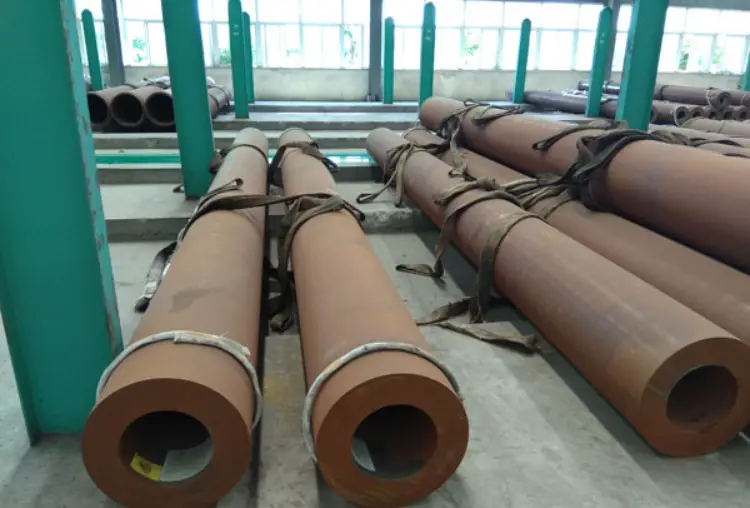
AH36 ERW Pipe Material
AH36 ERW Pipe: Marine Steel Properties, Equivalents & Applications
Comprehensive datasheet for AH36 ERW pipe, covering chemical composition, mechanical and physical properties, international equivalents, and application guidance according to ASTM A131 and major classification societies.
ERW pipe forming, cold forming, hot forming, machining, welding (all standard methods), galvanizing, coating
- Phone : +8618037372205
- Email : [email protected]
- WhatsApp: Contact via Whtsapp
- WeChat: +8618037372205
AH36 ERW Pipe Introduction
AH36 ERW pipe is a high-strength structural steel pipe manufactured by electric resistance welding from hot-rolled AH36 steel coils. AH36 is classified as a high-strength shipbuilding steel under ASTM A131 / A131M and all major classification society rules, offering a minimum yield strength of 355 MPa (51 ksi). It is primarily designed for marine and offshore structural applications such as hulls, decks, superstructures, and stiffeners. The ERW process ensures consistent wall thickness and dimensional accuracy, making it suitable for both structural and mechanical uses. Key attributes include
- Excellent weldability and formability
- Good low-temperature toughness (typically tested at 0°C)
- Controlled carbon equivalent for improved through-thickness properties
- Compliance with strict notch toughness requirements
AH36 ERW Pipe Chemical Composition
Typical chemical composition in accordance with ASTM A131 Grade AH36. The steel is fully killed and made to fine grain practice. Grain-refining elements such as Al, Nb, V, and Ti may be added individually or in combination. Carbon equivalent (CEV) is usually controlled to ensure weldability, typically CEV ≤ 0.38%.
| Chemical Element | Standard Value (max unless range given) | Remarks |
|---|---|---|
| Carbon (C) | ≤ 0.18 | Deoxidized and grain-refined |
| Manganese (Mn) | 0.90 – 1.60 | For thickness ≤ 25 mm; may vary slightly for greater thickness |
| Silicon (Si) | 0.10 – 0.50 | Killed steel |
| Phosphorus (P) | ≤ 0.035 | Maximum |
| Sulfur (S) | ≤ 0.035 | Maximum |
| Aluminum (Al) acid soluble | ≥ 0.015 | Minimum when used as grain refiner |
| Niobium (Nb) | ≤ 0.05 | Optionally added for grain refinement |
| Vanadium (V) | ≤ 0.10 | Optionally added |
| Titanium (Ti) | ≤ 0.02 | Optionally added |
| Copper (Cu) | ≤ 0.35 | If specified (e.g., for pitting resistance) |
| Chromium (Cr) | ≤ 0.20 | Residual |
| Nickel (Ni) | ≤ 0.40 | Residual |
| Molybdenum (Mo) | ≤ 0.08 | Residual |
| Total Nb+V+Ti | ≤ 0.12 | If multiple microalloying elements used |
AH36 ERW Pipe Thermal and Electrical Physical Properties
These values are representative for carbon-manganese structural steel at room temperature unless otherwise noted. Actual properties may exhibit minor variations due to processing and exact chemical composition.
| Property | Standard Value (Typical) | Unit | Test Condition / Remarks |
|---|---|---|---|
| Density (ρ) | 7.85 | g/cm³ | At 20°C |
| Elastic Modulus (E) | 200 – 210 | GPa | At 20°C, tension |
| Shear Modulus (G) | ∼ 80 | GPa | At 20°C, calculated |
| Poisson's Ratio (ν) | 0.30 | — | At 20°C |
| Thermal Expansion Coefficient (α) | 11.5 – 12.5 (20–100°C) | 10⁻⁶/°C | Average from 20°C to indicated temperature |
| Thermal Conductivity (λ) | ∼ 50 | W/(m·K) | At 20°C |
| Specific Heat Capacity (cₚ) | ∼ 460 | J/(kg·K) | At 20–100°C |
| Electrical Resistivity (ρₑ) | ∼ 0.22 | µΩ·m | At 20°C |
AH36 ERW Pipe Mechanical Properties
Mechanical properties are determined on specimens taken from the base material (transverse or longitudinal as applicable) and tested at room temperature unless stated otherwise. Minimum impact values correspond to longitudinal Charpy V-notch at 0°C. Values may vary depending on product thickness and processing route; consult the relevant product standard for exact requirements.
| Property | Standard Requirement Value | Unit | Test Condition / Remarks |
|---|---|---|---|
| Yield Strength (ReH) | ≥ 355 | MPa | Transverse, thickness ≤ 50 mm; for longitudinal specimen add 20 MPa |
| Tensile Strength (Rm) | 490 – 620 | MPa | Transverse; for longitudinal specimen min and max increased by 20 MPa |
| Elongation after fracture (A5) | ≥ 22 | % | Gauge length 200 mm (8 in) standard specimen; equivalent values for 50 mm gauge: ≥ 24% (thickness ≤ 50 mm) |
| Elongation after fracture (A50) | ≥ 24 (thickness ≤ 50 mm) | % | Gauge length 50 mm (2 in) standard specimen |
| Charpy Impact (KV) at 0°C, longitudinal | ≥ 34 (average), ≥ 24 (single) | J | Full-size specimen 10×10 mm, unless sub-size indicated |
| Charpy Impact (KV) at 0°C, transverse | ≥ 24 (average), ≥ 17 (single) | J | Full-size specimen 10×10 mm, unless sub-size indicated |
| Bend Test (Mandrel Diameter) | No cracks on outside of bent portion | — | Bend round mandrel; mandrel diameter = 3a (a = specimen thickness) for bend angle 180° |
| Through-thickness reduction of area (Z35) | ≥ 35 (individual) | % | When specified (e.g., for thick plates) |
AH36 ERW Pipe Identical Equivalents – International Standards and Replaceable Grades
| Country / Region | Standard / Specification | Grade / Equivalent | Remarks |
|---|---|---|---|
| USA / International | ASTM A131 / A131M | Grade AH36 | Primary standard for shipbuilding steel; ERW pipe may also reference API 5L or ASTM A53 but material certified as AH36. |
| American Bureau of Shipping (ABS) | ABS Rules | AH36 | Identical notation |
| DNV (Norway/Germany) | DNV Rules | NV A36 | Classification society equivalent |
| Lloyd's Register (UK) | LR Rules | AH36 | Classification society equivalent |
| Bureau Veritas (France) | BV Rules | AH36 | Classification society equivalent |
| China Classification Society (CCS) | CCS Rules | AH36 | Classification society equivalent |
| Nippon Kaiji Kyokai (ClassNK, Japan) | NK Rules | AH36 | Classification society equivalent |
| Korean Register (KR) | KR Rules | AH36 | Classification society equivalent |
| Registro Italiano Navale (RINA, Italy) | RINA Rules | AH36 | Classification society equivalent |
| Indian Register of Shipping (IRS) | IRS Rules | AH36 | Classification society equivalent |
| Russia Maritime Register of Shipping (RS) | RS Rules | A36 or AH36 | Notation may vary; AH36 is recognized |
AH36 ERW Pipe Application Introduction
AH36 ERW pipe is utilized wherever high strength, good weldability, and certified notch toughness are required in structural and mechanical applications. Its primary market is marine and offshore engineering, but it also finds use in heavy construction and industrial equipment. Below are typical industries and products.
Product Applications: Structural pipes for ship deck and hull framing, Piling pipe for docks and quay walls, Conductor pipes and casing for offshore wells, Tubular components for offshore platform legs and bracings, Bollard and fender support tubes, Crane pedestal sections, Mechanical tubes for heavy-duty hydraulic cylinders (when machined and treated)
Processed into products: Stiffener tube sections for ship double bottoms, Jacket leg members, Truss structures for offshore flare booms, Davit sockets, Boom rest pedestals, Subsea protection frames, Turret mooring system components, Cargo handling equipment beams
Application industries: Shipbuilding and ship repair (hull structures, superstructures, stiffeners, frames, masts, crane pedestals), Offshore oil & gas (jacket legs, platform decks, conductor pipes, flare booms, bridges), Marine engineering (bulkheads, barges, floating docks, port infrastructure), Heavy civil construction (structural columns, bridge supports, piling pipe, foundation elements), Industrial machinery (heavy equipment frames, crane booms, mining vehicle components), Renewable energy (offshore wind turbine support structures, transition pieces)
AH36 ERW Pipe Similar / Alternative Materials
| Country / Region | Standard | Grade | Remarks |
|---|---|---|---|
| Europe | EN 10025-2 / EN 10025-3 / EN 10025-4 | S355J2, S355K2, S355M | Similar yield strength (355 MPa); however, AH36 specifically meets Charpy at 0°C and marine service requirements. S355 grades can be used as structural alternatives but not certified for marine use without additional qualification. |
| China | GB/T 712 | AH36 | Identical to international AH36; direct substitute. |
| Russia/CIS | GOST 5521 | A36 or D36, depending on grade | Nearest match; check toughness temperature. |
| India | IS 2062 | E350 / Fe 490 | Comparable strength but without specific marine impact requirements unless ordered as 'shipbuilding quality'. |
| International (Pipeline Std) | API 5L | X52 (L360) | Similar yield strength; API 5L X52 pipe for non-marine transmission; not equivalent in terms of toughness/weldability certification for shipbuilding. |
Notes:
ERW Pipe Specifics: AH36 ERW pipes are normally produced to ASTM A53 Grade B mechanical requirements but with chemical and toughness compliance to AH36. The weld seam is heat-treated to ensure homogeneous properties. Weldability: The steel is readily weldable by all common methods (SMAW, GMAW, FCAW, SAW). Preheating is usually not required for sections under 40 mm when CEV ≤ 0.43. Corrosion Protection: For marine use, pipes are often coated (epoxy, zinc silicates, or galvanized) to meet NORSOK or IMO PSPC standards. Certifications: Material certificates (EN 10204 3.1 or 3.2) from a recognized classification society are standard. Note on ERW Process: The pipe may be supplied as-welded or stress-relieved depending on the end use; post-weld heat treatment (PWHT) is generally not required for structural applications except when specified for dimensional stability or after heavy cold forming.
- Share



