
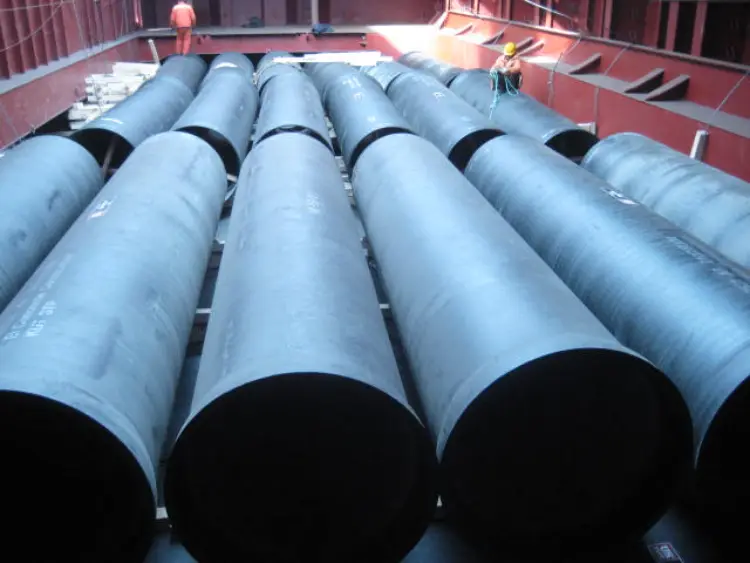
DH36 ERW Pipe Material
DH36 ERW Pipe | Marine Grade High-Strength Structural Steel for Shipbuilding & Offshore
Comprehensive material data on DH36 electric resistance welded (ERW) pipe: chemical composition, mechanical properties at room temperature and low temperature, thermal and electrical physical properties, equivalent international grades, and application guidelines for shipbuilding and offshore structures.
Suitable for hot forming, cold forming, welding (all common methods), machining, and bending. ERW pipe forming involves roll forming and high-frequency longitudinal seam welding, often followed by seam annealing and sizing.
- Phone : +8618037372205
- Email : [email protected]
- WhatsApp: Contact via Whtsapp
- WeChat: +8618037372205
DH36 ERW Pipe Introduction
DH36 ERW pipe is manufactured from structural steel plates conforming to Grade DH36 of ASTM A131 / ABS Rules, specifically intended for marine, offshore, and structural applications where high strength, excellent weldability, and good low-temperature toughness are required. It is produced by forming hot-rolled or normalized DH36 steel strip into a tubular shape and welding longitudinally using the high-frequency electric resistance welding (ERW) process. Key characteristics:
- Minimum yield strength of 355 MPa (51 ksi)
- Excellent toughness down to -20°C (-4°F)
- Good formability and weldability
- Suitable for structural members, piping systems, and offshore platforms
DH36 ERW Pipe Chemical Composition
The chemical composition of DH36 steel respects the requirements of ASTM A131 Grade DH36 and the classification society rules for shipbuilding steels. The steel is fully killed and contains grain-refining elements such as aluminum, niobium, vanadium, or titanium. Maximum limits are given for sulfur and phosphorus to ensure good ductility and weldability. Microalloying elements (Nb, V, Ti) may be added singly or in combination to achieve the required strength level while maintaining low carbon equivalent for excellent weldability.
| Element | Typical Value (max unless range given) | Remarks |
|---|---|---|
| Carbon (C) | ≤0.18% | Ladle analysis; lower C improves toughness and weldability |
| Manganese (Mn) | 0.90–1.60% | Provides strength and hardenability |
| Silicon (Si) | 0.10–0.50% | Deoxidizer; improves strength |
| Phosphorus (P) | ≤0.035% | Strict control for enhanced ductility |
| Sulfur (S) | ≤0.035% | Strict control for improved formability |
| Aluminum (Al) | ≥0.015% | Total Al used for grain refinement |
| Niobium (Nb) | 0.02–0.05% | Optional microalloy; for grain refinement and precipitation strengthening |
| Vanadium (V) | 0.05–0.10% | Optional microalloy; for strength |
| Titanium (Ti) | 0.007–0.05% | Optional microalloy; for grain refinement and nitrogen fixation |
| Chromium (Cr) | ≤0.25% | Residual element; may be present from scrap |
| Nickel (Ni) | ≤0.40% | Residual element; improves toughness at low temperature |
| Molybdenum (Mo) | ≤0.08% | Residual element |
| Copper (Cu) | ≤0.35% | Residual element; improves corrosion resistance slightly |
| Nitrogen (N) | ≤0.009% | May be present; Ti or Al can fix it |
| Carbon Equivalent (CEV) | ≤0.38–0.40% | Calculated by IIW formula: CE=C+Mn/6+(Cr+Mo+V)/5+(Ni+Cu)/15. Typical max for DH36 is 0.38% |
DH36 ERW Pipe Thermal and Electrical Physical Properties
The physical properties are typical values for DH36 steel at room temperature and elevated temperatures. These values are representative for low-alloy carbon-manganese structural steels and are suitable for engineering calculations. Variations may occur depending on the exact chemical composition and heat treatment condition. Data conforms to standard references for ASTM A131 Grade DH36 and similar marine steels. The values are not part of the mandatory specification but are widely accepted.
| Property | Typical Value | Unit | Test Condition |
|---|---|---|---|
| Density (ρ) | 7.85 | g/cm³ | At 20°C |
| Elastic Modulus (E) | 205 | GPa | At 20°C |
| Shear Modulus (G) | 80 | GPa | At 20°C, calculated from E and ν |
| Poisson's Ratio (ν) | 0.29 | – | At 20°C |
| Thermal Expansion (α) | 11.5 | 10⁻⁶/K | 20–100°C |
| Thermal Expansion (α) | 12.0 | 10⁻⁶/K | 20–200°C |
| Thermal Expansion (α) | 13.0 | 10⁻⁶/K | 20–400°C |
| Thermal Conductivity (λ) | 50 | W/(m·K) | At 20°C |
| Thermal Conductivity (λ) | 45 | W/(m·K) | At 200°C |
| Thermal Conductivity (λ) | 38 | W/(m·K) | At 400°C |
| Specific Heat Capacity | 470 | J/(kg·K) | At 20°C – 200°C range |
| Electrical Resistivity (ρₑ) | 0.22 | μΩ·m | At 20°C |
DH36 ERW Pipe Mechanical Properties
Mechanical properties are according to ASTM A131 Grade DH36 for plate thickness up to 100 mm (the pipe wall thickness is usually within the range 6–50 mm). Longitudinal tensile test results are typical for pipe body (base metal). The weld seam properties are verified separately. Impact tests are performed at -20°C on longitudinal specimens. Bend test requirements are often specified for pipe material by the purchaser; typical bend diameter is ≤2t for base metal. Values below represent the minimum required properties unless stated otherwise.
| Property | Specified Value | Unit | Test Condition |
|---|---|---|---|
| Yield Strength (ReH) | ≥ 355 | MPa | Room temperature, transverse direction for plate; pipe longitudinal |
| Tensile Strength (Rm) | 490 – 620 | MPa | Room temperature |
| Elongation (A) | ≥ 22 | % | 50 mm gauge length (2 in.), thickness ≤50 mm |
| Charpy V-notch Impact Energy (KV) | ≥ 34 | J | At -20°C, longitudinal specimen, average of 3 tests |
| Charpy V-notch Impact Energy (KV) | ≥ 24 | J | Individual minimum value at -20°C |
| Bend Test (mandrel diameter) | 1.5t – 2t | – | 180° bend, base metal; t = pipe wall thickness, no cracks after bending. (Where required by specification.) |
DH36 ERW Pipe Fully Equivalent Material Standards and Grade Substitutions
| Country/Region | Standard | Designation | Remarks |
|---|---|---|---|
| USA / International | ASTM A131 Grade DH36 | DH36 | Base standard for marine structural steel |
| USA (ABS) | ABS Rules for Materials and Welding | ABS Grade DH36 | Identical chemical and mechanical requirements |
| Norway / Germany (DNV GL) | DNV GL Rules Pt.2 Ch.2 | NV D36 | Fully equivalent; same min. yield 355 MPa |
| UK (LR) | Lloyd's Register Rules | LR DH36 | Fully equivalent |
| France (BV) | Bureau Veritas Rules | BV D36 | Fully equivalent |
| China (CCS) | China Classification Society Rules | CCS DH36 | Fully equivalent |
| Japan (NK) | Nippon Kaiji Kyokai Rules | KD36 | Fully equivalent |
| South Korea (KR) | Korean Register Rules | RD36 | Fully equivalent |
| Italy (RINA) | RINA Rules | RINA DH36 | Fully equivalent |
| Russia (RS) | Russian Maritime Register Rules | D36 | Equivalent with minor tolerance differences |
DH36 ERW Pipe Application Introduction
DH36 ERW pipe combines the well-proven properties of marine structural steel with the economic and dimensional advantages of electric resistance welded tubing. This product is extensively used in shipbuilding, offshore engineering, and heavy structural fabrication. It should be selected where both high strength and good toughness at sub-zero temperatures (down to -20°C) are required. The ERW process ensures consistent wall thickness and straightness, and the longitudinal seam can be fully tested (e.g., ultrasonic or eddy current) to ensure weld integrity.
Product Applications: Hull longitudinal stiffeners and web frames (when formed into open sections), Marine riser pipes and conductor casings (when further processed or coated), Offshore platform legs, braces, and deck support beams (hollow sections), Piling pipes for jetty and berthing structures, Structural columns and bracings for buildings near marine atmosphere, Suction anchors and piles for anchoring systems, Crane booms and heavy equipment frames
Processed into products: Tubular nodes and joints (as raw pipe cut and profiled), Structural pipe piles (as-delivered, often spliced), Tubular members in trusses and space frames, Short lengths used as stiffener rings or pad eyes after machining, Pressed end fittings and flanges for hydraulic piping, Welded pipe spools for ballast and bilge systems (after hydrotest)
Application industries: Shipbuilding and marine construction, Offshore oil & gas platforms and FPSO structures, Offshore wind turbine foundations (monopiles, jacket legs), Port and harbor engineering (piling, dolphins), Bridge and heavy civil structures in marine environments, Pressure vessel and boiler supports (secondary structures), Mining and heavy machinery (structural components)
DH36 ERW Pipe Similar / Alternative Materials and Substitutions
| Country/Region | Standard | Designation | Remarks |
|---|---|---|---|
| Europe | EN 10025-4 | S355ML (S355M/ML) | Thermomechanical rolled weldable fine grain structural steel; similar strength (355 MPa) and toughness; suitable for offshore structures; not dedicated to ship classification but often accepted with supplementary requirements. |
| Europe | EN 10025-4 | S355G10+M | Offshore structural steel with improved through-thickness properties; can replace DH36 in critical welded joints. |
| Japan | JIS G3106 | SM490YA / SM490YB | Higher strength but slightly different toughness; often used in shipbuilding as AH36, DH36 alternative subject to classification approval. |
| China | GB 712-2011 | DH36 | Identical to international DH36; widely used in domestic shipbuilding. |
| USA | ASTM A572 | Grade 50 [345], or Grade 55 [380] | Structural steel with similar yield strength but lacking the mandatory low-temperature impact requirement; not directly substitutable without verification. |
| API | API 5L | X52 (L360) | Line pipe grade with similar yield 360 MPa, but different chemical and toughness requirements; may be considered for non-marine applications with adjustment. |
Notes:
DH36 ERW pipe typically requires supplementary certifications including charpy V-notch test certificates, ultrasonic testing of the weld seam and the pipe body, and dimensional inspection reports. For critical marine applications, the pipe may need to be delivered in the normalized condition or with the weld zone subject to post-weld heat treatment (PWHT) if specified by the classification society. Additional tests like drop weight tear test (DWTT) or CTOD may be required for offshore structures designed for arctic conditions. Always consult the latest edition of the relevant IACS member rules and the project-specific material specification.
- Share



