
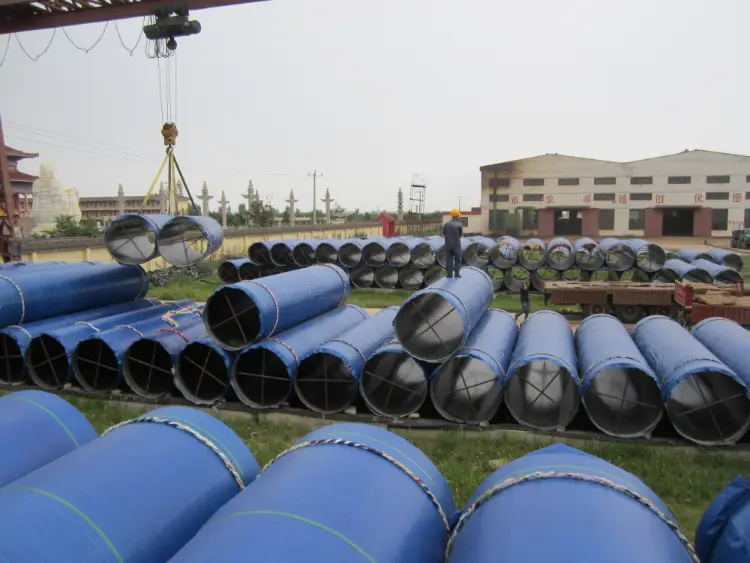
EH36 ERW Pipe Material: High-Strength Marine Steel
EH36 ERW Pipe: High-Strength Shipbuilding & Offshore Structural Steel Tube
Complete material property analysis of EH36 electric resistance welded (ERW) pipe used in shipbuilding and marine structures, including chemical composition, mechanical and thermal properties, international equivalents, and application guidance.
Welding (ERW, SAW), hot/cold bending, machining, cutting, and forming
- Phone : +8618037372205
- Email : [email protected]
- WhatsApp: Contact via Whtsapp
- WeChat: +8618037372205
EH36 ERW Pipe: High-Strength Marine Steel Introduction
EH36 is a high-strength, low-alloy structural steel grade primarily used in shipbuilding and offshore engineering. Produced as ERW pipe, it offers excellent weldability, high strength, and guaranteed impact toughness down to -40 °C. The grade complies with major classification society rules and is typically supplied in normalized or thermo-mechanically controlled rolled (TMCP) condition. Main attributes:
- Minimum yield strength of 355 MPa
- Good ductility and toughness at low temperatures
- Suitable for welded tubular structures in harsh marine environments
- Available as ERW pipes, plates, and sections
EH36 ERW Pipe: High-Strength Marine Steel Chemical Composition of EH36
The chemical composition shall comply with ASTM A131/A131M Grade EH36 and classification society requirements. Elements not listed may be present as residuals. Micro-alloying elements such as Nb, V, Ti, and Al are used singly or in combination to achieve the required strength and toughness. The CEV (carbon equivalent) is typically controlled to ensure weldability.
- Carbon Equivalent (CEV) usually ≤ 0.38–0.40 depending on thickness.
- Fine grain practice with total aluminum content ≥ 0.015%.
| Element | Specified Value (wt%) | Remarks |
|---|---|---|
| Carbon (C) | ≤ 0.18 | Ladle analysis |
| Manganese (Mn) | 0.90 – 1.60 | May be adjusted depending on thickness |
| Silicon (Si) | 0.10 – 0.50 | Killed steel practice |
| Phosphorus (P) | ≤ 0.035 | Controlled for toughness |
| Sulfur (S) | ≤ 0.035 | Controlled for shape and cleanliness |
| Aluminum (Al) | ≥ 0.015 (total) | Grain refining |
| Niobium (Nb) | 0.02 – 0.05 | Optional micro-alloy, if used |
| Vanadium (V) | 0.05 – 0.10 | Optional micro-alloy, if used |
| Titanium (Ti) | 0.007 – 0.05 | Optional, nitrogen binder |
| Copper (Cu) | ≤ 0.35 | Residual element |
| Chromium (Cr) | ≤ 0.20 | Residual element |
| Nickel (Ni) | ≤ 0.40 | Residual element |
| Molybdenum (Mo) | ≤ 0.08 | Residual element |
| Nitrogen (N) | ≤ 0.009 (≤ 0.012 if not Al treated) | For fine grain practice |
EH36 ERW Pipe: High-Strength Marine Steel Thermal and Electrical Physical Properties
The following thermal and electrical properties are typical for low-alloy carbon-manganese steel at room temperature unless otherwise stated. These values are not normative requirements but serve as design reference.
- Properties are comparable to those of general structural steels (e.g., S355).
- Values may vary slightly depending on exact composition and heat treatment.
| Property | Typical Value | Unit | Test Condition |
|---|---|---|---|
| Density (ρ) | 7.85 | g/cm³ | 20 °C |
| Elastic Modulus (E) | 210 | GPa | 20 °C |
| Shear Modulus (G) | 80 | GPa | 20 °C (estimated as E/2.6) |
| Poisson's Ratio (ν) | 0.3 | - | 20 °C |
| Thermal Expansion Coefficient (α) | 12.0 | 10⁻⁶/K | 20 °C to 100 °C |
| Thermal Expansion Coefficient (α) | 12.8 | 10⁻⁶/K | 20 °C to 200 °C |
| Thermal Expansion Coefficient (α) | 13.5 | 10⁻⁶/K | 20 °C to 300 °C |
| Thermal Conductivity (λ) | 50 | W/(m·K) | 20 °C |
| Specific Heat Capacity | 470 | J/(kg·K) | 20 °C |
| Electrical Resistivity (ρₑ) | 0.20 | 10⁻⁶ Ω·m | 20 °C |
EH36 ERW Pipe: High-Strength Marine Steel Mechanical Properties of EH36 Steel
Mechanical properties are determined on the base material before or after pipe forming, in accordance with the applicable standard. The values given here are typical for thicknesses up to 50 mm. For ERW pipes, the joint efficiency is normally 1.0 when fully welded and tested, but the longitudinal strength of the seam is verified by flattening and bend tests.
- Tensile test specimens are taken transverse or longitudinal according to the product.
- Impact test temperature: -40 °C, Charpy V-notch, minimum average energy 34 J.
| Property | Required Value | Unit | Test Condition / Remarks |
|---|---|---|---|
| Yield Strength (ReH) | ≥ 355 | MPa | Transverse, t ≤ 50 mm; for t > 50 mm minimum 355 MPa or agreed |
| Tensile Strength (Rm) | 490 – 620 | MPa | Transverse, room temperature |
| Elongation (A) | ≥ 21 | % | Gauge length 200 mm (8 in) for plate; for pipe may be 50 mm gauge, minimum values adjusted per standard |
| Bend Test | D = 2a (t ≤ 25 mm); D = 3a (t > 25 - 50 mm) | 弯心直径 (D), a = specimen thickness | 180° bend, no cracks; ERW pipe subjected to flattening test per ASTM A450/A450M or product standard |
| Impact Energy (KV) | ≥ 34 (average) / ≥ 27 (single) | J | Charpy V-notch, longitudinal, -40 °C |
| Hardness | Not specified; typical ≤ 200 HB | HB | Informative |
EH36 ERW Pipe: High-Strength Marine Steel Identical Material Standards and Replaceable Grades
| Country / Society | Standard | Grade / Designation | Remarks |
|---|---|---|---|
| American Bureau of Shipping (ABS) | ABS Rules Part 2 | EH36 | Identical to ASTM A131 EH36 |
| DNV (Norway/Germany) | DNV-OS-B101 | NV E36 | Guaranteed impact at -40 °C |
| Lloyd's Register (LR) | LR Rules | EH36 | Same chemistry and mechanical requirements |
| Bureau Veritas (BV) | BV Rules | EH36 | Equivalent strength and toughness grade |
| China Classification Society (CCS) | CCS Rules | EH36 | EH36; directly interchangeable |
| Nippon Kaiji Kyokai (NK) | NK Rules | KE36 | KE36 is equivalent to EH36 |
| Korean Register (KR) | KR Rules | RE36 | RE36 corresponds to EH36 |
EH36 ERW Pipe: High-Strength Marine Steel Application Introduction
EH36 ERW pipes are designed for demanding welded structures where high strength and low-temperature notch toughness are essential. Typical applications span shipbuilding, offshore oil and gas, heavy civil engineering, and port machinery.
- Key application criteria: service temperature ≥ -40 °C, high fatigue resistance, good weldability with no preheating or minimal preheat.
- ERW pipes produced from EH36 coils retain the base material properties; the HAZ usually shows adequate toughness.
Product Applications: Electric resistance welded structural pipes in diameters 219 mm to 610 mm, wall thickness 6–25 mm, Hollow sections for ship hull stiffening, Piled foundations and mooring systems, Jack-up rig chords and braces, Compressed air and ballast water piping
Processed into products: Ship deck supporting columns and handrail stanchions, Offshore platform braces and minor jacket members, Pneumatic conveyor tubes and process piping requiring impact toughness, Conveyor belt roller tubes in corrosive marine atmosphere, Structural trusses for cargo lifting appliances
Application industries: Shipbuilding (hulls, decks, bulkheads, ballast piping), Offshore oil & gas (jacket legs, conductor pipes, topside structural members), Marine & port engineering (dolphin piles, fender panels, crane pedestals), Renewable energy (offshore wind turbine foundation transition pieces, monopiles), Heavy construction (structural columns, bridge pipe trusses)
EH36 ERW Pipe: High-Strength Marine Steel Near-Substitute Materials with Similar Performance
| Country/Region | Standard | Grade | Remarks |
|---|---|---|---|
| International | ASTM A131 | DH36 | Impact test at -20 °C instead of -40 °C; otherwise identical strength; may be used where lower toughness suffice |
| International | ASTM A131 | FH36 | Impact test at -60 °C; better cryogenic toughness; suitable for applications requiring lower service temperatures |
| Europe | EN 10025-4 | S355ML | Thermo-mechanical rolled fine-grain steel with 355 MPa yield, low temperature toughness at -50 °C; close but not identical to EH36; requires CEV harmonization |
| USA | API 5L | X52 | Pipe steel with SMYS 359 MPa; comparable strength but different chemistry (PM controlled); not suitable for ship classification without specific approval |
| USA | ASTM A572 | Grade 50 (345 MPa) | Slightly lower yield; impact properties vary; may be acceptable for non-marine structural tube applications |
Notes:
Additional information regarding EH36 ERW pipe:
- Welding: The low carbon equivalent ensures excellent weldability by all common processes (ERW, SAW, SMAW, FCAW). The longitudinal ERW joint is formed by high-frequency welding without filler metal; it must be free of cracks and unacceptable oxides. Post-weld heat treatment (normalizing or stress relieving) may be specified for certain service conditions.
- Hydrostatic testing: ERW pipes are normally subjected to a hydrostatic test at the mill to verify joint integrity.
- Non-destructive testing: The weld seam is inspected by ultrasonic or electromagnetic methods as per relevant product standards (e.g., ASTM A53, ASTM A135, or ship classification rules).
- Surface condition: Pipes are supplied black or with protective coating; for sea exposure, external three-layer PE/PP or epoxy coating and internal FBE lining are typical.
- Ordering specifications: When specifying EH36 ERW pipe, refer to the applicable classification society rules for pipe intended for shipboard systems, or for offshore structural tubes, apply the relevant DNV-OS-F101 or API RP 2A guidelines with supplementary requirements for notch toughness.
- Share



