
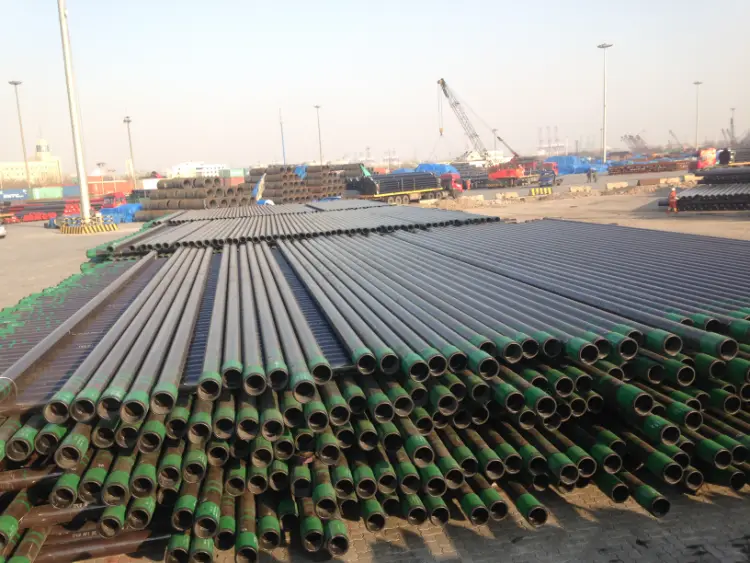
FH36 ERW Pipe Material
FH36 ERW Pipe: High Strength Shipbuilding Steel Tube for Arctic & Marine Applications
FH36 ERW pipe is a high-strength welded structural steel tube made from FH36 shipbuilding steel, featuring excellent low-temperature toughness down to -60°C. Compliant with ABS, DNV, and other classification society rules, it is widely used in marine, offshore, and Arctic engineering.
Electric Resistance Welding (ERW), cold forming, hot forming, welding, machining, coating, galvanizing
- Phone : +8618037372205
- Email : [email protected]
- WhatsApp: Contact via Whtsapp
- WeChat: +8618037372205
FH36 ERW Pipe Introduction
FH36 ERW pipe is produced by electric resistance welding (ERW) of FH36 steel strip or plate, a high-strength shipbuilding structural steel with specified minimum yield strength of 355 MPa. FH36 grade indicates fine grain steel with elevated low-temperature impact properties, tested at -60°C. The pipe offers a combination of high strength, excellent weldability, and reliable toughness even in extremely cold environments.
- Compliant with ABS Rules, DNV Rules, and ASTM A131 / A131M standards
- Yield strength ReH ≥ 355 MPa, tensile strength Rm 490–620 MPa
- Excellent low‑temperature impact toughness (KV₂ ≥ 24 J at -60°C)
- Suitable for critical structural members in ships, offshore platforms, and polar vessels
- Supplied in normalized, normalized rolled, or TMCP condition
FH36 ERW Pipe Chemical Composition
The chemical composition of FH36 steel is controlled to ensure high strength and low-temperature toughness. Grain refining elements (Al) are added to achieve fine ferritic grain structure, and low impurity levels (P, S) enhance weldability and ductility. Values are per heat analysis according to ASTM A131 / ABS Rules.
- Carbon equivalent CEV typically ≤ 0.38% for thickness ≤ 50 mm
- Microlloying elements (Nb, V, Ti) may be added optionally at the manufacturer's discretion
| Element | Standard Requirement (max unless range) | Remarks |
|---|---|---|
| C | ≤ 0.18% | Deoxidized (fully killed) |
| Mn | 0.90–1.60% | For specified strength and toughness |
| Si | ≤ 0.50% | Deoxidizer |
| P | ≤ 0.035% | Reduced for low-temperature ductility |
| S | ≤ 0.035% | Minimized for weldability |
| Al (acid sol.) | ≥ 0.015% (min) | Grain refinement |
| Nb | ≤ 0.05% | Optional microalloy |
| V | ≤ 0.10% | Optional microalloy |
| Ti | ≤ 0.02% | Optional microalloy |
| N | ≤ 0.012% | Optional, if bound by Al |
| CEV | ≤ 0.38% (t ≤ 50 mm) | Carbon Equivalent Value |
FH36 ERW Pipe Thermal and Electrical Physical Properties
The following physical properties are typical for FH36 steel at ambient temperature, unless otherwise stated. These values are approximate and applicable to similar low-alloy structural steels. Precise data may vary slightly with composition and heat treatment.
- Properties are valid for temperature ~20°C unless noted
- Density and elastic moduli are essentially the same for all high-strength shipbuilding steels
| Property | Typical Value | Unit | Test Conditions |
|---|---|---|---|
| Density (ρ) | 7850 | kg/m³ | At 20°C |
| Modulus of Elasticity (E) | 205 | GPa | Ambient temperature |
| Shear Modulus (G) | 80 | GPa | Ambient temperature |
| Poisson's Ratio (ν) | 0.29 | - | Ambient temperature |
| Thermal Expansion Coefficient (α) | 11.7 × 10⁻⁶ | 1/K | 20–100°C |
| Thermal Expansion Coefficient (α) | 12.5 × 10⁻⁶ | 1/K | 20–200°C |
| Thermal Expansion Coefficient (α) | 13.6 × 10⁻⁶ | 1/K | 20–400°C |
| Thermal Conductivity (λ) | 48 | W/(m·K) | At 20°C |
| Thermal Conductivity (λ) | 45 | W/(m·K) | At 100°C |
| Specific Heat Capacity | 470 | J/(kg·K) | At 20°C |
| Electrical Resistivity (ρ_e) | 0.16 × 10⁻⁶ | Ω·m | At 20°C |
FH36 ERW Pipe Mechanical Properties
Mechanical properties of FH36 pipe should meet the base material requirements unless otherwise specified by the classification society. Tensile and impact tests are performed on samples taken from the pipe or the parent plate. For ERW pipe, the longitudinal tensile properties are reported; the weld seam efficiency is typically 100%. Impact toughness is measured with Charpy V-notch specimens.
- Thickness classification: ≤ 50 mm (typical for pipe up to 50 mm wall)
- Impact test temperature: -60°C for FH36 (mandatory)
| Property | Standard Required Value | Unit | Test Conditions |
|---|---|---|---|
| Yield Strength (ReH) | ≥ 355 | MPa | Transverse, thickness ≤ 50 mm |
| Tensile Strength (Rm) | 490–620 | MPa | Transverse |
| Elongation (A) | ≥ 21 | % | Gauge length 5.65√S₀, transverse |
| Charpy Impact Energy (KV₂) | ≥ 24 (average) | J | Longitudinal, -60°C, thickness ≤ 50 mm |
| Charpy Impact Energy (KV₂) | ≥ 17 (average) | J | Transverse, -60°C, thickness ≤ 50 mm |
| Bend Test | No cracks or defects (d=3a) | - | 180° bend, d = 3 × thickness of specimen |
| Weld Tensile Strength (ERW Pipe) | ≥ 490 (Rm of pipe) | MPa | Transverse weld tensile, seamless or welded |
| Flattening Test | No cracks until distance between plates ≤ 2/3 OD | - | Stepwise flattening, as per ASTM A370 or ISO 8492 |
FH36 ERW Pipe Completely Equivalent Material Standards and Substitute Grades
| Country / Region | Standard | Grade | Remarks |
|---|---|---|---|
| International | ABS Rules | FH36 | American Bureau of Shipping |
| International | DNV Rules | FH36 | Det Norske Veritas |
| International | Lloyd's Register Rules | FH36 | Lloyd's Register |
| International | BV Rules | FH36 | Bureau Veritas |
| International | CCS Rules | FH36 | China Classification Society |
| International | NK Rules | FH36 | ClassNK (Nippon Kaiji Kyokai) |
| International | KR Rules | FH36 | Korean Register |
| International | RINA Rules | FH36 | Registro Italiano Navale |
| USA | ASTM A131 / A131M | FH36 | Standard Specification for Structural Steel for Ships |
FH36 ERW Pipe Application Introduction
FH36 ERW pipe is optimized for marine and offshore structures requiring reliable performance in low-temperature environments. Due to its fine grain and low sulfur content, it exhibits excellent weldability and formability, making it suitable for fabricating complex tubular assemblies.
- Commonly specified for structures exposed to temperatures down to -60°C
- Used as columns, braces, pipe sleeves, conductor pipes, and jack-up legs
- Often selected for icebreakers, arctic supply vessels, and winterized offshore platforms
Product Applications: Hull structural members (stiffeners, frames), Deck crane pedestals and booms, Offshore platform legs and braces, Conductor pipes and casings, Subsea structural tubes, Piling pipes for marine foundations, Penstocks and pressure lines
Processed into products: Tubular columns and girders in ship hulls, Bracing systems in offshore jackets, Joints and nodes in truss structures, Bent and fabricated pipe spools, Flanged connections for cryogenic service, Launch cradle components for shipbuilding
Application industries: Shipbuilding and ship repair, Offshore oil and gas (fixed and floating platforms), Marine renewable energy (wind turbine foundations), Polar and ice-class vessels, Port and harbor construction, Structural engineering (bridges, piling)
FH36 ERW Pipe Similar/Comparable Substitute Materials
| Country / Region | Standard | Grade | Remarks |
|---|---|---|---|
| International | ASTM A131 / ABS | EH36 | Temperature class E (-40°C); lower low-temperature toughness |
| International | ASTM A131 / ABS | DH36 | Temperature class D (-20°C); suitable for less severe conditions |
| International | EN 10025-4 | S420ML | Thermomechanical rolled structural steel, YP 420 MPa, but different impact test temperature |
| International | EN 10025-3 | S460N | Normalized fine grain steel, higher yield 460 MPa, -20°C impact |
| International | API 5L / ISO 3183 | X60 / L415 | Pipeline steel, similar strength, but lower toughness requirements than FH36 |
Notes:
Note: For FH36 ERW pipe, additional requirements such as hydrostatic testing, NDT of weld seam (ultrasonic or eddy current), dimensional tolerances (ASTM A999 or API 5L), and certification to classification society rules must be agreed upon at the time of ordering. The ERW welding process shall be carried out with proper control of heat input, and post-weld normalizing may be required depending on pipe wall thickness and application. Surface condition and protective coating (e.g., galvanizing, epoxy) can be specified to enhance corrosion resistance in marine atmospheres. Always consult the relevant class rules for the latest requirements regarding FH36 material and welding procedures.
- Share



