
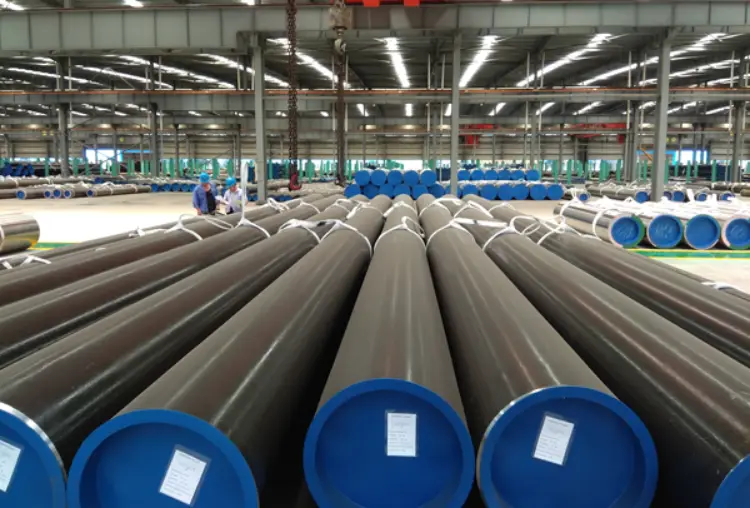
EH32 ERW Pipe Material
EH32 ERW Pipe - High-Strength Shipbuilding Steel Grade for Welded Structural Tubes
Comprehensive material data and equivalent grades for EH32 electric resistance welded (ERW) pipes, used in marine and offshore structural applications. Includes chemical composition, mechanical properties, physical data, and international cross-references.
Cold forming, electric resistance welding (ERW), normalizing or TMCP rolling for base material, stress-relief heat treatment after welding
- Phone : +8618037372205
- Email : [email protected]
- WhatsApp: Contact via Whtsapp
- WeChat: +8618037372205
EH32 ERW Pipe Introduction
EH32 ERW pipe is an electric resistance welded tubular product manufactured from EH32 high-strength shipbuilding structural steel. EH32 is a normalized or thermo-mechanically controlled rolled (TMCP) fine-grain steel with a minimum yield strength of 315 MPa, widely certified by major classification societies such as DNV GL, ABS, LR, BV, and CCS. The ERW pipe format is produced by cold-forming and high-frequency welding, then often heat-treated to relieve stresses. This material offers excellent weldability, good low-temperature toughness down to -40 °C, and reliable strength for demanding marine and offshore environments. Typical applications include ship hull stiffeners, deck supports, offshore platform members, and structural pipe piling.
EH32 ERW Pipe Chemical Composition
Chemical requirements according to DNV GL rules for grade EH32. Single values are maximums unless a range is shown. Fine-grain treatment elements (Nb, V, Ti) may be added individually or in combination.
| Chemical Element | Standard Value | Remarks |
|---|---|---|
| C | ≤ 0.18 | Ladle analysis |
| Mn | 0.90 – 1.60 | Depending on thickness |
| Si | ≤ 0.50 | |
| P | ≤ 0.025 | |
| S | ≤ 0.025 | |
| Al (acid-soluble) | ≥ 0.015 | Total Al ≥ 0.020 if used |
| Nb | 0.02 – 0.05 | Optional fine-grain element |
| V | 0.05 – 0.10 | Optional fine-grain element |
| Ti | 0.01 – 0.02 | Optional fine-grain element, total Ti |
| Cu | ≤ 0.35 | May be specified higher if agreed |
| Cr | ≤ 0.20 | |
| Ni | ≤ 0.40 | |
| Mo | ≤ 0.08 | |
| N | ≤ 0.012 | If Al, Nb or Ti present |
EH32 ERW Pipe Thermal and Electrical Physical Properties
Typical physical properties for a low-alloy structural steel similar to EH32 at room temperature. These values are representative for carbon-manganese steels and are not part of the classification specification. They may vary depending on exact composition and heat treatment.
| Property | Standard or Typical Value | Unit | Test Condition |
|---|---|---|---|
| Density (ρ) | 7.85 | g/cm³ | Room temperature |
| Elastic modulus (E) | 205 | GPa | Room temperature |
| Shear modulus (G) | 80 | GPa | Room temperature |
| Poisson's ratio (ν) | 0.3 | – | Room temperature |
| Thermal expansion coefficient (α) | 12 x 10⁻⁶ | K⁻¹ | 20–100 °C |
| Thermal conductivity (λ) | 50 | W/(m·K) | Room temperature |
| Specific heat capacity | 0.49 | J/(g·K) | Room temperature |
| Electrical resistivity (ρ_e) | 0.15 | μΩ·m | Room temperature |
EH32 ERW Pipe Mechanical Properties
Minimum mechanical properties for EH32 steel according to DNV GL rules, valid for thicknesses ≤ 50 mm. Impact test temperature is -40 °C. Values apply to the base material; ERW pipe may exhibit slightly different properties depending on forming and welding process.
| Property | Required Value | Unit | Test Condition |
|---|---|---|---|
| Yield strength (ReH) | ≥ 315 | MPa | Transverse, plate thickness ≤ 50 mm |
| Tensile strength (Rm) | 440 – 590 | MPa | Transverse |
| Elongation (A) | ≥ 22 | % | Gauge length 5.65√So, transverse |
| Bend test | No cracks | – | Mandrel diameter 2t (t = thickness), 180° |
| Impact toughness (KV2) | ≥ 31 (average) | J | At -40 °C, longitudinal |
| Impact toughness (KV2) min. individual | ≥ 22 | J | At -40 °C, longitudinal |
EH32 ERW Pipe Fully Equivalent Material Standards and Replaceable Grades
| Country / Region | Standard / Rule | Grade | Remarks |
|---|---|---|---|
| International | DNV GL Rules Pt.2 Ch.2 | VL EH32 | Primary classification society standard |
| USA | ABS Rules | EH32 | American Bureau of Shipping |
| UK | LR Rules | EH32 | Lloyd's Register |
| France | BV Rules | EH32 | Bureau Veritas |
| China | CCS Rules | EH32 | China Classification Society |
| Japan | NK Rules | KE32 | ClassNK |
| Korea | KR Rules | REH32 | Korean Register |
| Italy | RINA Rules | EH32 | Registro Italiano Navale |
| International | IACS UR W11 | EH32 | Unified requirement for normalized hull structural steel |
EH32 ERW Pipe Application Introduction
EH32 ERW pipes are specifically developed for structural applications in the shipbuilding and offshore industries. They are suitable for both primary and secondary structural members where good low-temperature toughness and weldability are essential. Typical processing involves cutting, beveling, bending (cold), and welding. The ERW process produces pipes with precise dimensions, smooth surfaces, and consistent properties, making them ideal for TKY joints and tubular frames.
Product Applications: Hull stiffeners and longitudinal frames, Deck support struts and pillars, Offshore jacket platforms, Helideck support structures, Mooring pipe guides and bumpers, Subsea structural pipe, Pipe piles and king piles
Processed into products: Tubular TKY joints (intersections between chords and braces), Stabbing guides and docking pins, Pipe-line end terminations (PLETs), Caisson tubes and conductor casings, Flanged and bolted structural connectors, Lifting eyes and padear attachments, Bent pipe sections for curved structural members
Application industries: Shipbuilding (cargo vessels, tankers, bulk carriers), Offshore oil & gas (jacket legs, boat landings, flare booms), Renewable energy (offshore wind turbine foundations, transition pieces), Marine construction (jetties, dolphins, fendering), Structural engineering (columns, trusses for large-span structures), Piling and foundation works
EH32 ERW Pipe Similar / Near-Equivalent Substitute Materials
| Country / Region | Standard / Rule | Grade | Remarks |
|---|---|---|---|
| International | DNV GL | VL DH32 | Lower impact test temperature (-20 °C) but same strength |
| International | DNV GL | VL AH32 | Impact test at 0 °C; may be acceptable for less demanding applications |
| Europe | EN 10025-3 | S355N / S355NL | Normalized structural steel with similar strength; N= -20°C, NL= -50°C imp. |
| Europe | EN 10210-1 | S355J2H | Structural hollow section, similar strength, J2 = -20°C impact |
| USA | ASTM A572 | Grade 50 | Similar yield strength but no specific low-temperature rating |
| USA | API 5L | X52 | Pipeline grade with comparable strength; impact properties per supplementary req. |
| Japan | JIS G 3106 | SM490YB | Welded structural steel with min. yield 325 MPa |
Notes:
Welding: EH32 ERW pipe can be welded by all common arc processes (SMAW, GMAW, FCAW). Low-hydrogen electrodes and appropriate preheat are recommended for thicker sections (>30 mm). The ERW seam meets classification society standards; however, seam quality tests (e.g., flattening, guided bend) are typically performed. Corrosion protection: Surfaces are usually furnished with shop primer or bare; final coating is applied after fabrication. Certification: Ship classification certificates (3.1/3.2 per EN 10204) are often required.
- Share



