
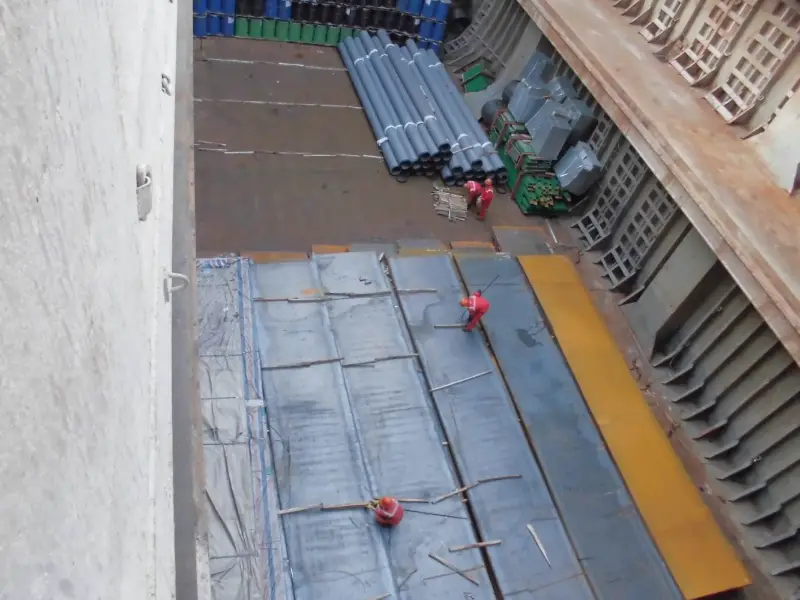
EN10225 S460G2+M High-Strength Shipbuilding Steel
EN10225 S460G2+M High-Strength Shipbuilding Steel for Offshore Structures
Detailed material data for EN 10225 S460G2+M thermomechanically rolled steel including chemistry, mechanical and physical properties, equivalents, and application guidance.
Hot-rolling, thermomechanical rolling, welding, cold forming (with restrictions), cutting
- Phone : +8618037372205
- Email : [email protected]
- WhatsApp: Contact via Whtsapp
- WeChat: +8618037372205
EN10225 S460G2+M High-Strength Shipbuilding Steel Introduction
S460G2+M is a high-strength weldable structural steel defined in EN 10225 for fixed offshore structures. Delivered in the thermomechanically rolled (+M) condition, it offers a minimum yield strength of 460 MPa (for thickness ≤16 mm), excellent toughness at -20 °C, and good weldability. The steel is designed for critical marine and offshore applications where high strength, ductility, and resistance to brittle fracture are essential. Its low carbon equivalent and fine-grain microstructure ensure reliable performance in harsh environments.
EN10225 S460G2+M High-Strength Shipbuilding Steel Chemical Composition per EN 10225
Unless otherwise agreed, the chemical composition shall comply with the cast analysis limits below. The steel is fully killed and fine-grain treated. Elements not listed are kept at residual levels only. The carbon equivalent value (CEV) typically does not exceed 0.43%.
| Element | Standard Value (%) | Remarks |
|---|---|---|
| Carbon (C) | ≤ 0.14 | max |
| Silicon (Si) | 0.15 – 0.55 | |
| Manganese (Mn) | 0.85 – 1.65 | |
| Phosphorus (P) | ≤ 0.020 | max |
| Sulfur (S) | ≤ 0.010 | max |
| Chromium (Cr) | ≤ 0.25 | max |
| Molybdenum (Mo) | ≤ 0.25 | max |
| Nickel (Ni) | ≤ 0.30 | max |
| Copper (Cu) | ≤ 0.30 | max |
| Nitrogen (N) | ≤ 0.010 | max |
| Vanadium (V) | ≤ 0.06 | max |
| Niobium (Nb) | ≤ 0.04 | max |
| Titanium (Ti) | ≤ 0.025 | max |
| Aluminium (Al_ total) | ≥ 0.015 | min, for grain refinement |
| Boron (B) | ≤ 0.0005 | if added |
EN10225 S460G2+M High-Strength Shipbuilding Steel Thermal and Electrical Physical Properties
These values are typical for normalized/thermomechanical rolled C-Mn structural steels and are not part of the EN 10225 mandatory requirements. They are suitable for design calculations and are valid at ambient temperature except where indicated.
| Property | Typical Value | Unit | Test Condition / Remarks |
|---|---|---|---|
| Density (ρ) | 7.85 | g/cm³ | 20 °C |
| Modulus of elasticity (E) | 205 | GPa | 20 °C |
| Shear modulus (G) | ≈ 80 | GPa | 20 °C, calculated from E and ν |
| Poisson's ratio (ν) | 0.3 | - | 20 °C |
| Thermal expansion coefficient (α) | 11.7 × 10⁻⁶ | K⁻¹ | 20 – 100 °C |
| Thermal conductivity (λ) | 45 | W/(m·K) | 20 °C |
| Specific heat capacity (c) | 460 | J/(kg·K) | 20 °C |
| Electrical resistivity (ρ_e) | 0.20 × 10⁻⁶ | Ω·m | 20 °C |
EN10225 S460G2+M High-Strength Shipbuilding Steel Mechanical Properties
The following tensile and impact properties apply to test pieces taken in the transverse direction from thermomechanically rolled (+M) product. Impact energy (KV) is specified at -20 °C (G2 designation) on longitudinal V-notch Charpy specimens. The actual minimum values depend on product thickness.
| Property | Specified Value | Unit | Test Condition / Thickness (t) |
|---|---|---|---|
| Yield strength (ReH) | ≥ 460 | MPa | t ≤ 16 mm |
| Yield strength (ReH) | ≥ 440 | MPa | 16 < t ≤ 25 mm |
| Yield strength (ReH) | ≥ 420 | MPa | 25 < t ≤ 40 mm |
| Yield strength (ReH) | ≥ 400 | MPa | 40 < t ≤ 63 mm |
| Yield strength (ReH) | ≥ 390 | MPa | 63 < t ≤ 80 mm |
| Yield strength (ReH) | ≥ 380 | MPa | 80 < t ≤ 100 mm |
| Tensile strength (Rm) | 530 – 720 | MPa | t ≤ 100 mm |
| Elongation (A) | ≥ 17 | % | 5.65√S₀ gauge, t ≤ 16 mm |
| Elongation (A) | ≥ 17 | % | 16 < t ≤ 25 mm |
| Elongation (A) | ≥ 18 | % | 25 < t ≤ 40 mm |
| Elongation (A) | ≥ 18 | % | 40 < t ≤ 63 mm |
| Elongation (A) | ≥ 19 | % | 63 < t ≤ 100 mm |
| Impact energy (KV) | ≥ 50 | J | -20 °C, longitudinal, t ≤ 150 mm |
| Bend test | No cracks | - | Mandrel diameter = 3t, 180° bending, t ≤ 40 mm |
EN10225 S460G2+M High-Strength Shipbuilding Steel Exact Equivalent Standards and Replaceable Grades
| Country/Region | Standard | Grade | Remarks |
|---|---|---|---|
| United Kingdom | BS EN 10225 | S460G2+M | Identical to EN 10225 |
| Germany | DIN EN 10225 | S460G2+M | Identical to EN 10225 |
| France | NF EN 10225 | S460G2+M | Identical to EN 10225 |
| Italy | UNI EN 10225 | S460G2+M | Identical to EN 10225 |
| Spain | UNE EN 10225 | S460G2+M | Identical to EN 10225 |
| Sweden | SS-EN 10225 | S460G2+M | Identical to EN 10225 |
| International | ISO 20340 (draft concept) | S460G2+M | Proposed international alignment |
EN10225 S460G2+M High-Strength Shipbuilding Steel Application Introduction
S460G2+M is used in welded offshore structures where high strength, good toughness at sub-zero temperatures, and through-thickness properties are required. Its thermomechanical processing ensures a fine grain size and low carbon equivalent, which facilitates excellent weldability and resistance to brittle fracture. The steel is typically supplied as coils or cut-to-length plate, and can be further processed by cold forming (within limitations) and welded with standard procedures.
Product Applications: Jacket legs and braces for offshore platforms, Deck beams and stiffeners, Node cans (thick wall cans for joints), Wind turbine tower adapters and flanges, Heavy-lift crane booms and outriggers
Processed into products: Tubular joints and Y/K nodes, Shear plates and gusset plates, Hinged structural connections, Load-bearing end-plates, Marine fender frames, Subsea structural frames
Application industries: Offshore oil and gas platform construction, Offshore wind energy (monopiles, transition pieces, jackets), Shipbuilding (hull, deck, and structural members), Marine heavy lifting and crane manufacturing, Civil engineering in marine environments (bridges, lock gates)
EN10225 S460G2+M High-Strength Shipbuilding Steel Similar or Closely Equivalent Substitute Materials
| Country/Region | Standard | Grade | Remarks |
|---|---|---|---|
| Europe | EN 10225 | S460G1+M | Same strength, impact temperature -10 °C |
| Europe | EN 10225 | S460G3+M | Same strength, impact temperature -40 °C |
| Europe | EN 10025-6 | S460QL | Quenched and tempered offshore steel, similar strength but different delivery condition |
| Europe | EN 10225 | S420G2+M | Lower minimum yield strength (420 MPa), similar toughness requirement |
| USA | API 2W | Grade 50 (345 MPa) | Lower strength, not an exact match; for welded tubular structures |
| Norway | DNV | NV E460 | Ship/offshore classification society grade, comparable strength and toughness |
Notes:
- Welding: S460G2+M has a maximum carbon equivalent (CEV) of 0.43% and is easily welded using all common processes. Preheat may be required for thick sections or high hydrogen conditions.
- Cold forming: Permissible deformation depends on thickness and notch toughness requirements; consult EN 10225 for limiting r/t ratios.
- Through-thickness properties: If Z-quality is needed, order e.g. S460G2+M-Z15, -Z25, or -Z35 according to EN 10164.
- Surface condition: Supplied as-rolled or with corrosion protection primer upon agreement.
- Share



