
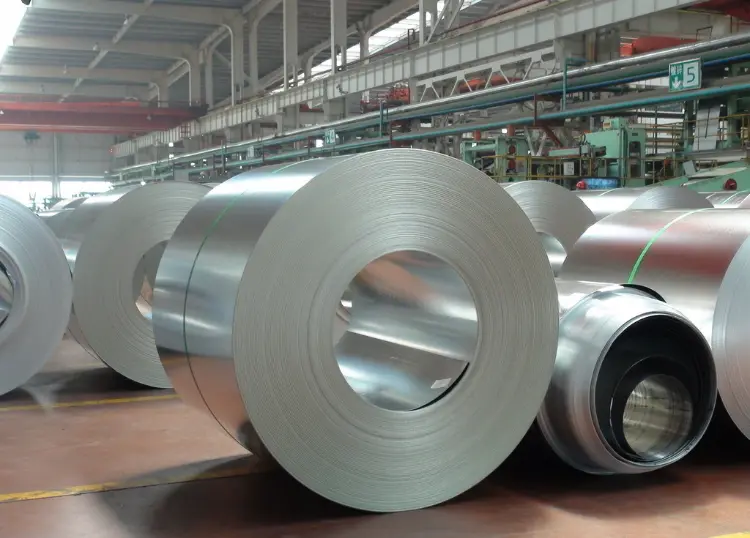
EN10225 S460G1+QT Shipbuilding Steel Coil
EN10225 S460G1+QT Shipbuilding Steel Coil - High-Strength Offshore Structural Steel
Detailed material properties of S460G1+QT steel coil: chemical composition, mechanical and thermal properties, international equivalents, and application guidance for fixed offshore structures.
Hot rolling followed by quenching and tempering; suitable for welding, cold forming, cutting, and machining
- Phone : +8618037372205
- Email : [email protected]
- WhatsApp: Contact via Whtsapp
- WeChat: +8618037372205
EN10225 S460G1+QT Shipbuilding Steel Coil Introduction
S460G1+QT is a high-strength, weldable structural steel supplied in the quenched and tempered condition under EN 10225-1. It is specifically designed for fixed offshore structures, including ship hulls, platforms, and wind turbine foundations. The steel offers a minimum yield strength of 460 MPa, combined with excellent toughness at low temperatures down to -40°C. Its balance of strength, ductility, and weldability meets the stringent requirements of the offshore industry, where structural integrity under harsh marine environments is critical. The +QT designation indicates that the material is quenched and tempered, resulting in a fine-grained martensitic–bainitic microstructure that provides superior strength-to-weight ratio. Typical thicknesses range up to 150 mm in plate form, and the coil format allows efficient fabrication of large welded assemblies.
EN10225 S460G1+QT Shipbuilding Steel Coil Chemical Composition
The chemical composition of S460G1+QT is tightly controlled to ensure consistent quenched and tempered properties and excellent weldability. The following limits are per EN 10225-1:2009 for ladle analysis. Carbon equivalent (CEV) is also restricted to guarantee cold cracking resistance during welding.
| Element | Standard Value (max, unless range given) | Remarks |
|---|---|---|
| Carbon (C) | ≤0.18 | Critical for hardenability and weldability |
| Silicon (Si) | ≤0.55 | Deoxidizer and strength enhancer |
| Manganese (Mn) | 1.00 – 1.70 | Improves hardenability and notch toughness |
| Phosphorus (P) | ≤0.020 | Strictly limited for toughness |
| Sulfur (S) | ≤0.010 | Low sulfur for lamellar tearing resistance |
| Chromium (Cr) | ≤0.25 | Added for hardenability |
| Molybdenum (Mo) | ≤0.08 | Increases tempering resistance |
| Nickel (Ni) | ≤0.70 | Improves low-temperature toughness |
| Copper (Cu) | ≤0.30 | May be present as residual |
| Niobium (Nb) | ≤0.04 | Microalloying for grain refinement |
| Vanadium (V) | ≤0.08 | Strengthening by carbonitride precipitation |
| Titanium (Ti) | ≤0.025 | Grain refinement and nitrogen fixation |
| Aluminum (Altot) | ≥0.020 | Deoxidation and fine-grained practice |
| Nitrogen (N) | ≤0.012 | Controlled to avoid strain aging |
| Carbon Equivalent (CEV) | ≤0.45 (typical) | CEV = C + Mn/6 + (Cr+Mo+V)/5 + (Ni+Cu)/15 |
EN10225 S460G1+QT Shipbuilding Steel Coil Physical and Thermal Properties
These physical constants are general guidance values for quenched and tempered structural steels and are not mandatory per EN 10225. They are useful for engineering calculations involving thermal stress, deformation, and electrical resistance. Slight variations may occur depending on exact composition and heat treatment.
| Property | Typical Value | Unit | Remarks / Test Condition |
|---|---|---|---|
| Density (ρ) | 7.85 | g/cm³ | at 20°C |
| Elastic modulus (E) | 210 | GPa | Static tensile test |
| Shear modulus (G) | ≈ 80 | GPa | Calculated; G = E/[2(1+ν)] |
| Poisson ratio (ν) | 0.3 | — | Typical for steel |
| Thermal expansion coefficient (α) | 12.0 | x10⁻⁶/K | 20–100°C |
| Thermal expansion coefficient (α) | 13.0 | x10⁻⁶/K | 20–200°C |
| Thermal expansion coefficient (α) | 14.0 | x10⁻⁶/K | 20–400°C |
| Thermal conductivity (λ) | 45 | W/(m·K) | at 20°C |
| Thermal conductivity (λ) | 42 | W/(m·K) | at 100°C |
| Specific heat capacity (cp) | 460 | J/(kg·K) | at 20–100°C |
| Electrical resistivity (ρe) | 0.20 – 0.25 | Ω·mm²/m | at 20°C |
EN10225 S460G1+QT Shipbuilding Steel Coil Mechanical Properties – Longitudinal Direction
The following minimum requirements apply to S460G1+QT steel in the quenched and tempered condition per EN 10225-1. Tensile properties depend on product thickness. Impact testing is carried out at -40°C on longitudinal Charpy V-notch specimens. Adequate ductility ensures structural safety even at low service temperatures.
| Property | Value | Unit | Test Condition / Thickness Range |
|---|---|---|---|
| Yield strength (ReH) min. | 460 | MPa | t ≤ 16 mm |
| Yield strength (ReH) min. | 440 | MPa | 16 < t ≤ 40 mm |
| Yield strength (ReH) min. | 420 | MPa | 40 < t ≤ 63 mm |
| Yield strength (ReH) min. | 400 | MPa | 63 < t ≤ 80 mm |
| Yield strength (ReH) min. | 390 | MPa | 80 < t ≤ 100 mm |
| Tensile strength (Rm) | 550 – 720 | MPa | t ≤ 100 mm |
| Elongation (A) min. | 17 | % | t ≤ 40 mm; gauge length 5.65√S₀ |
| Elongation (A) min. | 17 | % | 40 < t ≤ 63 mm |
| Elongation (A) min. | 16 | % | 63 < t ≤ 100 mm |
| Impact energy (KV₂) min. | 50 | J | Longitudinal, -40°C; average of 3 specimens |
| Bend test | Not specified; suitable for cold forming | — | Bending radius per agreement |
EN10225 S460G1+QT Shipbuilding Steel Coil Completely Equivalent Material Standards and Designations
| Country/Region | Standard | Designation | Remarks |
|---|---|---|---|
| Europe | EN 10225-1 | S460G1+QT | Original standard; all EU national adoptions are identical |
| United Kingdom | BS EN 10225-1 | S460G1+QT | British adoption of EN 10225-1 |
| France | NF EN 10225-1 | S460G1+QT | French adoption |
| Germany | DIN EN 10225-1 | S460G1+QT | German adoption |
| Italy | UNI EN 10225-1 | S460G1+QT | Italian adoption |
| Spain | UNE EN 10225-1 | S460G1+QT | Spanish adoption |
| Sweden | SS EN 10225-1 | S460G1+QT | Swedish adoption |
| Poland | PN EN 10225-1 | S460G1+QT | Polish adoption |
| Netherlands | NEN EN 10225-1 | S460G1+QT | Dutch adoption |
EN10225 S460G1+QT Shipbuilding Steel Coil Application Introduction
S460G1+QT is primarily used in offshore and marine engineering where high strength, low-temperature toughness, and weldability are essential. Its high yield strength allows for weight reduction in structures, lowering total construction costs. Processing must respect the heat input during welding and the tempering temperature of the +QT condition to avoid softening.
Product Applications: Structural steel coils and cut-to-length plates, Welded hollow sections (when produced from plate), Rolled beams and columns (by fabrication), Deck plates, stiffeners, and bulkheads, Node joints for jacket structures
Processed into products: Offshore platform legs and braces, Wind turbine monopiles and transition pieces, Ship hull plating and stiffening girders, Crane pedestals and A-frames, Mooring components and anchor piles, Pressure hull reinforcements, Bulkhead panels in ice-class vessels
Application industries: Offshore oil & gas (fixed platforms, floating production systems), Renewable energy (offshore wind turbine foundations and towers), Shipbuilding and marine engineering (ice-breakers, heavy-lift vessels), Bridge construction (truss and box girders), Heavy machinery and crane booms, Pressure vessels and storage tanks (offshore)
EN10225 S460G1+QT Shipbuilding Steel Coil Closely Related / Substitutable Materials
| Country/Region | Standard | Designation | Similarity and Differences |
|---|---|---|---|
| Europe | EN 10025-6 | S460Q / S460QL / S460QL1 | Same yield strength level, quenched and tempered, but intended for general structural and heavy equipment; toughness levels and thickness limitations may differ. |
| Europe | EN 10225-2 | S460G2+M | Thermomechanically rolled version; yield strength is similar but delivered in +M condition; not exactly interchangeable with +QT due to processing and property differences. |
| USA | ASTM A514 / A517 | Grade H / Grade F (e.g., A514 Gr. H, 690 MPa YS) | Higher yield strength grades (690 MPa) but with similar weldable quenched and tempered properties; used in offshore construction. |
| USA | ASTM A572 / A709 | Grade 50 (345 MPa) | Lower strength level; cannot directly replace S460G1+QT without redesign, but may be used in less critical structural elements. |
| International | API Specification 2W | Grade 50 (345 MPa) / Grade 60 (415 MPa) | Steel for offshore structures; Grade 60 approaches 460 MPa but is not identical; requires careful property comparison. |
| Japan | JIS G 3106 | SM490Y (355 MPa) / SM570 (460 MPa) | SM570 is a 460 MPa class steel, thermomechanically rolled or normalized; not a direct QT equivalent but can be considered after qualification. |
Notes:
Welding of S460G1+QT requires precise control of preheat and interpass temperatures to avoid hydrogen cracking and loss of heat-affected zone toughness. The recommended heat input ranges from 1.5 to 4.0 kJ/mm. Post-weld heat treatment (PWHT) is generally not required, but if stress relieving is performed, the temperature must remain sufficiently below the tempering temperature (typically ≤570°C). The steel is supplied with inspection documents per EN 10204 Type 3.1 or 3.2. Always consult the latest standard and material certificates for the exact lot-specific properties. The values provided herein are for reference and may vary with product thickness and actual processing conditions.
- Share



