
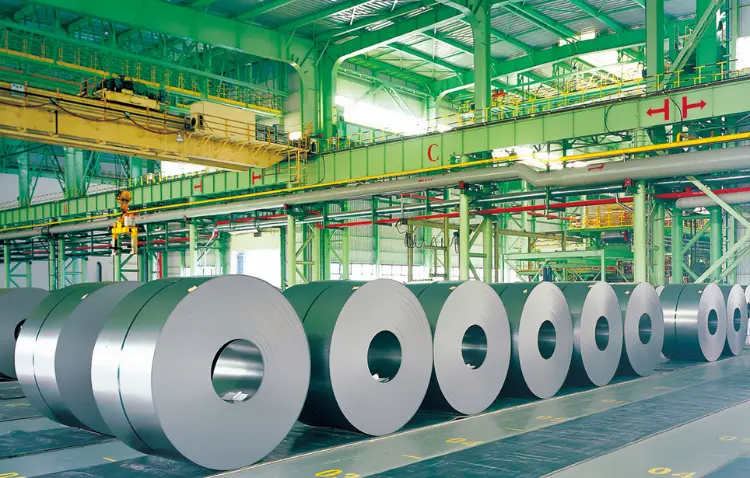
EN10225 S460G1+M Shipbuilding Steel Coil
EN10225 S460G1+M Shipbuilding Steel Coil | Comprehensive Material Data for Offshore Structures
Detailed technical specifications for EN 10225 S460G1+M steel coil, including chemical composition, mechanical properties, physical constants, and equivalent grades for marine and offshore engineering.
Thermo-mechanical controlled rolling (+M), suitable for cold forming, cutting, welding, and machining
- Phone : +8618037372205
- Email : [email protected]
- WhatsApp: Contact via Whtsapp
- WeChat: +8618037372205
EN10225 S460G1+M Shipbuilding Steel Coil Introduction
EN 10225 S460G1+M is a normalized or thermo-mechanically rolled weldable structural steel grade specifically designed for fixed offshore structures. It belongs to the high-strength low-alloy (HSLA) category with a minimum yield strength of 460 MPa in the as-delivered condition (+M, thermo-mechanical controlled process).
The steel exhibits excellent toughness at sub-zero temperatures, with guaranteed Charpy impact values down to -40 °C, making it suitable for harsh marine environments. Its chemical composition is strictly controlled with low carbon and alloying additions, ensuring good weldability and resistance to brittle fracture.
- High strength combined with good ductility and through-thickness properties.
- Complies with strict offshore regulations, often exceeding common shipbuilding steel standards.
- Available in plate and coil form, with TMCP delivery condition providing fine-grained microstructure and uniform mechanical properties.
EN10225 S460G1+M Shipbuilding Steel Coil Chemical Composition
The chemical composition complies with EN 10225 for grade S460G1 in the +M condition. Low carbon and controlled levels of microalloying elements (Nb, V, Ti) ensure high strength with good weldability. Ceq is strictly limited to avoid cold cracking. Sulfur and phosphorus are kept at very low levels to improve toughness and through-thickness properties.
| Element | Standard Value (max or range) | Remarks |
|---|---|---|
| Carbon (C) | 0.14 max | |
| Silicon (Si) | 0.15 - 0.55 | |
| Manganese (Mn) | 1.00 - 1.70 | |
| Phosphorus (P) | 0.020 max | |
| Sulfur (S) | 0.010 max | |
| Chromium (Cr) | 0.25 max | |
| Nickel (Ni) | 0.70 max | |
| Molybdenum (Mo) | 0.25 max | |
| Copper (Cu) | 0.30 max | |
| Niobium (Nb) | 0.05 max | |
| Vanadium (V) | 0.10 max | |
| Titanium (Ti) | 0.025 max | |
| Aluminium (Al, total) | 0.020 min | Fine grain practice |
| Nitrogen (N) | 0.012 max | |
| CEV (Ceq) | 0.43 max | For thickness ≤ 63 mm; formula: C + Mn/6 + (Cr+Mo+V)/5 + (Ni+Cu)/15 |
EN10225 S460G1+M Shipbuilding Steel Coil Thermal and Electrical Physical Properties
The physical properties are typical for microalloyed structural steel and are provided for engineering calculations. These values are not part of the delivery inspection but are essential for design regarding thermal expansion, heat transfer, and weight estimation. Minor variations may occur depending on the exact melt composition.
| Property | Typical Value | Unit | Test Condition / Remarks |
|---|---|---|---|
| Density (ρ) | 7850 | kg/m³ | 20 °C |
| Modulus of Elasticity (E) | 210 | GPa | 20 °C |
| Shear Modulus (G) | 81 | GPa | 20 °C |
| Poisson's Ratio (ν) | 0.3 | — | 20 °C |
| Thermal Expansion Coefficient (α) | 11.1 | 10⁻⁶/K | Between 20 °C and 100 °C |
| Thermal Conductivity (λ) | 50 | W/(m·K) | 20 °C |
| Specific Heat Capacity (c) | 460 | J/(kg·K) | 20 °C |
| Electrical Resistivity (ρe) | 0.25 | 10⁻⁶ Ω·m | 20 °C |
EN10225 S460G1+M Shipbuilding Steel Coil Mechanical Properties
The mechanical properties are guaranteed for thermo-mechanically rolled products with thickness up to 63 mm. Transverse and longitudinal values may differ; the table below lists the most commonly specified longitudinal tensile and transverse impact requirements. Bending test is performed as per EN 10225 to verify formability.
| Property | Standard Requirement | Unit | Test Condition |
|---|---|---|---|
| Yield Strength (ReH) | 460 min | MPa | Longitudinal, thickness ≤ 63 mm |
| Tensile Strength (Rm) | 540 - 720 | MPa | Longitudinal, thickness ≤ 63 mm |
| Elongation (A) | 17 min | % | Longitudinal, gauge length 5.65√So |
| Impact Energy (KV) | 50 min (average) / 35 min (single) | J | Transverse, -40 °C |
| Bend Test | No cracks or open defects | Mandrel diameter 3t (t = specimen thickness) for thickness ≤ 25 mm, bending angle 180° |
EN10225 S460G1+M Shipbuilding Steel Coil Completely Equivalent Material Standards and Replaceable Grades
Since S460G1+M is defined by a single European standard (EN 10225), the following designations are 100% identical because they refer to the same standard adopted by different national bodies. No metallurgical differences exist; only the prefix indicates the adopter.
| Country/Region | Standard | Grade | Remarks |
|---|---|---|---|
| European Union | EN 10225 | S460G1+M | Original standard |
| United Kingdom | BS EN 10225 | S460G1+M | British adoption |
| Germany | DIN EN 10225 | S460G1+M | German adoption |
| France | NF EN 10225 | S460G1+M | French adoption |
| Italy | UNI EN 10225 | S460G1+M | Italian adoption |
| Spain | UNE EN 10225 | S460G1+M | Spanish adoption |
| Sweden | SS EN 10225 | S460G1+M | Swedish adoption |
| International (ISO) | ISO 19902 (ref.) | S460G1+M | Referenced in offshore structure design code |
EN10225 S460G1+M Shipbuilding Steel Coil Application Introduction
S460G1+M is designed for demanding welded structures in the offshore and heavy marine sector. Its high yield strength and exceptional low-temperature toughness allow weight savings without compromising safety. The TMCP delivery condition ensures fine grain size and good weldability, often eliminating the need for post-weld heat treatment.
Product Applications: Coiled plates and strip for fabrication of tubulars, Discrete plates for stiffened panels and node cans, Wide flats for box girders and legs of self-elevating units, Slitted coils for narrow flange beams and channels
Processed into products: Jacket legs, braces, and node joints, Deck plate and stiffener assemblies, Monopile and transition piece shells, Ship side shells and deck stringers, Welded beam and column sections for offshore modules, Forged flanges and connectors (after appropriate conversion process)
Application industries: Offshore oil and gas platforms (jackets, topside modules, decks), Offshore wind turbine foundations (monopiles, transition pieces, jacket structures), Shipbuilding and heavy marine construction (hull reinforcement, deck plates, hatch covers), Bridge building (critical welded parts in cold climates), Pressure vessels and storage tanks for low-temperature service
EN10225 S460G1+M Shipbuilding Steel Coil Similar / Alternative Material Recommendations
The grades listed below are not identical but offer comparable minimum yield strength (≥ 450 MPa) and are used in heavy offshore or structural applications. Differences in chemistry, impact test temperature, delivery condition, and shape tolerance must be verified before substitution.
| Country/Region | Standard | Grade | Remarks |
|---|---|---|---|
| Japan | JIS G3106 | SM570 | Minimum ReH 460 MPa for thickness ≤ 100 mm; similar strength, but less strict offshore toughness requirements. |
| China | GB/T 712 | E460 | Shipbuilding steel with ReH ≥ 460 MPa; requires -40 °C impact for some grades. Deliver condition may be normalized or TMCP. |
| Norway / DNV | DNV Rules (Ship/Offshore) | NV E460 / VL E460 | Yield strength 460 MPa; toughness at -40 °C; used for marine structures. |
| USA | ASTM A913/A913M | Type 65 | High-strength low-alloy structural steel, ReH 450 MPa minimum; may be quenched-and-tempered, not identical TMCP. |
| USA | API 2W | Grade 60 with special chemistry | Offshore structural steel; typical yield ~415 MPa, but supplementary requirements can bring it closer to 460 MPa. Check chemistry and toughness. |
Notes:
- Welding: The low Ceq value and TMCP micro-structure allow welding with controlled heat input and low-hydrogen consumables. Preheating may be required for thicker sections or high restraint joints.
- Surface condition: As-rolled, shot-blasted, or primed, depending on the order. Check against EN 10225 for surface quality requirements (EN 10163).
- Internal soundness: Through-thickness properties (Z-quality) can be ordered as an option (e.g., Z25, Z35) for sections subject to high tensile stresses in the thickness direction.
- Certification: Supplied with inspection certificate type 3.1 or 3.2 according to EN 10204.
- Share



