
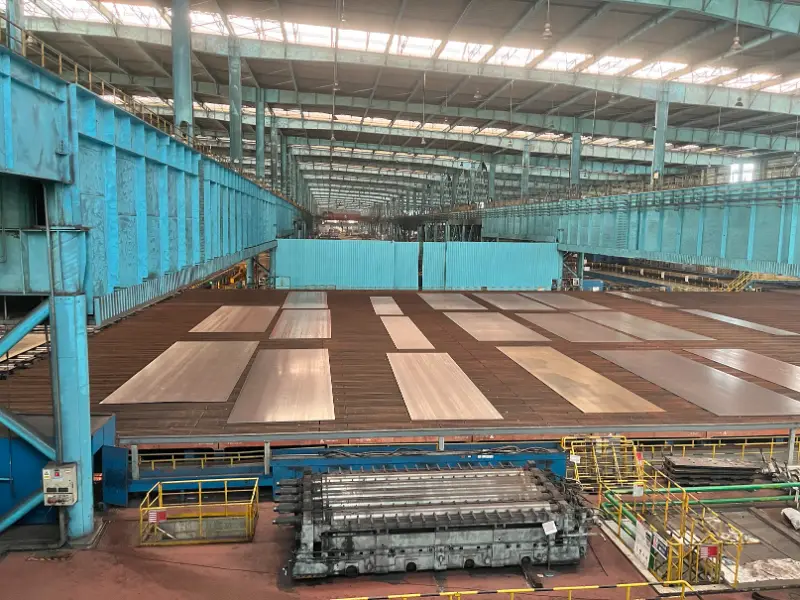
EN10225 S420G1+QT Offshore Structural Steel
EN10225 S420G1+QT Offshore Structural Steel - High Strength & Low-Temperature Toughness
Comprehensive technical data for S420G1+QT steel coil under EN 10225, covering chemical composition, mechanical properties, and thermal/electrical performance for offshore and marine engineering.
Cutting, cold forming, hot forming, welding, machining, shot blasting, priming
- Phone : +8618037372205
- Email : [email protected]
- WhatsApp: Contact via Whtsapp
- WeChat: +8618037372205
EN10225 S420G1+QT Offshore Structural Steel Introduction
S420G1+QT is a high-strength weldable structural steel specifically designed for fixed offshore structures. Supplied in the quenched and tempered (+QT) condition, it offers a minimum yield strength of 420 MPa for thicknesses up to 50 mm, combined with excellent toughness at low temperatures down to -40°C. The steel is produced to EN 10225:2009 (Weldable structural steels for fixed offshore structures – Technical delivery conditions). It features a fine-grain microstructure, low carbon equivalent, and strict limits on harmful elements such as phosphorus and sulfur, ensuring good weldability and resistance to brittle fracture. Available in flat products and coils, it is widely used in harsh marine environments for critical load-bearing components.
EN10225 S420G1+QT Offshore Structural Steel Chemical Composition
Limits according to EN 10225-2:2009 for grade S420G1. The steel is fully killed and fine-grain treated. Nb, V, Ti may be used individually or in combination for grain refinement. Al is added to ensure fine grain and deoxidation. Carbon equivalent (CEV) is controlled to guarantee weldability.
| Element | Standard Value (max unless range) | Remarks |
|---|---|---|
| C | ≤0.14 | Ladle analysis |
| Si | ≤0.50 | |
| Mn | ≤1.65 | For nominal thickness ≤40 mm may be increased to 1.70 |
| P | ≤0.020 | |
| S | ≤0.010 | |
| Cr | ≤0.30 | |
| Ni | ≤0.50 | Up to 0.70 permitted for certain products |
| Mo | ≤0.20 | |
| Cu | ≤0.30 | |
| Nb | ≤0.05 | Grain-refining element |
| V | ≤0.10 | Grain-refining element |
| Ti | ≤0.03 | Grain-refining element |
| Al (total) | ≥0.015 | Minimum for fine-grain practice |
| N | ≤0.015 | When Al, V, Nb, Ti are present, N may be controlled |
| CEV | Typically ≤0.43 | CEV = C + Mn/6 + (Cr+Mo+V)/5 + (Ni+Cu)/15, typical value for thickness ≤50 mm |
EN10225 S420G1+QT Offshore Structural Steel Typical Physical and Thermal Properties
These are representative values for low-alloy quenched and tempered structural steels similar to S420G1+QT. They are not specified in EN 10225 but are provided for design calculations. Density and elastic modulus are standard for steel. Thermal expansion and conductivity vary slightly with temperature; room-temperature values are given.
| Property | Typical Value | Unit | Test Condition / Remarks |
|---|---|---|---|
| Density (ρ) | 7850 | kg/m³ | At 20°C |
| Modulus of elasticity (E) | 205 – 210 | GPa | At 20°C, longitudinal |
| Shear modulus (G) | ≈ 81 | GPa | Calculated from E and ν |
| Poisson's ratio (ν) | 0.3 | – | In elastic range |
| Coefficient of thermal expansion (α) | 11.7 × 10⁻⁶ | K⁻¹ | Between 20°C and 100°C |
| Thermal conductivity (λ) | 45 – 50 | W/(m·K) | At 20°C |
| Specific heat capacity (cp) | ≈ 460 | J/(kg·K) | At 20°C |
| Electrical resistivity (ρₑ) | 0.20 – 0.25 | Ω·mm²/m | At 20°C |
EN10225 S420G1+QT Offshore Structural Steel Mechanical Properties
Minimum specified values for the quenched and tempered condition per EN 10225-2. Impact energy is guaranteed for longitudinal test pieces at -40°C (G1 quality). Bend test requires no cracks after 180° bending. Properties depend on product thickness; multiple thickness ranges are supplied.
| Property | Requirement | Unit | Test Condition / Thickness |
|---|---|---|---|
| Yield strength (ReH) | ≥420 | MPa | t ≤ 50 mm |
| Yield strength (ReH) | ≥390 | MPa | 50 < t ≤ 100 mm |
| Tensile strength (Rm) | 520 – 680 | MPa | t ≤ 50 mm |
| Tensile strength (Rm) | 500 – 660 | MPa | 50 < t ≤ 100 mm |
| Elongation (A) | ≥18 | % | Gauge length 5.65√So, t ≤ 50 mm |
| Elongation (A) | ≥18 | % | 50 < t ≤ 100 mm |
| Impact energy (KV, -40°C) | ≥50 | J | Longitudinal, V-notch, average of 3 tests |
| Impact energy (KV, -40°C) | ≥34 | J | Individual minimum value |
| Bend test, 180° | No cracks | – | Mandrel diameter: 3t (t ≤ 50 mm), 4t (50 < t ≤ 100 mm) |
EN10225 S420G1+QT Offshore Structural Steel Completely Equivalent Standards and Replaceable Grades
| Country/Region | Standard | Grade | Remarks |
|---|---|---|---|
| European Union | EN 10225:2009 | S420G1+QT | Original designation, identical |
| International | ISO 19901-1:2015 | S420G1+QT | Direct adoption of EN 10225 grade for offshore structures |
| United Kingdom | BS EN 10225:2009 | S420G1+QT | British adoption, fully identical |
| Norway | NS-EN 10225 | S420G1+QT | Norwegian standard, identical |
EN10225 S420G1+QT Offshore Structural Steel Application Introduction
S420G1+QT is extensively used in offshore and marine engineering where a combination of high strength, good weldability, and reliable low-temperature toughness is required. Its fine-grain quenched and tempered microstructure provides excellent resistance to fatigue and brittle fracture. The steel is suitable for welded fabrications in harsh, corrosive environments and can be formed into heavy sections, tubular joints, and stiffened panels.
- Fixed offshore platforms – primary structural members, legs, bracings, deck structures
- Wind turbine foundations – monopiles, transition pieces, jackets
- Shipbuilding – heavy lift vessel hulls, ice-class ship structures
- Subsea equipment – templates, manifolds, protection structures
Product Applications: Offshore platform jacket structures, Topside modules and decks, Monopile and transition piece for wind turbines, Heavy lift ship hulls and decks, Jack-up rig legs and spudcans, Riser and conductor support frames, Subsea templates and manifolds
Processed into products: Tubular joints (Y, K, T joints), Stiffened panel plates for decks and bulkheads, Flanges and gusset plates, Crane pedestals and slewing rings, Mooring brackets and fairleads, Connectors and transition cones, Forged nodes and cast nodes
Application industries: Offshore Oil & Gas, Offshore Wind Energy, Shipbuilding and Marine Engineering, Civil Engineering (Marine Structures), Heavy Machinery (Crane Booms, Jack-Up Legs)
EN10225 S420G1+QT Offshore Structural Steel Similar / Alternative Grades for Reference
| Country/Region | Standard | Grade | Remarks |
|---|---|---|---|
| European Union | EN 10225 | S420G2+M (or +QT) | Higher toughness class (tested at -50°C) but similar strength; may be used for colder environments |
| European Union | EN 10225 | S460G1+QT | Next strength level (460 MPa yield), similar weldability, for higher loads |
| International | API 2W / 2Y | Gr. 50 / Gr. 60 | Grades for offshore structures with yield around 345–415 MPa; not direct equivalent but comparable in some thicknesses |
| USA | ASTM A572/A572M | Grade 50 [345] / 55 [380] | High-strength low-alloy structural steel; lower strength, but sometimes used in less critical marine applications |
| USA | ASTM A514/A517 | Grade E / P / Q | Quenched & tempered steel with 690 MPa yield; higher strength, but similar production route; requires careful welding procedure |
| China | GB/T 712 | DH36 / EH36 / FH36 | Shipbuilding high-strength steel with yield ≥355 MPa; good toughness, but lower strength, often used in hull structures |
Notes:
The steel must be ordered to EN 10225 with the full designation S420G1+QT, specifying product form and inspection level. Weldability: Preheating and interpass temperature control may be required based on thickness and carbon equivalent; suitable for all common welding processes (SMAW, SAW, GMAW, FCAW). Heat treatment: +QT condition implies quenching (water or oil) followed by tempering above 580°C. Stress relief heat treatment (SRHT) below the tempering temperature is possible if agreed. Testing: Ultrasonic testing according to EN 10160 or client specification is common for critical applications. Material certificates according to EN 10204 type 3.1 or 3.2 are standard. For sour service or special corrosive environments, supplementary HIC/SSC testing may be required.
- Share



