
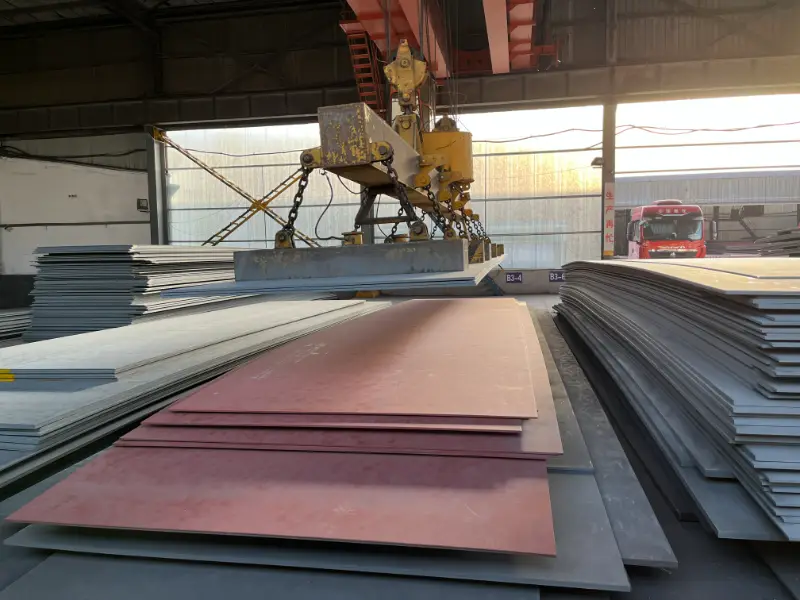
EN10225 S420G1+M Offshore Structural Steel
EN 10225 S420G1+M Shipbuilding Steel Coil – High Strength Offshore Structural Steel
Comprehensive data on EN 10225 S420G1+M shipbuilding steel coil: chemical composition, mechanical and thermal properties, international equivalents, and application guide for offshore and marine structures.
Thermomechanical rolling, cold forming, welding, machining, cutting, bending
- Phone : +8618037372205
- Email : [email protected]
- WhatsApp: Contact via Whtsapp
- WeChat: +8618037372205
EN10225 S420G1+M Offshore Structural Steel Introduction
EN 10225 S420G1+M is a weldable structural steel specifically designed for fixed offshore structures, compliant with the European standard EN 10225:2009. Delivered in the thermomechanically rolled (+M) condition, it offers a minimum yield strength of 420 MPa in thickness up to 40 mm, combined with excellent weldability and high resistance to brittle fracture even at low temperatures.
Key characteristics include:
- High yield and tensile strength for weight-efficient designs
- Very good notch toughness down to -40 °C (KV ≥ 50 J longitudinal)
- Strictly controlled chemical composition with low carbon equivalent to ensure weldability without preheat
- Fine-grained microstructure through thermomechanical rolling, eliminating the need for subsequent heat treatment
- Suitable for thick plates and coils used in offshore platforms, wind turbine foundations, and shipbuilding components
The +M designation indicates that the mechanical properties are achieved through a controlled rolling process with accelerated cooling, giving the steel its characteristic strength–toughness balance.
EN10225 S420G1+M Offshore Structural Steel Chemical Composition according to EN 10225-1:2009
The chemical composition of S420G1+M is tightly controlled to ensure weldability and low-temperature toughness. The maximum carbon equivalent (CEV) is usually ≤ 0.40% for thickness ≤ 40 mm. Microalloying elements like niobium, vanadium, and titanium are often added for grain refinement and precipitation strengthening. Typical values comply with the standard and support the +M delivery condition.
| Element | Specified Value (max, unless range) | Remarks |
|---|---|---|
| Carbon (C) | ≤ 0.14 % | Ladle analysis; lower carbon improves weldability |
| Silicon (Si) | ≤ 0.50 % | Deoxidizer |
| Manganese (Mn) | 0.90 – 1.65 % | Strength and toughness balance |
| Phosphorus (P) | ≤ 0.020 % | Controlled for low-temperature toughness |
| Sulfur (S) | ≤ 0.010 % | Very low; enhances ductility and through-thickness properties |
| Aluminium (Al, total) | ≥ 0.015 % | Grain refining element; ensures fine ferrite grain |
| Nitrogen (N) | ≤ 0.012 % | Binds with Al, V to form fine precipitates |
| Niobium (Nb) | ≤ 0.05 % | Microalloy; grain refinement and precipitation strengthening |
| Vanadium (V) | ≤ 0.10 % | Microalloy; optional for strength enhancement |
| Titanium (Ti) | ≤ 0.03 % | Grain refinement; also binds nitrogen |
| Copper (Cu) | ≤ 0.30 % | Low residual; controlled for welding |
| Chromium (Cr) | ≤ 0.25 % | Residual element |
| Nickel (Ni) | ≤ 0.30 % | Residual element |
| Molybdenum (Mo) | ≤ 0.10 % | Residual element |
| Ceq (IIW) | ≤ 0.40 % (typical) | Carbon equivalent for thickness ≤ 40 mm |
EN10225 S420G1+M Offshore Structural Steel Thermal and Electrical Physical Properties
The physical properties listed are typical for thermomechanically rolled structural steels at room temperature unless otherwise noted. These values are not mandatory in the delivery standard but are essential for design calculations in offshore engineering, including thermal expansion, heat transfer, and electrical behavior. Minor variations may occur depending on exact composition and processing.
| Property | Typical Value | Unit | Test Condition / Remarks |
|---|---|---|---|
| Density (ρ) | 7850 | kg/m³ | at 20 °C |
| Elastic modulus (E) | 210 | GPa | at 20 °C, tension |
| Shear modulus (G) | ~81 | GPa | Calculated from E and ν |
| Poisson's ratio (ν) | 0.3 | – | At room temperature |
| Coefficient of thermal expansion (α) | 12 × 10⁻⁶ | /K | 20–100 °C; 13 × 10⁻⁶ for 20–200 °C |
| Thermal conductivity (λ) | ~50 | W/(m·K) | at 20 °C; decreases with temperature |
| Specific heat capacity (cp) | ~460 | J/(kg·K) | At 20–100 °C |
| Electrical resistivity (ρ_e) | ~0.2 × 10⁻⁶ | Ω·m | At 20 °C |
EN10225 S420G1+M Offshore Structural Steel Mechanical Properties – S420G1+M
Mechanical properties are guaranteed for transverse (or longitudinal) test pieces according to EN 10225-1. The values below represent the specified minimum requirements for product thickness ≤ 40 mm. For larger thicknesses (40–63 mm) the minimum yield strength reduces to 390 MPa. Impact toughness at -40 °C is a key requirement for offshore service.
The thermomechanical rolling process (M) provides these properties without further heat treatment, enabling efficient fabrication.
| Property | Specified Requirement | Unit | Test Condition / Thickness |
|---|---|---|---|
| Yield Strength (ReH) | ≥ 420 | MPa | t ≤ 40 mm, transverse |
| Yield Strength (ReH) | ≥ 390 | MPa | 40 < t ≤ 63 mm, transverse |
| Tensile Strength (Rm) | 520 – 680 | MPa | t ≤ 63 mm, transverse |
| Elongation after fracture (A) | ≥ 19 | % | t ≤ 40 mm, gauge length 5.65√S₀, transverse |
| Elongation after fracture (A) | ≥ 18 | % | 40 < t ≤ 63 mm, transverse |
| Charpy-V Impact Energy (KV) | ≥ 50 | J | at -40 °C, longitudinal |
| Charpy-V Impact Energy (KV) | ≥ 33 | J | at -40 °C, transverse (if agreed) |
EN10225 S420G1+M Offshore Structural Steel Complete Equivalent Material Standards and Alternative Designations
S420G1+M is specifically defined in EN 10225; direct full equivalents in other national standards are rare due to unique requirements for offshore structures (e.g., carbon equivalent, impact toughness at -40 °C). The table below lists materials that are technically very similar or have been used as substitutions in past projects, but a detailed engineering assessment is recommended.
| Country/Region | Standard | Grade | Remarks |
|---|---|---|---|
| Europe | EN 10225-1 | S420G1+M | Original specification; thermomechanical rolled |
| United Kingdom (former) | BS 7191:1989 | 355EMZ | Obsolete; lower yield (355 MPa) but similar application |
| International (API) | API 2Y (1987) | Grade 50 | Used for offshore structures; yield ≥ 345-414 MPa, but different testing and chemistry. Not fully equivalent to +M. |
| Norway (NORSOK) | M-120 (rev. 4) | Y40 | Similar requirements, but S420G1+M is preferred under EN 10225 |
EN10225 S420G1+M Offshore Structural Steel Application Introduction
S420G1+M steel coils and plates are predominantly used in offshore and marine engineering where high strength, excellent weldability, and reliable low-temperature toughness are mandatory. The thermomechanical rolling process allows thinner sections can carry higher loads, reducing structural weight and welding volume. This grade is frequently selected for:
- Splash zone and submerged structural members of fixed offshore platforms
- Transition pieces, monopiles, and braces for offshore wind turbines
- Ship hulls, ice-going vessel reinforcement, and heavy-lift crane pedestals
- Nodes, tubular joints, and stiffeners in jacket structures
Typical end-use products include structural plates, welded beams, tubular columns, and cold-formed profiles. The steel can be processed by bending, flame cutting, and welding with appropriate consumables matching the -40 °C toughness requirement. Preheating is generally not required for thicknesses up to 40 mm under standard welding conditions, but a welding procedure specification should always be validated.
Product Applications: Hot-rolled coils and cut-to-length sheets, Structural plates for primary and secondary members, Welded tubular sections (pipes for jackets and piles), Cold-formed sections and profiles, Fabricated beams and girders
Processed into products: Jacket nodes and leg members, Deck plating for offshore platforms, Monopile foundations and transition pieces, Ship frames, bulkheads, and hull stiffeners, Boom and saddle structures for heavy-lift cranes
Application industries: Offshore oil and gas platforms, Marine and shipbuilding, Offshore wind energy, Heavy civil engineering (bridge structures in cold climates), Port and harbor crane manufacturing
EN10225 S420G1+M Offshore Structural Steel Similar / Alternative Material Recommendations
When S420G1+M is not available, the following grades may be considered as functional replacements, taking into account differences in mechanical properties, toughness, and weldability. Engineering judgment and qualification tests are advised.
| Country/Region | Standard | Grade | Remarks |
|---|---|---|---|
| Europe | EN 10225-1 | S420G2+M | Higher toughness (KV ≥ 60 J at -40 °C); otherwise similar chemistry and strength. Ideal substitute. |
| Europe | EN 10225-1 | S355G10+M | Lower yield (355 MPa); if strength reduction is acceptable, similar weldability and toughness. |
| Europe | EN 10025-4 | S420ML | Thermomechanical rolled steel for general structural use; similar strength but less strict offshore qualifications (e.g., through-thickness requirements). |
| Europe | EN 10149-2 | S420MC | High-strength low-alloy steel for cold forming; not intended for offshore welded structures but may be considered for non-critical parts. |
| USA | ASTM A572/A572M | Grade 65 (Type 2) | Yield 450 MPa; similar strength but higher carbon equivalent; check toughness requirements. |
| Japan | JIS G 3106 | SM520B/C | Tensile 520 MPa class; impact properties at 0 °C or -20 °C; not equivalent at -40 °C without special agreement. |
Notes:
Supplementary requirements: EN 10225 allows optional through-thickness tensile testing (Z-quality) to ensure lamellar tearing resistance – often specified for offshore applications as Z25 or Z35. The material may also be ordered with normalized rolled condition (+N) if required, but S420G1+M achieves its properties exclusively through thermomechanical rolling. For thicknesses above 63 mm, grade S420G1 is usually supplied in quenched and tempered (+Q) condition. Specific corrosion protection in the splash zone is achieved by coating, corrosion allowance design, or cathodic protection. All welding must follow approved procedures in accordance with EN 1090 or client specifications.
Data provided is for general information; always refer to the actual material certificate and project-specific standards.
- Share



