
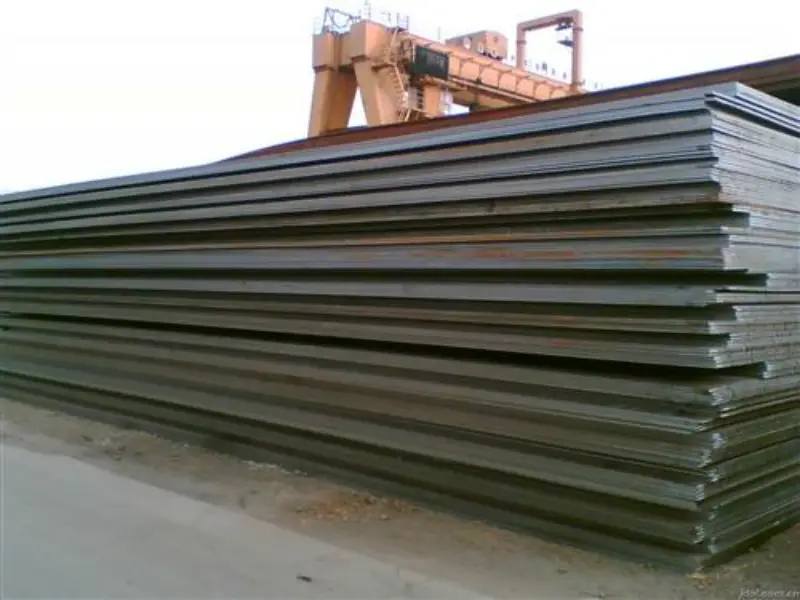
S420G2+M Offshore Structural Steel
S420G2+M Offshore Structural Steel: EN 10225 Grade for Shipbuilding and Marine Applications
Comprehensive data for EN 10225 S420G2+M steel coil: chemical composition, mechanical properties, physical performance, and global equivalents for offshore and shipbuilding applications.
Thermomechanical rolling (+M), cutting, welding, bending, cold forming
- Phone : +8618037372205
- Email : [email protected]
- WhatsApp: Contact via Whtsapp
- WeChat: +8618037372205
S420G2+M Offshore Structural Steel Introduction
EN 10225 S420G2+M is a weldable structural steel intended for fixed offshore structures, also widely used in shipbuilding and marine engineering. It is delivered in the thermomechanically rolled condition (+M), which provides a fine-grained microstructure, excellent strength, and superior toughness at low temperatures. The 'S' denotes structural steel, '420' indicates a minimum yield strength of 420 MPa for thicknesses up to 40 mm, 'G2' designates a quality level with guaranteed impact toughness at -20°C, and '+M' specifies the thermomechanical rolling process. This grade is designed for critical welded connections in harsh marine environments, offering high resistance to brittle fracture and fatigue. It is commonly supplied as coil, plate, or sections and is suitable for heavy fabrication such as jackets, topsides, and wind turbine foundations. The steel meets strict requirements for through-thickness properties (Z-quality optional) and is weldable by all standard methods with appropriate consumables. Its balanced chemical composition, controlled rolling, and fine grain size ensure consistent performance even in thick sections. Compliance with EN 10225 ensures traceability and quality assurance from approved manufacturers, making S420G2+M a reliable choice for demanding maritime infrastructure.
S420G2+M Offshore Structural Steel Chemical composition
The chemical composition of S420G2+M is controlled to ensure weldability, toughness, and strength. Maximum limits are specified for harmful elements (P, S) and alloying elements. Carbon equivalent (CEV) is restricted to ≤0.43% for thickness ≤40 mm to guarantee weldability. Grain-refining elements such as Al, Nb, and V are added to achieve fine grain size. The +M rolling condition does not alter the chemical analysis requirements; it only governs the processing path.
| Element | Standard Value (max % unless range) | Remarks |
|---|---|---|
| C | ≤ 0.12 | For thickness ≤ 40 mm |
| Si | ≤ 0.55 | |
| Mn | ≤ 1.60 | Higher Mn permitted with CEV control |
| P | ≤ 0.025 | Reduced for better toughness |
| S | ≤ 0.020 | Enhanced for Z-quality options |
| Al (total) | 0.015 – 0.06 | Min 0.015% for grain refinement |
| Nb | ≤ 0.05 | Fine grain and precipitation strengthening |
| V | ≤ 0.10 | Optional strengthening element |
| Ti | ≤ 0.05 | Deoxidation and grain refinement |
| Cu | ≤ 0.35 | May be present from scrap |
| Cr | ≤ 0.25 | Residual element |
| Ni | ≤ 0.30 | May be added for toughness |
| Mo | ≤ 0.10 | Residual limit |
| N | ≤ 0.015 | Unless adequate Al is present |
| CEV | ≤ 0.43 | CEV = C+Mn/6+(Cr+Mo+V)/5+(Ni+Cu)/15, applies for t ≤ 40 mm |
S420G2+M Offshore Structural Steel Thermal and electrical physical properties
Physical properties are based on typical carbon-manganese structural steel values. These data are not specified in EN 10225 but are useful for design calculations. Thermal expansion and thermal conductivity affect welding distortion and heat transfer. Density and elastic moduli are essential for structural analysis. Electrical resistivity influences cathodic protection design. All values are approximate for temperatures around 20°C unless stated.
| Property | Reference Value | Unit | Test Conditions / Remarks |
|---|---|---|---|
| Density (ρ) | 7850 | kg/m³ | At 20°C |
| Modulus of elasticity (E) | 210 | GPa | Tension, at 20°C |
| Shear modulus (G) | 81 | GPa | Calculated from E and ν |
| Poisson's ratio (ν) | 0.3 | - | Elastic range |
| Thermal expansion coefficient (α) | 11.7 | 10⁻⁶/°C | From 20°C to 100°C |
| Thermal expansion coefficient (α) | 12.2 | 10⁻⁶/°C | From 20°C to 200°C |
| Thermal expansion coefficient (α) | 13.0 | 10⁻⁶/°C | From 20°C to 400°C |
| Thermal conductivity (λ) | 52 | W/(m·K) | At 20°C |
| Thermal conductivity (λ) | 48 | W/(m·K) | At 100°C |
| Specific heat capacity (c) | 460 | J/(kg·K) | At 20°C – 100°C |
| Electrical resistivity (ρₑ) | 0.23 | μΩ·m | At 20°C (approximate) |
S420G2+M Offshore Structural Steel Mechanical properties
Mechanical properties are guaranteed by EN 10225 for the +M delivery condition. Yield strength (ReH) and tensile strength (Rm) vary with product thickness. Minimum elongation reflects good ductility. The G2 grade requires minimum impact energy of 60 J at -20°C for transverse Charpy V-notch specimens (size 10x10 mm) for thickness ≤50 mm. Bending tests confirm sufficient formability. All values are minimum unless stated otherwise.
| Property | Standard Requirement (min. unless stated) | Unit | Test Conditions |
|---|---|---|---|
| Yield strength ReH | 420 | MPa | Thickness ≤ 40 mm; transverse |
| Yield strength ReH | 400 | MPa | 40 < t ≤ 63 mm; transverse |
| Yield strength ReH | 390 | MPa | 63 < t ≤ 80 mm; transverse |
| Yield strength ReH | 380 | MPa | 80 < t ≤ 100 mm; transverse |
| Yield strength ReH | 370 | MPa | 100 < t ≤ 120 mm; transverse |
| Tensile strength Rm | 500 – 660 | MPa | Thickness ≤ 40 mm; transverse |
| Tensile strength Rm | 480 – 640 | MPa | 40 < t ≤ 63 mm; transverse |
| Tensile strength Rm | 470 – 630 | MPa | 63 < t ≤ 80 mm; transverse |
| Tensile strength Rm | 460 – 620 | MPa | 80 < t ≤ 100 mm; transverse |
| Tensile strength Rm | 450 – 600 | MPa | 100 < t ≤ 120 mm; transverse |
| Elongation A (L₀=5.65√S₀) | 23 | % | Thickness ≤ 40 mm; transverse |
| Elongation A (L₀=5.65√S₀) | 22 | % | 40 < t ≤ 63 mm; transverse |
| Elongation A (L₀=5.65√S₀) | 21 | % | 63 < t ≤ 100 mm; transverse |
| Elongation A (L₀=5.65√S₀) | 19 | % | 100 < t ≤ 120 mm; transverse |
| Charpy impact energy KV₂ (10x10) | 60 | J | Transverse, -20°C; t ≤ 50 mm |
| Charpy impact energy KV₂ (10x10) | 50 | J | Transverse, -20°C; 50 < t ≤ 120 mm (option agreed) |
| Bend test (180° or per standard) | No cracks | - | Mandrel diameter per thickness ratio |
S420G2+M Offshore Structural Steel Fully equivalent material standards and replaceable grades
| Country/Region | Standard | Grade | Remarks |
|---|---|---|---|
| European Union | EN 10225 | S420G2+M | Original specification |
| United Kingdom | BS EN 10225 | S420G2+M | Identical adoption of EN 10225 |
| Germany | DIN EN 10225 | S420G2+M | Identical adoption |
| France | NF EN 10225 | S420G2+M | Identical adoption |
| Italy | UNI EN 10225 | S420G2+M | Identical adoption |
| Spain | UNE EN 10225 | S420G2+M | Identical adoption |
| Sweden | SS-EN 10225 | S420G2+M | Identical adoption |
| Norway | NS-EN 10225 | S420G2+M | Identical adoption, widely used in offshore sector |
| Netherlands | NEN-EN 10225 | S420G2+M | Identical adoption |
| Belgium | NBN EN 10225 | S420G2+M | Identical adoption |
| Poland | PN-EN 10225 | S420G2+M | Identical adoption |
S420G2+M Offshore Structural Steel Application Introduction
S420G2+M steel is engineered for welded structures in marine and offshore environments where high strength, excellent low-temperature toughness, and reliable weldability are essential. Its combination of properties makes it suitable for fabrication of heavy, dynamically loaded components exposed to seawater and harsh weather. Typical applications include primary structural members of fixed platforms, ship hulls, and renewable energy foundations. The material can be cut, formed, and welded using standard shop practices, provided preheating and interpass temperature recommendations are followed. When through-thickness properties are critical (e.g., for tubular joints), Z-quality options should be specified. Designers should consult EN 10225 for detailed processing guidelines.
Product Applications: Heavy plate and coil (for cutting, bending, rolling, and assembly), Welded beams and columns (built-up H-sections, box girders), Tubular components (jacket legs, braces, piles, transition pieces), Offshore platform modules (deck frameworks, equipment support structures), Ship sections (for block construction method), Wind tower flanges and base rings
Processed into products: Jacket leg can nodes and stiffened plates, Topside module main girders and column splices, Ice belt strakes for ice-class vessels, Bilge keel connections, Fairlead and bollard foundation plates, Crane pedestal base rings, Transition piece ring stiffeners and brackets, Monopile door frames and grillage beams, Padeyes and lifting lugs (with Z-quality), Grillage beams for heavy equipment mounting
Application industries: Offshore oil and gas (fixed platforms, jackets, topsides, bridges, flare booms), Shipbuilding (main decks, bottom plates, frames, bulkheads for large vessels, ice-class ships), Marine civil engineering (coastal bridges, locks, gates, port cranes, breakwaters), Renewable energy (offshore wind turbine monopiles, transition pieces, jackets), Heavy machinery (marine crane pedestals, mining dump bodies if corrosion from seawater is a factor), Military shipbuilding (surface combatants, auxiliary vessels, submarine pressure hulls with appropriate modifications)
S420G2+M Offshore Structural Steel Similar or substitute grades
| Country/Region | Standard | Grade | Remarks |
|---|---|---|---|
| USA | ASTM A572/A572M | Grade 60 [415] | Yield strength comparable, but not specifically for offshore; no Z-quality requirement; lower toughness at low temperature. Not a direct substitute without additional requirements. |
| USA | API 2H | Grade 50 (modified 50) | Offshore structural steel; yield strength 414 MPa min; good toughness and through-thickness properties; widely accepted in offshore, but requires supplementary fracture toughness assessment. |
| EU | EN 10025-3 | S420N / S420M / S420ML | Thermomechanical rolled fine-grain structural steel; similar strength, but not intended for offshore with specific weldability and Z-quality demands; impact toughness at -50°C for ML variant. |
| UK (former) | BS 7191 | 355EM / 355EMZ | Older offshore steel grade; yield 355 MPa – lower strength, but similar production and testing philosophy; often replaced by EN 10225 grades. |
| Japan | JIS G 3106 | SM490A/B/C | Welded structural steel; yield 325–365 MPa, significantly lower strength; not directly substitute. |
| Russia | GOST 5521 | D40 / 10ХСНД | Marine structural steels with yield up to 390 MPa; different chemical composition; must be verified for offshore use. |
Notes:
Welding recommendations: Use low-hydrogen processes (SMAW, SAW, GMAW, FCAW) with consumables matched to strength and toughness. Preheat and interpass temperatures depend on thickness and CEV; typically 80–150°C for thicknesses < 50 mm. Post-weld heat treatment is usually not required for this grade. Z-quality (through-thickness properties): If the design requires resistance to lamellar tearing, specify option Z25 or Z35 according to EN 10164. Corrosion protection: Standard marine coating systems or cathodic protection should be applied, as the steel itself has no enhanced corrosion resistance. Certification: Mill certificates according to EN 10204 3.1 or 3.2 are typically provided, including full chemical and mechanical test results.
- Share



