
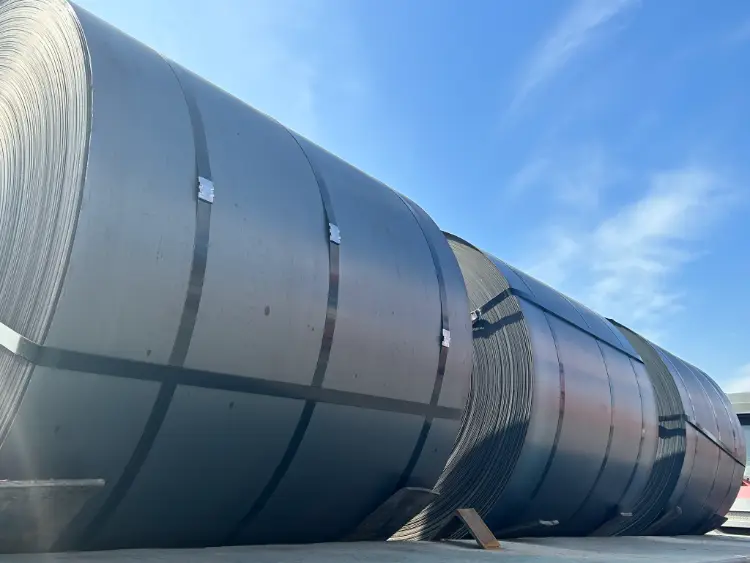
EN10225 S355G10+M Offshore Structural Steel Coil
EN10225 S355G10+M Offshore Structural Steel Coil - Properties, Equivalents & Applications
Detailed material data for S355G10+M steel coil under EN 10225: high strength, excellent weldability, and toughness for offshore and shipbuilding applications.
Hot rolling, thermomechanical rolling, cold forming, welding
- Phone : +8618037372205
- Email : [email protected]
- WhatsApp: Contact via Whtsapp
- WeChat: +8618037372205
EN10225 S355G10+M Offshore Structural Steel Coil Introduction
S355G10+M is a weldable fine-grain structural steel for offshore constructions, specified in EN 10225:2009. The grade S355 designates a minimum yield strength of 355 MPa, G10 indicates that the material achieves a minimum impact energy of 50 J at -40°C in the transverse direction, and the delivery condition +M denotes thermomechanical rolling. This steel offers a balanced combination of strength, ductility, and low-temperature toughness, making it suitable for critical welded structures subjected to severe marine environments. Its controlled chemical composition ensures good weldability without preheating under normal conditions, while the fine-grained microstructure enhances resistance to brittle fracture. Typical applications include primary members of fixed and floating offshore platforms, wind turbine foundations, and ship hull structures.
EN10225 S355G10+M Offshore Structural Steel Coil Chemical Composition
The chemical composition of S355G10+M is carefully balanced to achieve high strength, excellent weldability, and low-temperature toughness. Carbon equivalent (CEV) is controlled to ensure crack-free welding. All values comply with EN 10225:2009 Table 1, with product analysis tolerances per the standard.
| Element | Standard Value (wt %) | Remarks |
|---|---|---|
| C | ≤ 0.16 | Typical 0.10–0.14 |
| Si | ≤ 0.50 | Typical 0.20–0.40 |
| Mn | 1.00 – 1.70 | Typical 1.40–1.60 |
| P | ≤ 0.020 | Stringent control for low-temperature toughness |
| S | ≤ 0.010 | Low sulfur for improved ductility |
| Al (total) | ≥ 0.020 | Sufficient for full grain refinement |
| N | ≤ 0.012 | Bounded nitrogen content |
| Nb | ≤ 0.05 | Microalloying for grain refinement and precipitation strengthening |
| V | ≤ 0.08 | Microalloying element |
| Ti | ≤ 0.05 | Microalloying element |
| Cr | ≤ 0.25 | Residual element |
| Ni | ≤ 0.30 | Residual element |
| Mo | ≤ 0.08 | Residual element |
| Cu | ≤ 0.35 | Residual element |
| CEV (max) | 0.43 (for thickness ≤ 40 mm) | Carbon equivalent based on ladle analysis: CEV = C + Mn/6 + (Cr+Mo+V)/5 + (Ni+Cu)/15 |
EN10225 S355G10+M Offshore Structural Steel Coil Thermal and Electrical Physical Properties
The following physical properties are typical for hot-rolled structural steel and are not mandatory in EN 10225. They are provided for engineering calculations. Values may vary slightly depending on exact chemical composition and manufacturing route. The properties are valid in the as-delivered (+M) condition at ambient temperature unless otherwise noted.
| Property | Typical Value | Unit | Test Conditions / Remarks |
|---|---|---|---|
| Density (ρ) | 7.85 | g/cm³ | 20°C |
| Elastic modulus (E) | 210 | GPa | 20°C, static tensile test |
| Shear modulus (G) | 81 | GPa | Calculated from E and ν |
| Poisson's ratio (ν) | 0.30 | – | In elastic range |
| Thermal expansion coefficient (α) | 11.8 × 10⁻⁶ | K⁻¹ | 20–100°C |
| Thermal expansion coefficient (α) | 12.5 × 10⁻⁶ | K⁻¹ | 20–200°C |
| Thermal expansion coefficient (α) | 13.2 × 10⁻⁶ | K⁻¹ | 20–400°C |
| Thermal conductivity (λ) | 51 | W/(m·K) | 20°C |
| Thermal conductivity (λ) | 47 | W/(m·K) | 200°C |
| Thermal conductivity (λ) | 41 | W/(m·K) | 400°C |
| Specific heat capacity | 460 | J/(kg·K) | 20°C |
| Specific heat capacity | 530 | J/(kg·K) | 200°C |
| Specific heat capacity | 620 | J/(kg·K) | 400°C |
| Electrical resistivity (ρ_e) | 0.20 – 0.25 | μΩ·m | 20°C |
EN10225 S355G10+M Offshore Structural Steel Coil Mechanical Properties
The mechanical properties are guaranteed by EN 10225 for the +M delivery condition. Tensile testing is performed on transverse specimens. Charpy V-notch impact tests are carried out at -40°C. Values vary with product thickness; the most common ranges are shown. Bending tests are also required for formability verification.
| Property | Value | Unit | Test Condition / Thickness (mm) |
|---|---|---|---|
| Yield Strength (ReH) | ≥ 355 | MPa | Thickness ≤ 16 |
| Yield Strength (ReH) | ≥ 355 | MPa | 16 < thickness ≤ 40 |
| Yield Strength (ReH) | ≥ 345 | MPa | 40 < thickness ≤ 63 |
| Yield Strength (ReH) | ≥ 335 | MPa | 63 < thickness ≤ 80 |
| Yield Strength (ReH) | ≥ 325 | MPa | 80 < thickness ≤ 100 |
| Tensile Strength (Rm) | 470 – 630 | MPa | Thickness ≤ 100 |
| Elongation (A, 5.65√So) | ≥ 22 | % | Thickness ≤ 40, longitudinal |
| Elongation (A, 5.65√So) | ≥ 21 | % | Thickness ≤ 40, transverse |
| Elongation (A, 5.65√So) | ≥ 19 | % | 40 < thickness ≤ 100, longitudinal |
| Charpy Impact Energy (KV) | ≥ 50 (min. single 35) | J | -40°C, transverse, thickness ≤ 40 |
| Charpy Impact Energy (KV) | ≥ 45 (min. single 31) | J | -40°C, transverse, 40 < thickness ≤ 100 |
| Bend Test (bend angle 180°) | d ≥ 3a (t ≤ 16); d ≥ 4a (t > 16 ≤ 40) | – | d = mandrel diameter, a = specimen thickness |
EN10225 S355G10+M Offshore Structural Steel Coil Direct Equivalent Standards and Substitutable Grades
EN 10225 S355G10+M is a harmonized European standard for offshore structures. There is no identical international standard; however, the following grades may be considered equivalent when supplementary low-temperature impact requirements and CEV limits are agreed upon.
| Country/Region | Standard | Grade | Remarks |
|---|---|---|---|
| EU | EN 10225:2009 | S355G10+M | Original specification |
| International | ISO 19902-1:2018 (referenced) | S355G10 (per EN 10225) | ISO for fixed steel offshore structures recognizes this grade |
| UK | BS EN 10225:2009 | S355G10+M | Identical to EN |
| Germany | DIN EN 10225:2009 | S355G10+M | Identical to EN |
| Not fully equivalent | ASTM A572/A572M | Grade 50 [345] with impact test at -40°C | Requires additional agreement on CEV, impact orientation, and through-thickness properties |
EN10225 S355G10+M Offshore Structural Steel Coil Application Introduction
S355G10+M steel coil and cut plates are designed for highly loaded welded structures that must resist fatigue, brittle fracture, and aggressive marine corrosion. Its thermomechanical processing ensures a fine grain size, which improves both strength and toughness without compromising weldability. Typical applications include the following:
Product Applications: Offshore platform decks and substructures, Monopile and jacket foundations for wind turbines, Pressure-resistant hulls and stiffened panels, Heavy-lift crane pedestals, Floating production storage and offloading (FPSO) structural modules
Processed into products: Welded box girders and I-beams, Flanges and web plates for built-up sections, Stiffeners, brackets, and node joints, Circular hollow sections for tubular joints, High-load shear plates and end connections, Fatigue-sensitive components in dynamic structures
Application industries: Offshore oil and gas: topside modules, jacket legs, nodes, and braces, Renewable energy: offshore wind turbine towers and transition pieces, Shipbuilding: decks, hull stiffeners, and structural members of ice-class vessels, Bridge engineering: movable bridges and marine bridge foundations, Heavy lifting: offshore crane booms and heavy-duty structural components
EN10225 S355G10+M Offshore Structural Steel Coil Similar or Alternative Material Recommendations
In applications where S355G10+M is not available, the following grades provide comparable mechanical properties and may be used after careful evaluation of toughness, weldability, and project specifications. Note that delivery conditions differ (e.g., normalized instead of thermomechanically rolled).
| Country/Region | Standard | Grade | Remarks |
|---|---|---|---|
| EU | EN 10025-3 | S355N/NL | Normalized rolled, similar strength but higher carbon/CEV; impact test temperatures differ |
| EU | EN 10025-4 | S355M/ML | Thermomechanical rolled, same strength, similar toughness but intended for general structural use; CEV may be higher |
| EU | EN 10225 | S355G8+N | Offshore steel with normalized delivery, -20°C impact (G8), lower toughness than G10 |
| USA | ASTM A709/A709M | 50W [345W] with supplemental Charpy requirements | Weathering offshore suitability requires verification |
| International | API 2W | Grade 50T | Thermomechanically processed plate for offshore structures, comparable strength and toughness |
Notes:
Weldability: The typical carbon equivalent (CEV ≤ 0.43) allows welding without preheating under normal workshop conditions, but a welding procedure specification (WPS) should be prepared according to EN 1011-2.
Through-thickness properties: When Z-direction properties are required, the steel must be ordered with Z-quality (e.g., Z25, Z35) per EN 10164.
Surface condition: Delivered with mill scale unless shot-blasted and primed if specified.
Testing: Ultrasonic testing to EN 10160 Class S1 or more stringent (e.g., S0E2) is often required for offshore components.
Corrosion protection: Requires painting, coating, or cathodic protection in marine environments; no inherent corrosion resistance beyond standard carbon steel.
- Share



