
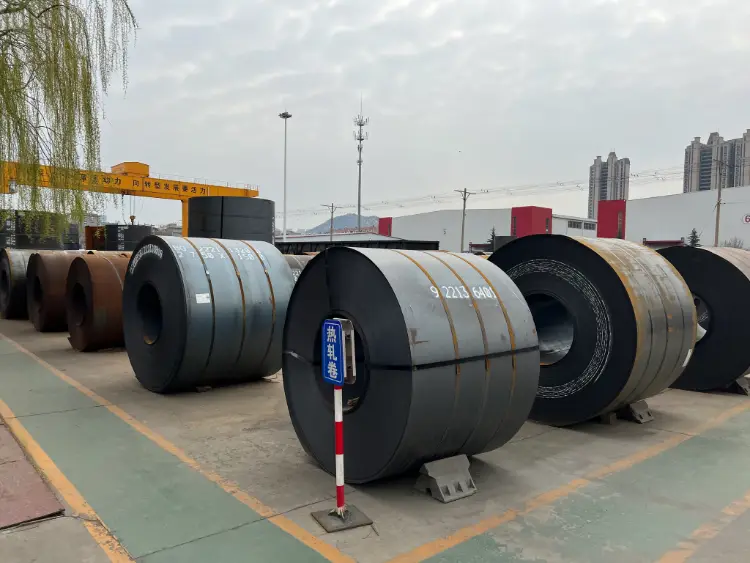
EN10225 S355G9+M Shipbuilding Steel Coil
EN10225 S355G9+M Shipbuilding Steel Coil: Mechanical and Physical Properties
Detailed material data for S355G9+M offshore structural steel according to EN 10225, including chemical composition, mechanical properties, and thermal characteristics.
Hot rolling, thermo-mechanical rolling, cold forming, welding, cutting, and machining
- Phone : +8618037372205
- Email : [email protected]
- WhatsApp: Contact via Whtsapp
- WeChat: +8618037372205
EN10225 S355G9+M Shipbuilding Steel Coil Introduction
S355G9+M is a high-strength low-alloy structural steel for offshore applications, delivered in the thermo-mechanically rolled condition (+M). It is specified in the European standard EN 10225, which covers weldable structural steels for fixed offshore structures. The grade designation S355 indicates a minimum yield strength of 355 MPa for thicknesses up to 40 mm, while G9 defines enhanced low-temperature toughness with a guaranteed minimum Charpy V-notch impact energy of 50 J at -40 °C.
- Excellent weldability due to low carbon equivalent and controlled rolling process.
- Superior toughness and crack arrest properties, essential for harsh marine environments.
- Uniform mechanical properties through thermo-mechanical rolling, eliminating the need for subsequent heat treatment.
- Suitable for heavy plate, coil, and structural sections typically used in ship hulls, offshore platforms, and wind turbine foundations.
EN10225 S355G9+M Shipbuilding Steel Coil Chemical Composition
The ladle analysis limits for S355G9+M as defined in EN 10225. These tight controls on carbon, phosphorus, and sulfur, combined with microalloying elements, ensure good weldability, strength, and toughness. All values are maximum percentages unless a range is indicated.
| Element | Standard Requirement (wt. %) | Remarks |
|---|---|---|
| Carbon (C) | ≤ 0.12 | Max; lower values improve weldability |
| Silicon (Si) | ≤ 0.50 | Max; contributes to deoxidation |
| Manganese (Mn) | 1.00 – 1.60 | Range; main solid solution strengthener |
| Phosphorus (P) | ≤ 0.020 | Max; kept low for toughness |
| Sulfur (S) | ≤ 0.010 | Max; low S for improved through-thickness properties |
| Aluminium (Al, total) | ≥ 0.020 | Min; required for grain refinement |
| Niobium (Nb) | ≤ 0.05 | Max; microalloying for grain size control |
| Vanadium (V) | ≤ 0.10 | Max; optional microalloying |
| Titanium (Ti) | ≤ 0.05 | Max; microalloying element |
| Chromium (Cr) | ≤ 0.25 | Max; optional alloying |
| Nickel (Ni) | ≤ 0.30 | Max; optional for toughness enhancement |
| Molybdenum (Mo) | ≤ 0.10 | Max; optional |
| Copper (Cu) | ≤ 0.35 | Max; residual/optional |
| Nitrogen (N) | ≤ 0.012 | Max; limits strain aging effects |
EN10225 S355G9+M Shipbuilding Steel Coil Thermal and Electrical Physical Properties
Typical ambient-temperature physical properties for S355G9+M steel. These values are not mandatory per EN 10225 but are representative of HSLA steel chemistries. Actual properties may vary slightly depending on exact composition and processing conditions.
| Property | Typical Value | Unit | Test Condition / Temperature |
|---|---|---|---|
| Density (ρ) | 7850 | kg/m³ | 20 °C |
| Elastic modulus (E) | 205 | GPa | 20 °C, longitudinal vibration |
| Shear modulus (G) | 80 | GPa | 20 °C |
| Poisson's ratio (ν) | 0.29 | - | 20 °C, static |
| Thermal expansion coefficient (α) | 12.0 | 10⁻⁶/K | 20 °C – 100 °C |
| Thermal expansion coefficient (α) | 12.5 | 10⁻⁶/K | 20 °C – 200 °C |
| Thermal expansion coefficient (α) | 13.0 | 10⁻⁶/K | 20 °C – 300 °C |
| Thermal conductivity (λ) | 50 | W/(m·K) | 20 °C |
| Thermal conductivity (λ) | 45 | W/(m·K) | 200 °C |
| Specific heat capacity | 460 | J/(kg·K) | 20 °C – 100 °C |
| Electrical resistivity (ρ_e) | 0.22 × 10⁻⁶ | Ω·m | 20 °C |
EN10225 S355G9+M Shipbuilding Steel Coil Mechanical Properties
Mechanical test requirements for S355G9+M according to EN 10225, transverse samples unless stated otherwise. Properties depend on product thickness. The grade achieves its strength through thermo-mechanical rolling and maintains high toughness at -40 °C. These are minimum values unless a range is specified.
| Property | Standard Requirement | Unit | Test Condition / Thickness |
|---|---|---|---|
| Yield strength (ReH) | ≥ 355 | MPa | Thickness ≤ 16 mm, transverse |
| Yield strength (ReH) | ≥ 345 | MPa | 16 mm < thickness ≤ 40 mm |
| Yield strength (ReH) | ≥ 335 | MPa | 40 mm < thickness ≤ 63 mm |
| Yield strength (ReH) | ≥ 325 | MPa | 63 mm < thickness ≤ 80 mm |
| Yield strength (ReH) | ≥ 315 | MPa | 80 mm < thickness ≤ 100 mm |
| Tensile strength (Rm) | 470 – 630 | MPa | All thicknesses ≤ 100 mm |
| Elongation (A) | ≥ 22 | % | Thickness ≤ 40 mm, gauge length 5.65√S₀ |
| Elongation (A) | ≥ 21 | % | 40 mm < thickness ≤ 63 mm |
| Elongation (A) | ≥ 20 | % | 63 mm < thickness ≤ 100 mm |
| Charpy impact energy (KV) | ≥ 50 (longitudinal) | J | Test at -40 °C, 10x10 mm specimen |
| Charpy impact energy (KV) | ≥ 34 (transverse) | J | Test at -40 °C, 10x10 mm specimen |
| Bend test (180°) | No cracks | - | Mandrel diameter = 3 x thickness (t) for t ≤ 20 mm |
EN10225 S355G9+M Shipbuilding Steel Coil Full Equivalents
Grades that are recognized as identical or functionally equivalent to EN10225 S355G9+M, including the thermo-mechanically rolled condition and minimum impact energy requirement at -40 °C.
| Country/Region | Standard | Grade | Remarks |
|---|---|---|---|
| United Kingdom | BS 7191 | 355EMZ | Z indicates through-thickness properties; equivalent to S355G9+M in mechanical and toughness requirements |
| Norway | NORSOK M-120 | S355G9+M | Adopted directly from EN 10225 in offshore standards |
| International | API 2H | Grade 50 | With supplementary requirement for Charpy at -40 °C, 50 J; must be ordered as thermo-mechanically rolled |
EN10225 S355G9+M Shipbuilding Steel Coil Application Introduction
S355G9+M combines high strength with excellent notch toughness at sub-zero temperatures, making it an ideal choice for critical marine and offshore structures. Its thermo-mechanical delivery condition eliminates the need for post-weld heat treatment in most cases and guarantees consistent properties across the entire coil or plate. Typical application areas:
Product Applications: Ship hull plates, deck plates, and bulkheads, Jack-up rig legs, spudcans, and cantilever beams, Monopile and transition piece shells for wind turbines, Heavy-lift crane booms and structural booms, Pressure vessel and heat exchanger shells (if supplementary requirements are met)
Processed into products: Main deck stringers and longitudinal stiffeners, Bottom plates and bilge keels for ice-class vessels, Fatigue-critical welded nodes (K-, Y-, T-joints) on offshore jackets, Flare boom and bridge structures on FPSOs, Large-diameter welded pipe piles
Application industries: Shipbuilding (commercial and naval vessels), Offshore oil & gas exploration and production platforms, Fixed and floating wind turbine foundations, Heavy civil engineering (bridge components, lock gates), Port and harbor construction equipment
EN10225 S355G9+M Shipbuilding Steel Coil Close Substitutes / Similar Grades
Alternative structural steels that offer comparable strength, toughness, and weldability. Substitution should be verified for specific application requirements, especially regarding notch toughness and through-thickness properties.
| Country/Region | Standard | Grade | Remarks |
|---|---|---|---|
| EU | EN 10225 | S355G5+M | Same yield strength; minimum 40 J at -40 °C instead of 50 J |
| EU | EN 10225 | S355G10+M | Higher toughness (50 J at -50 °C); may be used as an upgrade |
| EU | EN 10025-4 | S355ML | Thermo-mechanically rolled, similar chemistry and strength, but toughness for -50 °C (27 J). Not originally designed for offshore. |
| USA | ASTM A572 | Grade 50 | Equivalent yield strength; impact test not mandatory; may require supplementary specifications for offshore use |
| USA | API 2W | Grade 50 | Offshore structural plate, produced by TMCP; similar strength and toughness profile |
| Japan | JIS G 3106 | SM520C | Rolled steel for welded structures; yield ≥ 355 MPa; Charpy at 0 °C typically; can be upgraded to low-temperature versions |
Notes:
- Ultrasonic testing to Class 3 or higher is often mandatory for S355G9+M plates used in through-thickness loaded applications (Z-quality).
- When welding, preheat and interpass temperatures should follow EN 1011-2 recommendations; no post-weld heat treatment is usually required if heat input is controlled.
- The steel is not intended for applications requiring significant oxidation or corrosion resistance (not a weathering steel).
- For thicknesses above 100 mm, consult the producer for specific mechanical properties and through-thickness guarantees.
- Share



