
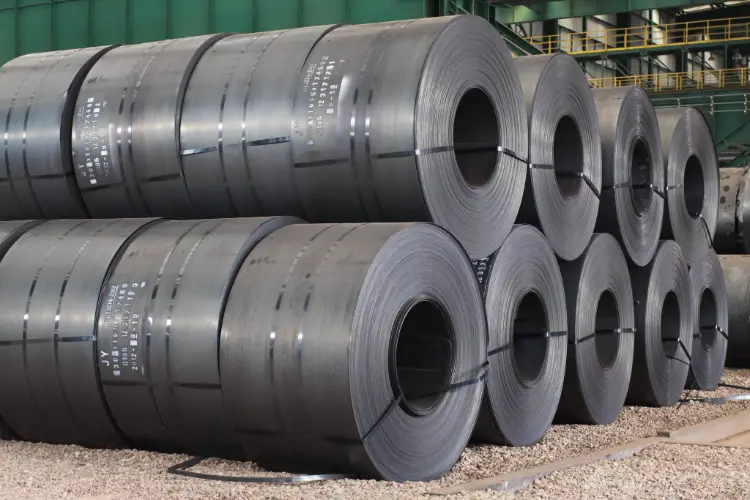
EN10225 S355G8+M Shipbuilding Steel Coil
EN10225 S355G8+M Shipbuilding Steel Coil: High-Strength Offshore Structural Steel
Comprehensive technical data for EN10225 S355G8+M thermomechanically rolled steel coil used in offshore structures and shipbuilding, including chemical composition, mechanical properties, and thermal characteristics.
Thermomechanically rolled (M); can be cold formed, welded, machined, and flame cut
- Phone : +8618037372205
- Email : [email protected]
- WhatsApp: Contact via Whtsapp
- WeChat: +8618037372205
EN10225 S355G8+M Shipbuilding Steel Coil Introduction
EN10225 S355G8+M is a thermomechanically rolled weldable fine-grain structural steel specifically designed for offshore and marine applications. It belongs to the S355 strength class with a minimum yield strength of 355 MPa and is supplied in tempered condition (M = thermomechanically rolled). Grade G8 indicates enhanced low-temperature toughness, guaranteed down to -40°C. The steel offers excellent weldability, good ductility, and high resistance to brittle fracture, making it suitable for critical structural components in harsh environments. Its fine-grain microstructure ensures uniform properties across thick sections and good fatigue performance.
EN10225 S355G8+M Shipbuilding Steel Coil Chemical Composition
Typical ladle analysis according to EN 10225:2009 for S355G8+M grade. All values are maximum unless otherwise stated. Elements not listed are residual and controlled by the sum limitations.
- Carbon equivalent CEV ≤ 0.43% for thermomechanically rolled condition.
- Aluminum is required for fine grain practice (Al/N ratio ≥ 2).
- Microalloying elements (Nb, V, Ti) are used singly or in combination up to the specified limits.
| Element | Standard Value (max %) | Remarks |
|---|---|---|
| Carbon (C) | ≤ 0.12 | For thickness ≤ 40 mm |
| Silicon (Si) | ≤ 0.50 | |
| Manganese (Mn) | ≤ 1.60 | |
| Phosphorus (P) | ≤ 0.025 | |
| Sulfur (S) | ≤ 0.015 | |
| Nitrogen (N) | ≤ 0.012 | |
| Aluminum (Altotal) | ≥ 0.020 | Acid soluble or total |
| Chromium (Cr) | ≤ 0.30 | |
| Copper (Cu) | ≤ 0.35 | |
| Molybdenum (Mo) | ≤ 0.08 | |
| Nickel (Ni) | ≤ 0.50 | |
| Niobium (Nb) | ≤ 0.05 | |
| Vanadium (V) | ≤ 0.10 | |
| Titanium (Ti) | ≤ 0.05 | |
| Nb+V+Ti | ≤ 0.12 | Sum of microalloying elements |
| Cr+Cu+Mo+Ni | ≤ 0.80 | Sum of residual elements |
EN10225 S355G8+M Shipbuilding Steel Coil Thermal and Electrical Physical Properties
Representative physical properties for structural steel S355G8+M at room temperature, unless otherwise noted. These are typical values and not mandatory standard requirements. They can vary slightly depending on exact composition and processing.
| Property | Typical Value | Unit | Test Condition / Temperature |
|---|---|---|---|
| Density (ρ) | 7.85 | g/cm³ | 20°C |
| Elastic modulus (E) | 210 | GPa | 20°C, static |
| Shear modulus (G) | 81 | GPa | 20°C |
| Poisson's ratio (ν) | 0.3 | – | 20°C |
| Thermal expansion coefficient (α) | 12.0×10⁻⁶ | K⁻¹ | 20–100°C |
| Thermal expansion coefficient (α) | 13.0×10⁻⁶ | K⁻¹ | 20–200°C |
| Thermal conductivity (λ) | 45 – 50 | W/m·K | 20°C |
| Specific heat capacity (cp) | 460 | J/kg·K | 20°C |
| Electrical resistivity (ρe) | 0.20 – 0.25 | μΩ·m | 20°C |
EN10225 S355G8+M Shipbuilding Steel Coil Mechanical Properties
Mechanical properties according to EN 10225:2009 for S355G8+M, tested on transverse specimens unless otherwise indicated. Values vary with product thickness.
- For thicknesses > 40 mm, yield strength may be slightly reduced.
- Impact energy requirements apply to longitudinal Charpy V-notch specimens at -40°C.
- Bend test mandrel diameters are valid for 180° bending.
| Property | Standard Requirement | Unit | Test Condition |
|---|---|---|---|
| Yield strength (ReH) | ≥ 355 | MPa | Thickness ≤ 16 mm |
| Yield strength (ReH) | ≥ 345 | MPa | Thickness > 16 mm to 40 mm |
| Tensile strength (Rm) | 470 – 630 | MPa | Thickness ≤ 40 mm |
| Elongation (A5) | ≥ 22 | % | Gauge length 5.65√S₀, ≤ 40 mm |
| Elongation (A5) | ≥ 21 | % | Thickness > 40 mm to 63 mm |
| Charpy impact (KV, longitudinal) | ≥ 50 | J | At -40°C |
| Charpy impact (KV, transverse) | ≥ 34 | J | At -40°C |
| Bend test (mandrel diameter) | 2t (t ≤ 16 mm) | – | 180° bend, no cracks |
| Bend test (mandrel diameter) | 3t (t > 16 mm to 25 mm) | – | 180° bend, no cracks |
| Bend test (mandrel diameter) | 4t (t > 25 mm) | – | 180° bend, no cracks |
EN10225 S355G8+M Shipbuilding Steel Coil Fully Equivalent Material Standards and Substitutable Grades
| Country/Region | Standard | Grade | Remarks |
|---|---|---|---|
| International / ISO | ISO 4950-2 | E355DD | Similar fine-grain TMCP steel for offshore; not identical |
| NORSOK | NORSOK M-120 | Y35 | Offshore structural steel with comparable strength and toughness; verify CEV and Z-quality requirements |
EN10225 S355G8+M Shipbuilding Steel Coil Application Introduction
S355G8+M steel coils are optimized for welded structures in marine and offshore environments. Its low carbon equivalent, fine grain size, and guaranteed toughness at low temperatures make it ideal for thick plate applications subjected to dynamic loading and low ambient temperatures. The thermomechanically rolled condition eliminates the need for normalizing and provides excellent dimensional stability during fabrication.
Product Applications: Jack-up rig legs and spudcans, Offshore platform decks, modules, and flare booms, Ship hulls, decks, and superstructures, Subsea templates and manifolds, Wind turbine monopiles and jackets, Mooring and anchoring components
Processed into products: Nodes and welded joints, Stiffeners and girders, Flanges and brackets, Heavy plates for pressure vessels (non-fired), Transition pieces for wind towers, Bulkheads and watertight doors
Application industries: Offshore oil & gas exploration and production, Shipbuilding and marine engineering, Renewable energy (offshore wind turbine foundations, transition pieces), Onshore structural engineering (where enhanced toughness is required), Heavy civil construction
EN10225 S355G8+M Shipbuilding Steel Coil Closely Related / Alternative Material Recommendations
| Country/Region | Standard | Grade | Remarks |
|---|---|---|---|
| European Union | EN 10225 | S355G10+M | Higher toughness class (-20°C vs -40°C for G8); slightly adjusted composition |
| European Union | EN 10025-4 | S355ML | Thermomechanically rolled structural steel for general use, not offshore certified |
| European Union | EN 10225 | S355G7+M | Lower toughness grade (-20°C); suitable for less critical offshore components |
| Japan | JIS G 3106 | SM490YA | Comparable strength, but not specifically for offshore; verify low-temperature toughness |
| USA | ASTM A572/A572M | Grade 50 | Similar strength level, but chemical and toughness requirements differ |
| USA | ASTM A709/A709M | Grade 50 | Bridge steel with comparable strength; may require additional testing for offshore use |
Notes:
This grade is delivered in thermomechanically rolled (+M) condition and is not intended for subsequent heat treatment (such as normalizing or stress relieving) without consulting the steelmaker. Formability and weldability are excellent, but preheating may be required depending on thickness and hydrogen control measures. The material can be ordered with additional requirements, such as through-thickness tensile testing (Z-quality according to EN 10164) or improved corrosion resistance. For very thick sections (> 63 mm), verify properties with the manufacturer.
- Share



