
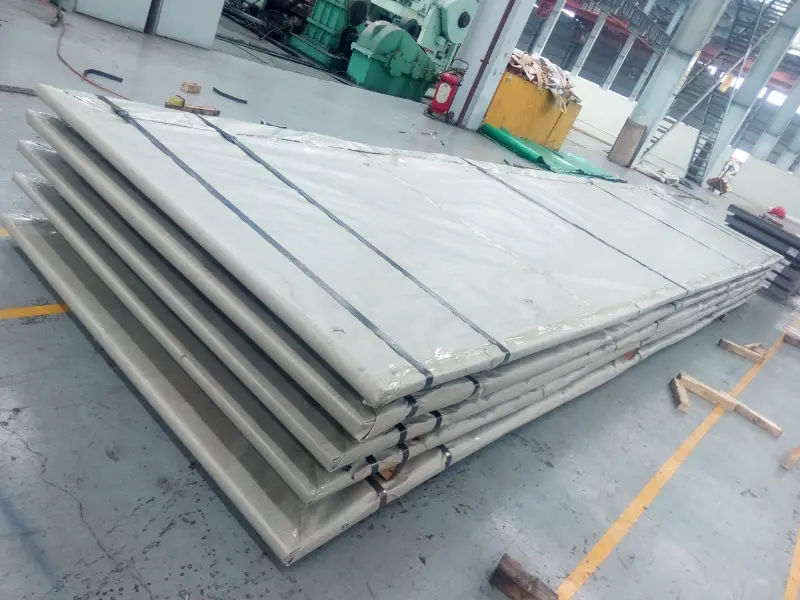
EN10225 S355G7+M Offshore Structural Steel Plate & Coil
EN10225 S355G7+M: High-Strength Structural Steel for Offshore and Marine Engineering
S355G7+M is a normalized or thermomechanically rolled weldable fine-grain structural steel for fixed offshore structures, offering minimum yield strength of 355 MPa, excellent toughness at -40°C, and through-thickness properties per EN 10225.
Suitable for thermomechanical rolling, welding (all common processes), cold forming (limited), and machining; excellent weldability through controlled CEV.
- Phone : +8618037372205
- Email : [email protected]
- WhatsApp: Contact via Whtsapp
- WeChat: +8618037372205
EN10225 S355G7+M Offshore Structural Steel Plate & Coil Introduction
S355G7+M is a high-strength low-alloy structural steel grade specified in EN 10225 for weldable structural steels in fixed offshore structures. The designation '+M' indicates thermomechanical rolling, which refines the grain structure to achieve superior strength and toughness. This grade is designed for critical offshore applications where exceptional resistance to brittle fracture, lamellar tearing, and harsh marine environments is essential. It offers a minimum yield strength of 355 MPa for thicknesses up to 16 mm, with outstanding Charpy V-notch impact toughness at -40°C. Typical uses include primary structural members such as columns, bracings, and nodes for offshore platforms, wind turbine foundations, and subsea frameworks. The steel is supplied with through-thickness testing (Z-quality) and closely controlled chemistry to ensure weldability and long-term durability in extreme sea conditions.
EN10225 S355G7+M Offshore Structural Steel Plate & Coil Chemical Composition
The chemical composition of S355G7+M is carefully controlled to ensure good weldability, low-temperature toughness, and resistance to lamellar tearing. The steel is fully killed and fine-grain treated. Carbon equivalent (CEV) is limited to 0.43 max (for thickness ≤50 mm) to avoid hardening during welding. Residual elements such as Cr, Ni, Mo, and Cu are restricted to maintain corrosion and toughness performance.
| Element | Standard Value (max/range, wt%) | Remarks |
|---|---|---|
| Carbon (C) | ≤0.14 | Ladle analysis |
| Silicon (Si) | 0.15 – 0.55 | Often ≤0.55 in practice |
| Manganese (Mn) | 1.00 – 1.65 | Higher Mn improves strength and toughness |
| Phosphorus (P) | ≤0.020 | Strictly controlled for cleanliness |
| Sulfur (S) | ≤0.010 | Low S for lamellar tearing resistance |
| Chromium (Cr) | ≤0.25 | Residual element; may be added optionally |
| Nickel (Ni) | ≤0.30 | May be added for toughness |
| Molybdenum (Mo) | ≤0.08 | May be present as residual |
| Copper (Cu) | ≤0.30 | Provides some corrosion resistance |
| Aluminium (Al) | ≥0.020 (total) | Grain refining agent; acid-soluble Al typically 0.020–0.060% |
| Niobium (Nb) | ≤0.05 | Microalloying for grain refinement |
| Vanadium (V) | ≤0.08 | Microalloying |
| Titanium (Ti) | ≤0.025 | Microalloying |
| Nitrogen (N) | ≤0.012 | Tied by Al and Ti |
| Carbon Equivalent (CEV) | ≤0.43 (t ≤50 mm) | CEV = C + Mn/6 + (Cr+Mo+V)/5 + (Ni+Cu)/15 |
| Cr+Ni+Mo+Cu | ≤0.70 | For overall control of hardenability |
EN10225 S355G7+M Offshore Structural Steel Plate & Coil Thermal and Electrical Physical Properties
Physical properties of S355G7+M are typical of carbon–manganese structural steels. These values are not mandatory in EN 10225 but are provided for design calculations. They apply at room temperature unless otherwise noted and may vary slightly with composition and temperature.
| Property | Typical Value | Unit | Test Condition / Remarks |
|---|---|---|---|
| Density (ρ) | 7850 | kg/m³ | At 20°C |
| Young's modulus (E) | 205 – 210 | GPa | Longitudinal, at room temperature; decreases with temperature |
| Shear modulus (G) | 79 – 81 | GPa | Calculated from E and ν |
| Poisson's ratio (ν) | 0.28 – 0.30 | – | Elastic range |
| Thermal expansion coefficient (α) | 11.7 – 12.5 | ×10⁻⁶ /K | Mean value between 20°C and 100°C |
| Thermal conductivity (λ) | 45 – 52 | W/(m·K) | At 20°C; lower at elevated temperatures |
| Specific heat capacity (cp) | 460 – 490 | J/(kg·K) | At 20°C to 100°C |
| Electrical resistivity (ρe) | 0.18 – 0.24 | μΩ·m | At 20°C; typical for low-alloy steel |
EN10225 S355G7+M Offshore Structural Steel Plate & Coil Mechanical Properties
Mechanical properties of S355G7+M are guaranteed at room temperature in the as-delivered thermomechanically rolled condition. This steel exhibits high yield and tensile strengths with excellent ductility and impact toughness at -40°C, meeting the stringent requirements of offshore structural codes. Values vary with product thickness. Through-thickness tensile testing (Z-quality) is mandatory for many offshore applications, with reduction of area ≥35% (Z35) or ≥25% (Z25).
| Property | Required Value | Unit | Test Condition / Remarks |
|---|---|---|---|
| Minimum yield strength (ReH) | 355 | MPa | Thickness ≤ 16 mm |
| Minimum yield strength (ReH) | 345 | MPa | Thickness 16 < t ≤ 25 mm |
| Minimum yield strength (ReH) | 335 | MPa | Thickness 25 < t ≤ 40 mm |
| Minimum yield strength (ReH) | 325 | MPa | Thickness 40 < t ≤ 63 mm |
| Minimum yield strength (ReH) | 315 | MPa | Thickness 63 < t ≤ 80 mm |
| Minimum yield strength (ReH) | 295 | MPa | Thickness 80 < t ≤ 100 mm |
| Minimum yield strength (ReH) | 285 | MPa | Thickness 100 < t ≤ 150 mm |
| Tensile strength (Rm) | 470 – 630 | MPa | All thicknesses ≤ 150 mm |
| Minimum elongation (A5) | 22 | % | Gauge length 5.65√S₀; transverse specimens may have slightly lower values |
| Bend test (mandrel diameter) | 2a | – | Thickness ≤ 16 mm, 180° bend, at room temperature |
| Bend test (mandrel diameter) | 3a | – | Thickness 16 < t ≤ 25 mm |
| Bend test (mandrel diameter) | 4a | – | Thickness > 25 mm |
| Charpy V-notch impact energy (KV) | ≥50 (longitudinal) | J | -40°C, standard specimen 10×10 mm |
| Charpy V-notch impact energy (KV) | ≥30 (transverse) | J | -40°C, standard specimen |
| Through-thickness reduction of area (Z) | ≥25 (Z25) / ≥35 (Z35) | % | Per EN 10164, optional requirement; Z35 often specified for primary joints |
EN10225 S355G7+M Offshore Structural Steel Plate & Coil Fully Equivalent Material Standards and Substitutable Grades
The following standards and grades are considered technically identical or fully interchangeable with EN 10225 S355G7+M, as they reference the same chemical and mechanical requirements for offshore structural steels.
| Country/Region | Standard | Grade | Remarks |
|---|---|---|---|
| Norway | NORSOK M-120 (rev. 6) | S355G7+M | Direct adoption of EN 10225; commonly used in Norwegian sector projects. |
| International (ISO) | ISO 19902:2020 | S355G7 | ISO standard for fixed steel offshore structures refers to EN 10225 S355G7. |
| United Kingdom | BS EN 10225:2009 | S355G7+M | Identical to EN 10225. |
| Netherlands | NEN-EN 10225 | S355G7+M | Identical to EN 10225. |
| Germany | DIN EN 10225 | S355G7+M | Identical to EN 10225. |
EN10225 S355G7+M Offshore Structural Steel Plate & Coil Application Introduction
S355G7+M is engineered for the most demanding offshore environments, where high strength, excellent low-temperature toughness, and resistance to lamellar tearing are mandatory. Its balanced chemistry and controlled rolling provide superior weldability, making it the industry standard for primary structural components in deepwater platforms, wind energy foundations, and subsea structures. The grade is often specified with Z-quality (Z35) for tubular joints and connections subject to through-thickness stresses. It can be formed, welded, and machined using standard procedures, with low preheat requirements and no post-weld heat treatment in most cases, significantly reducing fabrication times.
Product Applications: Fixed offshore platform jackets and decks, Monopile and transition piece foundations for offshore wind turbines, Subsea manifold and protection structures, Floating production unit (FPU) hull and turret structural members, Flare booms and helideck support frames, Caissons and riser supports, Heavy-lift beams and padeyes
Processed into products: Tubular nodes and braces (K-joints, T-joints, Y-joints), Stiffened plate panels for modules and decks, Shear keys and shear plates in concrete-steel composite structures, Flanges for bolted connections on tubulars, Pile sleeves and grout connections, Mudmats and seabed templates, Transition ring stiffeners and cone segments, Lifting trunnions and installation aids
Application industries: Offshore oil and gas exploration and production, Offshore wind power (renewable energy), Marine and coastal engineering, Shipbuilding and repair (specialty structural parts), Heavy civil engineering (pier, caisson, submersible structures)
EN10225 S355G7+M Offshore Structural Steel Plate & Coil Similar or Approximate Substitute Materials
The grades listed below offer similar strength levels and may be considered as alternatives, provided additional testing and qualification for offshore service conditions (especially toughness at -40°C and through-thickness properties) are satisfied.
| Country/Region | Standard | Grade | Remarks |
|---|---|---|---|
| European Union | EN 10025-3 | S355NL | Normalized fine-grain steel with minimum 355 MPa yield and -50°C impact toughness; lacks guaranteed through-thickness properties. |
| European Union | EN 10025-4 | S355ML | Thermomechanically rolled fine-grain steel with -50°C toughness; comparable to S355G7 but must confirm offshore project approvals. |
| United States | ASTM A572 / A572M | Grade 50 [345] | Yield 345 MPa; requires supplementary Charpy testing at -40°C and Z-quality to match S355G7+M. |
| United States | API 2H | Grade 50 | Offshore structural steel; yield 345 MPa min; similar but not identical in chemistry and CEV limits. |
| DNV Classification | DNVGL-OS-B101 | NV E355 | Offshore structural steel; yield 355 MPa, Charpy at -40°C; close to EN 10225 S355G7. |
| Japan | JIS G 3106 | SM490YB | High-tensile strength steel for welded structures; 490 MPa tensile class; yield ~355 MPa; needs Charpy and Z-quality verification. |
Notes:
- Weldability: S355G7+M has a low carbon equivalent (CEV ≤0.43), which minimizes cold cracking risk and allows welding without preheat for moderate thicknesses. Qualified welding procedures per EN 1090 or AWS D1.1 are typically used.
- Corrosion protection: Offshore structures require coating systems (e.g., NORSOK M-501) or cathodic protection. The steel itself is not inherently corrosion-resistant in seawater.
- Certification: Products are usually certified by classification societies (DNV, ABS, LR, BV) against EN 10225, with mandatory traceability and 3.2 inspection certificates.
- Dimensional standards: Plates and coils are supplied to EN 10029 for thickness tolerances and EN 10048 for coil dimensions, with class A or B tolerances being standard.
- Z-quality: For critical through-thickness loaded joints, Z25 or Z35 must be specified at the time of order. This involves ultrasonic testing (EN 10160) and through-thickness tensile tests in accordance with EN 10164.
- Share



