
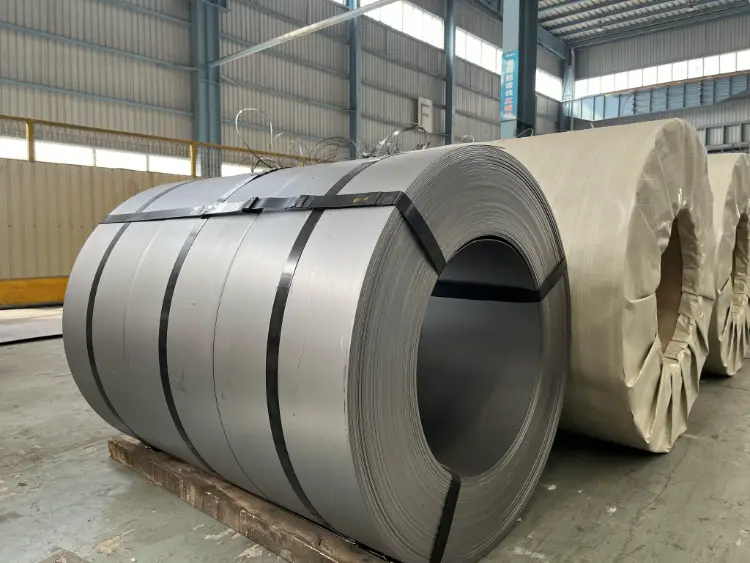
EN 10225 S355G6+N Offshore Structural Steel Coil
EN 10225 S355G6+N Offshore Structural Steel Coil - High Strength Normalized Weldable Steel for Harsh Marine Environments
Detailed material specification for EN 10225 S355G6+N steel coil used in shipbuilding and offshore structures, including chemical, mechanical and physical properties.
Hot rolling, normalizing, cutting, welding, bending, forming
- Phone : +8618037372205
- Email : [email protected]
- WhatsApp: Contact via Whtsapp
- WeChat: +8618037372205
EN 10225 S355G6+N Offshore Structural Steel Coil Introduction
EN 10225 S355G6 is a weldable fine-grain structural steel delivered in normalized condition (+N) according to EN 10225-2. It is specifically designed for fixed offshore structures, such as platforms and wind turbine foundations, where high strength, excellent toughness at low temperatures and good weldability are essential. With a minimum yield strength of 355 MPa for thicknesses up to 40 mm and guaranteed Charpy impact energy of 50 J at -20 °C, S355G6 ensures reliable performance in aggressive marine conditions. The steel is fully killed and contains micro-alloying elements to refine the grain structure and improve mechanical properties. Typical applications include heavy plates, strips and coils for welded constructions, offering good formability and resistance to brittle fracture.
EN 10225 S355G6+N Offshore Structural Steel Coil Chemical composition
Chemical composition limits according to EN 10225-2:2019 for grade S355G6. Values are maximum unless a range is indicated. The steel is fully killed, fine-grain treated, and micro-alloyed to achieve the required strength and toughness.
| Element | Standard value (wt.%) | Remarks |
|---|---|---|
| Carbon (C) | ≤ 0.14 | CEV max 0.43 for t ≤ 40 mm |
| Silicon (Si) | ≤ 0.50 | - |
| Manganese (Mn) | 1.00 – 1.65 | - |
| Phosphorus (P) | ≤ 0.020 | - |
| Sulfur (S) | ≤ 0.010 | - |
| Chromium (Cr) | ≤ 0.30 | - |
| Nickel (Ni) | ≤ 0.30 | - |
| Copper (Cu) | ≤ 0.30 | - |
| Molybdenum (Mo) | ≤ 0.08 | - |
| Nitrogen (N) | ≤ 0.012 | Acid-soluble |
| Niobium (Nb) | ≤ 0.05 | Micro-alloying |
| Vanadium (V) | ≤ 0.08 | Micro-alloying |
| Titanium (Ti) | ≤ 0.06 | Micro-alloying |
| Aluminium (Al) | ≥ 0.015 | Total aluminium for grain refinement |
| Carbon Equivalent (CEV) | ≤ 0.43 (t ≤ 40 mm) | Calculated per EN 1011-2; other thickness limits exist |
EN 10225 S355G6+N Offshore Structural Steel Coil Thermal and electrical physical properties
Typical physical properties for carbon-manganese normalized structural steel at room temperature. These values are not part of the delivery condition but serve as engineering references for design calculations. Slight variations may occur depending on exact composition and heat treatment.
| Property | Typical value | Unit | Test condition |
|---|---|---|---|
| Density (ρ) | 7850 | kg/m³ | at 20 °C |
| Elastic modulus (E) | 210 | GPa | at 20 °C |
| Shear modulus (G) | 81 | GPa | at 20 °C |
| Poisson's ratio (ν) | 0.3 | — | at 20 °C |
| Thermal expansion coefficient (α) | 11.7 × 10⁻⁶ | K⁻¹ | 20 – 100 °C |
| Thermal expansion coefficient (α) | 12.5 × 10⁻⁶ | K⁻¹ | 20 – 200 °C |
| Thermal conductivity (λ) | 50 | W/(m·K) | at 20 °C |
| Specific heat capacity (c) | 460 | J/(kg·K) | at 20 °C |
| Electrical resistivity (ρₑ) | 0.25 × 10⁻⁶ | Ω·m | at 20 °C |
EN 10225 S355G6+N Offshore Structural Steel Coil Mechanical properties
Minimum mechanical properties according to EN 10225-2 for normalized condition. Properties depend on product thickness. Impact energy values are for longitudinal specimens; transverse values are lower. All tests performed at room temperature unless stated otherwise.
| Property | Standard requirement | Unit | Test condition |
|---|---|---|---|
| Yield strength (ReH) | ≥ 355 | MPa | thickness t ≤ 40 mm |
| Yield strength (ReH) | ≥ 345 | MPa | 40 < t ≤ 63 mm |
| Yield strength (ReH) | ≥ 335 | MPa | 63 < t ≤ 80 mm |
| Yield strength (ReH) | ≥ 325 | MPa | 80 < t ≤ 100 mm |
| Yield strength (ReH) | ≥ 315 | MPa | 100 < t ≤ 150 mm |
| Tensile strength (Rm) | 470 – 630 | MPa | t ≤ 40 mm |
| Tensile strength (Rm) | 470 – 630 | MPa | 40 < t ≤ 63 mm |
| Tensile strength (Rm) | 470 – 630 | MPa | 63 < t ≤ 100 mm |
| Tensile strength (Rm) | 450 – 600 | MPa | 100 < t ≤ 150 mm |
| Elongation after fracture (A) | ≥ 22 | % | gauge length 5.65√S₀, t ≤ 40 mm |
| Elongation after fracture (A) | ≥ 22 | % | 40 < t ≤ 63 mm |
| Elongation after fracture (A) | ≥ 21 | % | 63 < t ≤ 100 mm |
| Elongation after fracture (A) | ≥ 21 | % | 100 < t ≤ 150 mm |
| Charpy impact energy (KV₂) | ≥ 50 | J | -20 °C, longitudinal, t ≤ 40 mm |
| Charpy impact energy (KV₂) | ≥ 45 | J | -20 °C, longitudinal, 40 < t ≤ 63 mm |
| Charpy impact energy (KV₂) | ≥ 42 | J | -20 °C, longitudinal, 63 < t ≤ 100 mm |
| Charpy impact energy (KV₂) | ≥ 40 | J | -20 °C, longitudinal, 100 < t ≤ 150 mm |
EN 10225 S355G6+N Offshore Structural Steel Coil Fully equivalent material standards and replaceable grades
| Country/Region | Standard | Grade | Remarks |
|---|---|---|---|
| Europe (EU, UK) | EN 10225-2 | S355G6+N | Current standard; fully killed, fine-grain normalized steel for offshore structures. Reference for all equivalent comparisons. |
| United Kingdom (withdrawn) | BS 7191:1989 | 355EM | Superseded by EN 10225‑2. Chemical and mechanical properties broadly comparable, but verification against current requirements is necessary. |
| Germany (withdrawn) | SEW 083 | StE 355 | No longer valid; replaced by EN 10225. Historical predecessor. |
EN 10225 S355G6+N Offshore Structural Steel Coil Application Introduction
EN 10225 S355G6+N steel is a primary choice for welded structures exposed to harsh marine and low‑temperature conditions. It combines good formability with predictable mechanical properties, making it suitable for heavy-duty offshore and shipbuilding components. Typical usage involves practices compliant with EN 1090 and offshore construction codes.
Product Applications: Jacket legs and braces for fixed platforms, Monopile and transition piece for wind turbines, Deck plates and bulkheads for vessels, Structural modules (topsides), Crane pedestals and heavy‑lift equipment
Processed into products: Stiffeners and ribs in shell structures, Node cans and tubular joints, Flanges and gussets in bolted connections, Built‑up beams and columns (welded I‑sections), Shear panels and diaphragms, Anchor flanges and padeyes
Application industries: Offshore oil & gas, Offshore wind energy, Shipbuilding and repair, Marine engineering, Heavy steel construction
EN 10225 S355G6+N Offshore Structural Steel Coil Similar / alternative materials for substitution
| Country/Region | Standard / Grade | Remarks |
|---|---|---|
| Europe | EN 10025-3 S355N | Normalized structural steel for general engineering. Comparable strength but lacks the specific offshore toughness and certification requirements of EN 10225. Not suitable for critical offshore welded joints without additional qualification. |
| Europe | EN 10225-3 S355G7+M | Thermomechanically rolled offshore steel with matching yield strength (355 MPa) and improved weldability. Better toughness than S355G6 at equal thickness. If +M is required, this grade should be specified instead. |
| USA | ASTM A572 Gr 50 [345] | Common structural steel with similar yield strength (345 MPa) but lower toughness values and no mandatory low‑temperature impact tests. Not recommended for offshore primary structures without supplementary testing. |
| USA (offshore) | API 2H Grade 50 | Steel for offshore platforms with specified strength and toughness. Closer to S355G6 but with different chemical and delivery requirements. Requires careful comparison of test temperature and energy. |
| International | DNV NV A36 / AH36 (shipbuilding) | Shipbuilding steel with similar strength and good low‑temperature toughness down to -20 °C. Often used as a pragmatic substitute for less critical structural members; however, EN 10225 certification may be mandatory for offshore projects. |
Notes:
Note on delivery condition: The user supplied grade 'S355G6+M', but EN 10225‑2 specifies S355G6 in normalized condition (+N). Thermomechanically rolled (+M) grades exist in EN 10225‑3 (e.g., S355G7+M). It is essential to verify the correct standard part and delivery state.
Bend test: Not explicitly required by EN 10225 for flat products unless specified in the order; usually bend radii of 2.5t (t = thickness) are achievable in the normalized condition.
Further processing: Welding should follow qualified procedures considering the carbon equivalent (CEV ≤ 0.43); preheating may be required for thick sections.
- Share



