
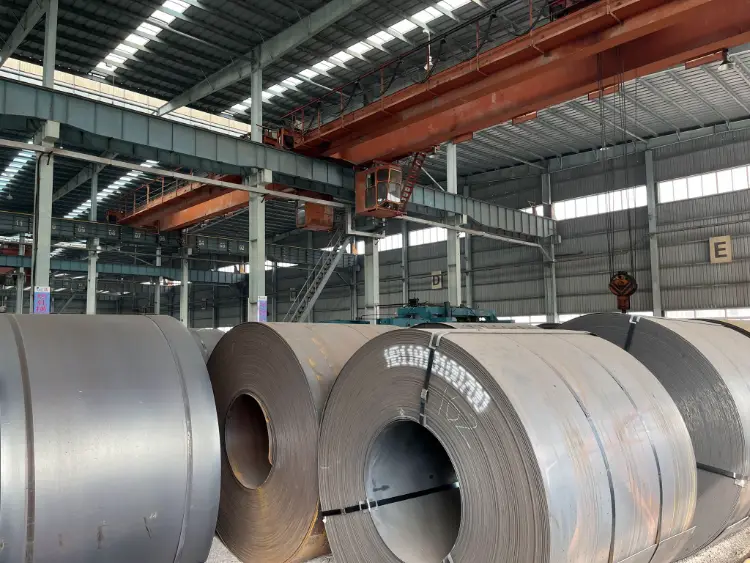
EN10225 S355G5+M Shipbuilding Steel Coil
EN10225 S355G5+M Shipbuilding Steel Coil: High-Strength Offshore Structural Steel with Through-Thickness Properties
Analyze EN10225 S355G5+M steel coil for shipbuilding and offshore structures: chemical composition, mechanical properties, physical parameters, international equivalents, and applications.
Thermomechanical rolling (+M), welding, cold forming, gas cutting, plasma cutting
- Phone : +8618037372205
- Email : [email protected]
- WhatsApp: Contact via Whtsapp
- WeChat: +8618037372205
EN10225 S355G5+M Shipbuilding Steel Coil Introduction
EN10225 S355G5+M is a thermomechanically rolled weldable fine-grain structural steel for fixed offshore structures and shipbuilding applications. As a +M delivery condition, the steel achieves its mechanical properties through controlled rolling with accelerated cooling. The G5 designation ensures guaranteed through-thickness properties (minimum 35% reduction of area, equivalent to Z35) and impact toughness at -40°C. Key features include high yield strength (≥355 MPa), excellent toughness at low temperature, improved lamellar tearing resistance, and good weldability with a low carbon equivalent. The steel is typically supplied as coil for further processing into plates, sections, and welded components for harsh marine environments.
EN10225 S355G5+M Shipbuilding Steel Coil Chemical composition
Typical values according to EN 10225-1:2019 for product thickness ≤ 40 mm. The low carbon content and microalloying with niobium, vanadium and titanium ensure fine grain strengthening and good weldability. Sulfur is limited to 0.008% max to enhance through‑thickness ductility and lamellar tearing resistance, corresponding to Z35 quality. CEV limited to 0.43% for good weldability without preheating under normal conditions.
| Element | Standard Value (wt%) | Remarks |
|---|---|---|
| Carbon (C) | ≤ 0.12 | For t ≤ 40 mm; for 40 < t ≤ 100 mm: ≤ 0.14 |
| Silicon (Si) | ≤ 0.50 | Deoxidizer |
| Manganese (Mn) | 1.00 – 1.70 | Enhances strength and toughness |
| Phosphorus (P) | ≤ 0.020 | Maximum content |
| Sulfur (S) | ≤ 0.008 | Low for Z‑quality; through‑thickness properties |
| Aluminium (Altotal) | ≥ 0.015 | Acid‑soluble; fine grain practice |
| Niobium (Nb) | ≤ 0.05 | Microalloying element |
| Vanadium (V) | ≤ 0.10 | Microalloying element |
| Titanium (Ti) | ≤ 0.03 | Microalloying element |
| Chromium (Cr) | ≤ 0.25 | Residual element |
| Nickel (Ni) | ≤ 0.50 | Residual element |
| Molybdenum (Mo) | ≤ 0.10 | Residual element |
| Copper (Cu) | ≤ 0.35 | Residual element |
| Nitrogen (N) | ≤ 0.012 | Max for Al‑killed steel |
| Carbon Equivalent (CEV) | ≤ 0.43 | Based on IIW formula: CEV = C+Mn/6+(Cr+Mo+V)/5+(Ni+Cu)/15 |
EN10225 S355G5+M Shipbuilding Steel Coil Physical properties
The following physical properties are representative for structural steel of this type and are included as engineering guidance. They are not part of EN 10225‑1 but are commonly used for design calculations. Values are valid at room temperature except where otherwise noted.
| Property | Typical Value | Unit | Test Condition / Remarks |
|---|---|---|---|
| Density (ρ) | 7.85 | kg/dm³ (g/cm³) | 20°C |
| Modulus of elasticity (E) | 210 | GPa | 20°C, static |
| Shear modulus (G) | ≈ 80.8 | GPa | Calculated from E and ν |
| Poisson's ratio (ν) | 0.3 | — | Within elastic range |
| Thermal expansion coefficient (α) | 12.0 × 10⁻⁶ | K⁻¹ (1/K) | 20–100°C |
| Thermal conductivity (λ) | ≈ 50 | W/(m·K) | At 100°C |
| Specific heat capacity (cp) | ≈ 460 | J/(kg·K) | 20–100°C |
| Electrical resistivity (ρe) | ≈ 0.20 | µΩ·m (20°C) | Typical for low‑alloy steel |
EN10225 S355G5+M Shipbuilding Steel Coil Mechanical properties
Mechanical properties conform to EN 10225‑1:2019 for +M (thermomechanically rolled) delivery condition. Yield strength and tensile strength are valid for thickness ≤ 40 mm; values decrease slightly for thicker sections. Impact toughness is guaranteed at −40°C with KVmin = 42 J longitudinal. Through‑thickness reduction of area (Z35 requirement) applies to thickness ≥ 10 mm and reflects excellent lamellar tearing resistance.
| Property | Standard Value | Unit | Test Condition |
|---|---|---|---|
| Yield Strength (ReH) | ≥ 355 | MPa | t ≤ 40 mm, longitudinal |
| Yield Strength (ReH) | ≥ 345 | MPa | 40 < t ≤ 80 mm, longitudinal (reference) |
| Tensile Strength (Rm) | 470 – 630 | MPa | t ≤ 40 mm, longitudinal |
| Elongation (A5) | ≥ 22 | % | Proportional test piece, L0=5.65√S0, t ≤ 40 mm |
| Impact energy (KV) | ≥ 42 (min.) | J | Longitudinal, −40°C, 5 < t ≤ 63 mm |
| Impact energy (KV) | ≥ 28 (min.) | J | Transverse, −40°C, 5 < t ≤ 63 mm |
| Through‑thickness reduction of area (Z) | ≥ 35 (average), ≥ 25 (individual) | % | Z35 quality, t ≥ 10 mm, per EN 10164 |
EN10225 S355G5+M Shipbuilding Steel Coil Full equivalent grades / direct substitutions
| Country / Region | Standard | Grade | Remarks |
|---|---|---|---|
| European Union | EN 10225-1:2019 | S355G5+M | Thermomechanically rolled, Z35 through‑thickness, −40°C impact |
| International | ISO 19902-1:2007 | S355G5 | Identical designation, same technical requirements |
| United Kingdom | BS 7191:1989 | 355EMZ | Equivalent offshore steel, Z35 quality, similar chemistry |
EN10225 S355G5+M Shipbuilding Steel Coil Application Introduction
EN10225 S355G5+M steel coil is specifically designed for critical welded structures in marine and offshore environments. Its combination of high strength, guaranteed low‑temperature toughness, and through‑thickness ductility makes it ideal for dynamically loaded parts and nodes subject to high restraint where lamellar tearing must be avoided. The +M condition ensures uniform mechanical properties and good surface quality directly from the coil, reducing the need for subsequent heat treatment.
Product Applications: Hot‑rolled coil, cut‑to‑length plates, heavy plates, Welded H‑beams, box columns, tubular sections, Ship and offshore modules, Wind turbine foundation transition pieces (TPs), Pipeline end bulkheads and riser clamps
Processed into products: Longitudinal stiffeners and frames in ship hulls, Jacket leg braces and node cans, Deck plate inserts under high local loads, Monopile door frames and brackets, Crane pedestal base plates, Fatigue‑critical welded joints in splash zone, Support stools and pad‑eyes for offshore lifting
Application industries: Offshore Oil & Gas: Jacket platforms, topside modules, FPSO hulls, Marine & Shipbuilding: Hull structural members, deck plating, engine room girders, Renewable Energy: Offshore wind turbine foundations (monopiles, transition pieces, jackets), Civil Engineering: Bridges, lock gates, harbour structures, Heavy Machinery: Crane booms, excavator components for marine duty
EN10225 S355G5+M Shipbuilding Steel Coil Similar / comparable alternative materials
| Country / Region | Standard | Grade | Remarks |
|---|---|---|---|
| European Union | EN 10225-1:2019 | S355G4+M | Same strength, impact −20°C, Z35 possible; lower toughness requirement |
| European Union | EN 10225-1:2019 | S355G10+M | Impact −10°C, Z35; less severe temperature performance |
| European Union | EN 10025-3:2019 | S355N/NL | Normalized/normalized rolled fine‑grain steel; no mandatory Z‑quality; S355NL offers −50°C toughness, not offshore certified |
| USA | ASTM A572 / ASTM A578 | Grade 50 + Z‑test | Comparable yield (345 MPa) with supplementary through‑thickness testing; different chemistry and impact philosophy |
| USA | API 2H Grade 50 | API 2H | Offshore structural plate, Z‑quality optional; slightly different yield and thickness ranges |
Notes:
- Welding: S355G5+M offers excellent weldability with low carbon equivalent (CEV ≤ 0.43). Preheating is generally not required for moderate thicknesses, but follow EN 1011‑2 recommendations. Low hydrogen processes (SAW, FCAW, SMAW with basic electrodes) are preferred to avoid cold cracking.
- Z‑quality verification: Through‑thickness tensile tests (Z35) are mandatory for thicknesses ≥ 10 mm and must be carried out according to EN 10164. The designation G5 implies a minimum average reduction of area of 35%.
- Surface condition: As‑rolled surface with possible mill scale. Coil may be pickled and oiled on request for improved surface finish before fabrication.
- Tolerances: Dimensional tolerances for coil‑derived plates correspond to EN 10029 or EN 10051, as applicable.
- Certification: Typical inspection certificate 3.1 per EN 10204, including chemical analysis, tensile, impact, and through‑thickness test results.
- Share



