
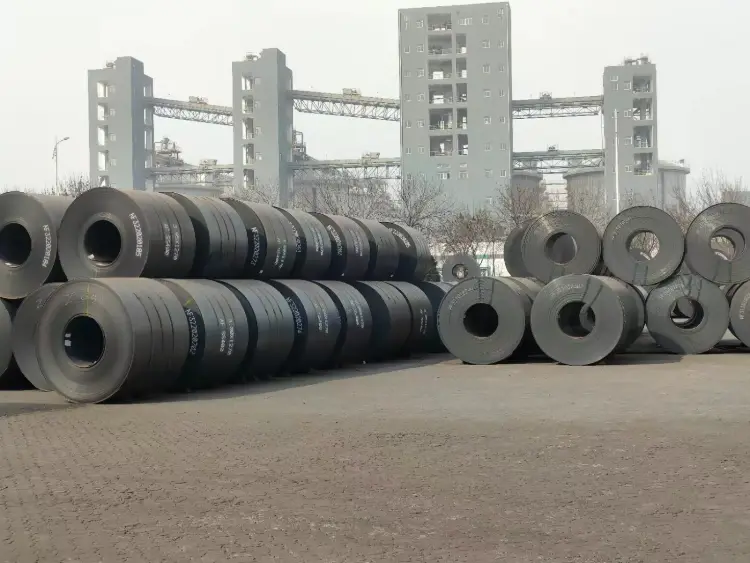
EN10225 S355G10+N Offshore Steel Coil
EN10225 S355G10+N Offshore Steel Coil - Normalized Structural Steel for Marine Environments
Comprehensive data sheet for S355G10+N steel under EN 10225: normalized structural steel for offshore and marine applications, including chemistry, mechanical properties, and thermal performance.
Hot rolling followed by normalizing heat treatment (+N). Suitable for cold forming, welding (all conventional methods), cutting, and machining.
- Phone : +8618037372205
- Email : [email protected]
- WhatsApp: Contact via Whtsapp
- WeChat: +8618037372205
EN10225 S355G10+N Offshore Steel Coil Introduction
EN10225 S355G10+N is a weldable normalized structural steel specifically designed for offshore structures, wind turbine foundations, and shipbuilding components. The grade designation indicates a minimum yield strength of 355 MPa at thicknesses up to 16 mm and guaranteed Charpy impact energy at -10°C (symbol "G10"). The "+N" suffix denotes a normalized delivery condition, which refines the grain structure, improves toughness, and ensures uniform mechanical properties across thick sections. Typical applications include jacket legs, transition pieces, and primary structural members exposed to low ambient temperatures and dynamic loads. The steel exhibits good weldability and resistance to brittle fracture, meeting strict requirements for North Sea and other harsh marine environments. Such properties are achieved through controlled chemistry with low carbon equivalent (CEV) and microalloying additions such as niobium and vanadium.
EN10225 S355G10+N Offshore Steel Coil Chemical Composition
The alloying design of S355G10+N emphasizes low carbon content for weldability and fine grain structure for toughness. Controlled additions of manganese, niobium, and vanadium provide the required strength without excessive carbon equivalent values (CEV ≤ 0.43 typically). Phosphorus and sulfur are tightly controlled to minimise centreline segregation and improve through‑thickness properties. Full deoxidation with aluminium ensures fine‑grained steel. The limits below are based on cast analysis from EN 10225:2009 for grade S355G10.
| Chemical element | Standard value (max unless range) | Remarks |
|---|---|---|
| Carbon (C) | ≤0.14 % | Maximum permissible content |
| Silicon (Si) | ≤0.50 % | |
| Manganese (Mn) | ≤1.60 % | Minimum value may be agreed (e.g., 0.90 – 1.60 %) |
| Phosphorus (P) | ≤0.020 % | Stringent control for through‑thickness properties |
| Sulfur (S) | ≤0.010 % | Low sulphur improves Z‑direction ductility |
| Chromium (Cr) | ≤0.30 % | Incidental residual element |
| Nickel (Ni) | ≤0.30 % | Incidental residual element |
| Molybdenum (Mo) | ≤0.10 % | |
| Copper (Cu) | ≤0.35 % | Residual limit |
| Niobium (Nb) | ≤0.05 % | Grain refiner, increases strength |
| Vanadium (V) | ≤0.10 % | Precipitation strengthening |
| Titanium (Ti) | ≤0.05 % | Grain refinement, nitrogen binding |
| Aluminium (Al) | ≥0.020 % | Total aluminium, ensures fine‑grained practice |
| Nitrogen (N) | ≤0.012 % | Maximum unless bound by Ti or Al |
| Carbon equivalent (CEV) | Typically ≤0.43 % | Formula: CEV = C + Mn/6 + (Cr+Mo+V)/5 + (Ni+Cu)/15; actual value depends on product thickness |
EN10225 S355G10+N Offshore Steel Coil Thermal and Electrical Physical Properties
The values provided are typical for normalized structural carbon‑manganese steel of this strength level. They are not mandatory physical requirements specified in EN 10225, but are commonly used for design calculations, welding procedure development, and finite element analysis. Slight variations may occur depending on exact chemical composition and heat treatment.
| Property | Typical value | Unit | Test condition / Remarks |
|---|---|---|---|
| Density (ρ) | 7850 | kg/m³ | Room temperature |
| Modulus of elasticity (E) | 210 | GPa | Ambient temperature |
| Shear modulus (G) | 81 | GPa | Calculated from E and ν |
| Poisson's ratio (ν) | 0.3 | — | Within elastic range |
| Thermal expansion coefficient (α) | 11.7 × 10⁻⁶ | K⁻¹ | Between 20°C and 100°C |
| Thermal expansion coefficient (α) | 12.5 × 10⁻⁶ | K⁻¹ | Between 20°C and 300°C |
| Thermal conductivity (λ) | 50 | W/(m·K) | At 20°C |
| Thermal conductivity (λ) | 45 | W/(m·K) | At 200°C |
| Specific heat capacity (cₚ) | 460 | J/(kg·K) | Room temperature |
| Electrical resistivity (ρₑ) | 0.20 – 0.23 | µΩ·m | Typical for structural CMn steel |
EN10225 S355G10+N Offshore Steel Coil Mechanical Properties
Mechanical testing is performed on specimens taken in the transverse direction, unless otherwise agreed. S355G10+N meets minimum yield and tensile strength requirements across a range of thicknesses. Charpy V‑notch impact tests are mandatory at -10°C, with separate requirements for longitudinal and transverse specimens. Bend tests ensure adequate ductility without cracking. The values below are in accordance with EN 10225:2009 for grade S355G10.
| Property | Standard required value | Unit | Test condition / Remarks |
|---|---|---|---|
| Yield strength (ReH) | ≥355 | MPa | Thickness t ≤ 16 mm |
| Yield strength (ReH) | ≥345 | MPa | 16 mm < t ≤ 40 mm |
| Yield strength (ReH) | ≥335 | MPa | 40 mm < t ≤ 63 mm |
| Yield strength (ReH) | ≥325 | MPa | 63 mm < t ≤ 80 mm |
| Yield strength (ReH) | ≥315 | MPa | 80 mm < t ≤ 100 mm |
| Tensile strength (Rm) | 470 – 630 | MPa | t ≤ 100 mm |
| Elongation (A) | ≥22 | % | t ≤ 40 mm, gauge length 5.65√So |
| Elongation (A) | ≥21 | % | 40 mm < t ≤ 63 mm |
| Elongation (A) | ≥20 | % | 63 mm < t ≤ 80 mm |
| Elongation (A) | ≥19 | % | 80 mm < t ≤ 100 mm |
| Charpy V‑notch impact energy (KV) | ≥50 (longitudinal) | J | at -10°C, average of 3 tests; individual min ≥35 J |
| Charpy V‑notch impact energy (KV) | ≥34 (transverse) | J | at -10°C, average of 3 tests; individual min ≥24 J |
| Bend test (mandrel diameter) | 180° bend, no cracks | — | Mandrel diameter = 3t (t = sample thickness) for tensile face bending |
EN10225 S355G10+N Offshore Steel Coil Completely Equivalent Material Standards and Substitutable Grades
| Country/Region | Standard | Grade | Remarks |
|---|---|---|---|
| Europe | EN 10225:2009 | S355G10+N | The base grade discussed; normalized (+N) condition. |
| Europe | EN 10225:2009 | S355G10+M | Thermomechanically rolled variant; often interchangeable provided toughness and CEV align. Subject to purchaser agreement. |
| Europe | EN 10025-3:2019 | S355NL | Normalized structural steel for general application; not specifically for offshore, but can substitute if additional toughness and Z‑tests are agreed. |
| International | API RP 2A / API 2W | API 2W Grade 50 (normalized) | For tubular joints and offshore structures; equivalent mechanical properties when normalized, with supplementary impact testing at -10°C or lower. |
| USA | ASTM A572/A572M | Grade 50 [345] with S5 supplement | When ordered with Charpy impact requirement at -10°C and fine‑grain practice, can be a practical substitute. Must confirm CEV and sulfur limits. |
EN10225 S355G10+N Offshore Steel Coil Application Introduction
S355G10+N is engineered for heavy structural fabrications in marine and offshore sectors where reliability at low ambient temperatures and high fatigue resistance are critical. It is commonly delivered in normalized plate or coil form and processed into components that demand consistent through‑thickness properties.
Product Applications: Jacket structures and nodes for offshore platforms, Transition pieces and grouted connections for wind turbines, Helideck support frames and crane pedestals, Hull stiffeners and deck components on ice‑class vessels, Subsea templates and manifold skids, Heavy‑lift beams and piling gates
Processed into products: Tubular joints (Y, K, T joints) fabricated from welded plates, Flanges and ring stiffeners for wind turbine towers, Gusset plates, base plates, and shear keys, Pile sleeves and mud mats, Lifting lugs and pad‑eyes, Connection brackets for bracing members
Application industries: Offshore oil and gas exploration and production, Offshore wind energy (foundations, transition pieces, monopiles), Shipbuilding and marine engineering (special structural members), Bridge construction in cold regions, Heavy civil engineering and infrastructure subjected to wind and wave loads
EN10225 S355G10+N Offshore Steel Coil Similar or Analogous Substitute Materials
| Country/Region | Standard | Grade | Remarks |
|---|---|---|---|
| Europe | EN 10025-3 | S355N / S355NL | S355N has similar strength but less stringent low‑temperature toughness (impact at -20°C); S355NL offers better toughness and is closer to G10 when normalized. |
| USA | ASTM A572/A572M | Grade 50 (Type 1) | Must be ordered with fine‑grain practice and supplementary Charpy testing at -10°C. Residual element limits are less strict, so verification is required. |
| Japan | JIS G 3106 | SM490A / SM490B / SM490C | SM490C provides impact guarantee at 0°C; may approach S355G10 performance if tested separately at -10°C and normalized. Chemistry differs (higher Mn permitted). |
| China | GB/T 712 | DH36 / EH36 | High‑strength shipbuilding steels; DH36 guarantees impact at -20°C, but CEV and phosphorus limits differ. Suitable for marine structures but not directly for offshore unless agreed. |
| International | ISO 630-3 | S355N | ISO standard for normalized structural steel; similar to EN 10025-3 S355N. Can be considered if purchaser verifies impact testing at -10°C. |
Notes:
S355G10+N may be produced with improved through‑thickness properties (Z‑quality) according to EN 10164 if specified. The carbon equivalent value (CEV) can be lower for thicker products to ensure crack‑free welding without excessive preheat. Supplementary Charpy V‑notch testing at temperatures other than -10°C can be agreed between purchaser and manufacturer. Ultrasonic testing per EN 10160 is often mandatory for plates destined for critical offshore components. When comparing with the +M variant, normalized material exhibits greater thermal stability and is preferred for hot‑forming operations.
- Share



