
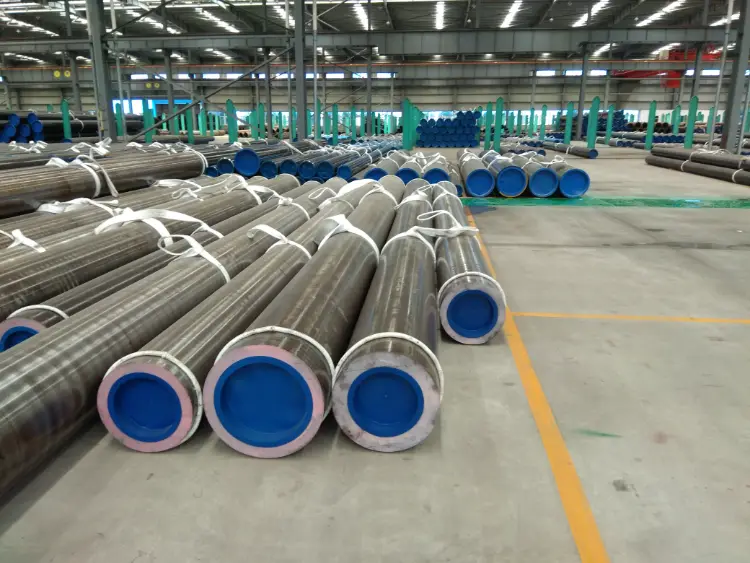
EN10219 S420MLH SSAW Pipe
EN10219 S420MLH SSAW Pipe: High-Strength Low-Alloy Structural Hollow Section Steel
Comprehensive material data for S420MLH steel grade according to EN 10219-1 standard, used for cold-formed welded structural hollow sections, focusing on spiral submerged arc welded (SSAW) pipe applications.
Cold forming, welding (SAW, SSAW), cutting, machining, bending, and optional stress relieving
- Phone : +8618037372205
- Email : [email protected]
- WhatsApp: Contact via Whtsapp
- WeChat: +8618037372205
EN10219 S420MLH SSAW Pipe Introduction
S420MLH is a high-strength low-alloy structural steel grade defined in the European standard EN 10219-1 for cold-formed welded structural hollow sections. The 'S' indicates structural steel, '420' specifies a minimum yield strength of 420 MPa, 'M' stands for thermomechanical rolled delivery condition, 'L' denotes improved low-temperature notch toughness, and 'H' signifies hollow section. This grade is typically supplied as spiral submerged arc welded (SSAW) pipe, offering excellent weldability, high strength-to-weight ratio, and good toughness at low temperatures. It is widely used in demanding structural applications such as offshore structures, bridges, heavy machinery, and building construction. The steel is produced through a controlled rolling process, resulting in a fine-grained microstructure that provides superior mechanical properties without the need for subsequent heat treatment.
EN10219 S420MLH SSAW Pipe Chemical Composition
The chemical composition is critical for achieving the mechanical properties of S420MLH steel. The alloying elements are carefully controlled to ensure high strength, good weldability, and low-temperature toughness. The maximum carbon equivalent (CEV) is typically limited to ensure weldability, with a maximum value of 0.43% based on heat analysis. Niobium, vanadium, and titanium are microalloying elements that contribute to grain refinement and precipitation strengthening during thermomechanical rolling.
| Element | Standard Value (max %) | Remarks |
|---|---|---|
| Carbon (C) | 0.16 | For sections up to 40 mm thickness; for larger thicknesses, see standard |
| Silicon (Si) | 0.50 | Deoxidizer and strength contributor |
| Manganese (Mn) | 1.70 | Main alloying element for strength and toughness |
| Phosphorus (P) | 0.025 | Maximum limit for low-temperature toughness |
| Sulfur (S) | 0.015 | Maximum limit to ensure formability and weld quality |
| Aluminum (Al) total | ≥ 0.020 | Minimum for grain refinement and deoxidation |
| Niobium (Nb) | 0.05 | Microalloying for grain refinement |
| Vanadium (V) | 0.12 | Microalloying for precipitation strengthening |
| Titanium (Ti) | 0.05 | Microalloying for grain refinement |
| Nickel (Ni) | 0.80 | Optional for improving low-temperature toughness |
| Chromium (Cr) | 0.30 | Optional; for larger thicknesses, increased Cr may be present |
| Molybdenum (Mo) | 0.20 | Optional; can enhance strength for thicker sections |
| Copper (Cu) | 0.55 | Optional; may be present from scrap or added for weathering resistance |
| Nitrogen (N) | 0.015 | Maximum for bound nitrogen in microalloyed steels |
| Carbon Equivalent (CEV) | 0.43 | Maximum based on heat analysis for weldability |
EN10219 S420MLH SSAW Pipe Thermal and Electrical Physical Properties
The physical properties are typical for thermomechanically rolled structural steels and are applicable at ambient temperature unless otherwise stated. These values are provided as reference for design calculations and may vary slightly depending on the actual chemical composition and processing conditions. Thermal expansion and conductivity are critical for welded structure design, while electrical resistivity is useful for specific applications.
| Property | Typical Value | Unit | Test Condition / Remarks |
|---|---|---|---|
| Density (ρ) | 7850 | kg/m³ | At 20°C |
| Modulus of Elasticity (E) | 210 | GPa | At 20°C, longitudinal direction |
| Shear Modulus (G) | 81 | GPa | At 20°C, calculated |
| Poisson's Ratio (ν) | 0.3 | — | At 20°C, in elastic range |
| Thermal Expansion Coefficient (α) | 12.0 × 10⁻⁶ | 1/K | Average from 20°C to 100°C |
| Thermal Expansion Coefficient (α) | 12.5 × 10⁻⁶ | 1/K | Average from 20°C to 200°C |
| Thermal Expansion Coefficient (α) | 13.0 × 10⁻⁶ | 1/K | Average from 20°C to 300°C |
| Thermal Conductivity (λ) | 48 | W/(m·K) | At 20°C |
| Thermal Conductivity (λ) | 46 | W/(m·K) | At 100°C |
| Specific Heat Capacity | 480 | J/(kg·K) | At 20°C |
| Specific Heat Capacity | 520 | J/(kg·K) | At 100°C |
| Electrical Resistivity (ρ_e) | 0.25 | μΩ·m | At 20°C, approximate value |
EN10219 S420MLH SSAW Pipe Mechanical Properties
The mechanical properties of S420MLH are specified for the base material at ambient temperature in the delivery condition. The yield strength and tensile strength depend on the specified wall thickness of the hollow section. The minimum impact energy values are guaranteed for the longitudinal direction at specified test temperatures. All values are according to EN 10219-1 for structural hollow sections.
| Property | Standard Requirement Value | Unit | Test Condition / Remarks |
|---|---|---|---|
| Yield Strength (ReH) | 420 | MPa | For thickness t ≤ 16 mm |
| Yield Strength (ReH) | 400 | MPa | For thickness 16 < t ≤ 40 mm |
| Yield Strength (ReH) | 390 | MPa | For thickness 40 < t ≤ 63 mm |
| Tensile Strength (Rm) | 520 to 680 | MPa | For thickness t ≤ 63 mm |
| Elongation after fracture (A) | 19 | % | For thickness t ≤ 40 mm; longitudinal, gauge length L₀ = 5.65√S₀ |
| Elongation after fracture (A) | 18 | % | For thickness 40 < t ≤ 63 mm |
| Impact energy (KV) at -50°C | 27 | J | Minimum, longitudinal; test temperature is given by the 'L' designation |
| Impact energy (KV) at -50°C | 27 | J | Average of three specimens; one individual value may be below, but ≥ 70% of specified min. |
| Bend test (mandrel diameter) | No cracks | — | Bend test to 180°; mandrel diameter depends on thickness, typically 3t for outer diameter bending |
EN10219 S420MLH SSAW Pipe Completely Equivalent Material Standards and Replaceable Grades
| Country/Region | Standard | Grade | Remarks |
|---|---|---|---|
| Europe | EN 10219-1 | S420MLH | Original standard and grade for cold-formed hollow sections |
| International | ISO 630-3 | S420MLH | Identical grade under the ISO system for structural steels |
| Germany | DIN EN 10219-1 | S420MLH | Adopted European standard |
| France | NF EN 10219-1 | S420MLH | Adopted European standard |
| United Kingdom | BS EN 10219-1 | S420MLH | Adopted European standard |
| Russia | GOST R 58021 | S420MLH | Equivalent in Russian standard for hollow sections, if certification is transferable |
EN10219 S420MLH SSAW Pipe Application Introduction
EN10219 S420MLH SSAW pipe is ideally suited for demanding structural applications where high strength, reduced weight, and reliable low-temperature performance are critical. Its spiral welded construction allows for the production of large-diameter pipes with consistent mechanical properties, making it a preferred choice in heavy engineering, offshore projects, and large-scale infrastructure. The M (thermomechanical rolled) and L (low-temperature toughness) designations ensure that the material can withstand dynamic loads and harsh environments.
Product Applications: SSAW pipes in diameters up to 3000 mm and wall thicknesses up to 25 mm (or as per producer capacity), Cold-formed rectangular and square hollow sections for structural frameworks, Welded structural components such as transition pieces and Y-joints for offshore jackets, Longitudinally welded pipes for smaller diameters (ERW/HFI) when SSAW is not applicable
Processed into products: Primary structural columns and beams, Lattice tower members (bolted or welded), Pile sleeves and connectors, Bracing elements for earthquake-resistant frames, Heavy-duty scaffolding and shoring systems, Chimney and flare stack structures
Application industries: Offshore Oil & Gas: Jacket legs, piles, conductors, and riser components, Civil Engineering & Construction: Bridge piers, stadium roofs, airport terminal structures, and high-rise building columns, Wind Energy: Tower shafts and foundation monopiles for onshore and offshore wind turbines, Heavy Machinery & Equipment: Crane booms, heavy vehicle chassis, and mining equipment, Shipbuilding: Deck structures and hull stiffeners (subject to classification society approval), Foundation Engineering: Large-diameter piling for deep foundations
EN10219 S420MLH SSAW Pipe Similar/Alternative Materials Recommendation
| Country/Region | Standard | Grade | Remarks |
|---|---|---|---|
| Europe | EN 10219-1 | S460MLH | Higher strength grade (460 MPa yield) with similar toughness; may require adjusted welding procedures |
| Europe | EN 10219-1 | S420MH | Same strength, but without the improved low-temperature toughness (L); suitable for less demanding conditions |
| Europe | EN 10210-1 | S420MLH | Hot-finished hollow section version; mechanical properties are similar, but dimensional tolerances and residual stresses differ |
| China | GB/T 1591 | Q420D | High-strength low-alloy structural steel with minimum yield 420 MPa and -20°C impact; hollow sections may follow GB/T 6728 or GB/T 3091. Not direct equivalent but similar in strength. |
| USA | ASTM A500/A500M | Grade C (enhanced) | Strength similar when modified, but standard mill practice often does not guarantee 420 MPa min. yield; ASTM A572 Grade 65 for plate may be used to fabricate pipes, but toughness levels are project-specific. |
Notes:
The SSAW (Spiral Submerged Arc Welded) pipe form requires careful control of weld metal properties to match base metal toughness. The weld seam is typically subject to 100% non-destructive testing (e.g., ultrasonic or radiographic). End users should specify supplementary requirements such as through-thickness properties (Z-quality per EN 10164) if heavy restraints or fatigue loading are expected. Heat treatment is generally not required for base material in the delivery condition, but post-weld heat treatment (PWHT) may be applied to reduce residual stresses if specified. Always refer to the latest EN 10219-1:2006 and its amendments for mandatory requirements.
- Share



