
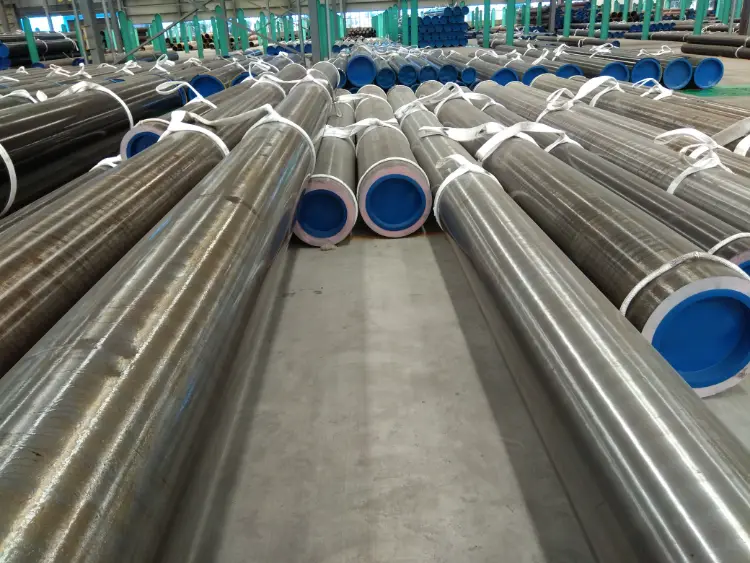
EN10219 S420MH Steel for SSAW Pipes
EN10219 S420MH Steel for SSAW Pipes - Complete Material Data and Properties
Comprehensive technical data sheet for S420MH structural steel according to EN 10219, used in spiral submerged arc welded (SSAW) pipes. Covers chemical composition, mechanical properties, physical constants, and equivalents.
Cold forming, submerged arc welding, high-frequency welding, machining
- Phone : +8618037372205
- Email : [email protected]
- WhatsApp: Contact via Whtsapp
- WeChat: +8618037372205
EN10219 S420MH Steel for SSAW Pipes Introduction
S420MH is a thermomechanically rolled weldable fine-grain structural steel intended for cold-formed welded hollow sections. It is primarily specified in EN 10219-1 and is commonly supplied as SSAW (spiral submerged arc welded) pipes for structural and pressure applications. The 'S' denotes structural steel, '420' indicates a minimum yield strength of 420 MPa for thicknesses up to 16 mm, 'M' stands for thermomechanical rolling, and 'H' indicates hollow section. This grade offers a balanced combination of high strength, good weldability, and adequate toughness at low temperatures when ordered with the appropriate quality suffix (J0, J2 or K2). Typical applications include heavy structural frameworks, piling, bridges, and offshore structures. The steel can be produced in various hollow profiles, including circular, square, and rectangular sections, as well as SSAW pipes.
EN10219 S420MH Steel for SSAW Pipes Chemical Composition
The ladle analysis limits for S420MH according to EN 10219-1 are provided below. The steel is microalloyed with niobium, vanadium, and titanium to achieve fine grain size. The carbon equivalent (CEV) is controlled to ensure good weldability. For quality grade K2, the maximum phosphorus and sulfur contents are tighter: P ≤ 0.025%, S ≤ 0.020%. For grades J0 and J2, the limits for P and S are 0.030% and 0.025% respectively.
| Element | Value (max %) | Remarks |
|---|---|---|
| Carbon (C) | 0.16 | Maximum |
| Silicon (Si) | 0.50 | Maximum |
| Manganese (Mn) | 1.70 | Maximum |
| Phosphorus (P) | 0.030 (0.025 for K2) | Maximum |
| Sulfur (S) | 0.025 (0.020 for K2) | Maximum |
| Niobium (Nb) | 0.05 | Maximum; typical grain refiner |
| Vanadium (V) | 0.12 | Maximum; typical grain refiner |
| Titanium (Ti) | 0.05 | Maximum; typical grain refiner |
| Aluminium (Al total) | ≥ 0.020 | Minimum total aluminium content |
| Nickel (Ni) | 0.30 | Maximum |
| Chromium (Cr) | 0.30 | Maximum |
| Copper (Cu) | 0.35 | Maximum |
| Molybdenum (Mo) | 0.10 | Maximum |
| Nitrogen (N) | 0.020 | Maximum |
| CEV (Carbon Equivalent) | 0.41 | Maximum; CEV = C + Mn/6 + (Cr+Mo+V)/5 + (Ni+Cu)/15 |
EN10219 S420MH Steel for SSAW Pipes Physical and Thermal Properties
Physical properties are typical for low-alloy structural steels and are not mandatory requirements. They are provided for design calculations. The values are applicable at room temperature unless otherwise stated. Thermal expansion and thermal conductivity are temperature-dependent; the given values cover a frequently used range.
| Property | Value | Unit | Test Condition |
|---|---|---|---|
| Density (ρ) | 7.85 | g/cm³ | 20 °C |
| Elastic modulus (E) | 210 | GPa | 20 °C |
| Shear modulus (G) | ≈ 81 | GPa | 20 °C |
| Poisson's ratio (ν) | 0.3 | — | 20 °C |
| Thermal expansion coefficient (α) | 12.0 × 10⁻⁶ | K⁻¹ | 20 °C to 100 °C |
| Thermal expansion coefficient (α) | 12.5 × 10⁻⁶ | K⁻¹ | 20 °C to 200 °C |
| Thermal expansion coefficient (α) | 13.0 × 10⁻⁶ | K⁻¹ | 20 °C to 300 °C |
| Thermal conductivity (λ) | 50 | W/m·K | 20 °C |
| Thermal conductivity (λ) | 46 | W/m·K | 100 °C |
| Specific heat capacity (c) | 460 | J/kg·K | 20 °C |
| Electrical resistivity (ρₑ) | 0.20 × 10⁻⁶ | Ω·m | 20 °C |
EN10219 S420MH Steel for SSAW Pipes Mechanical Properties
Mechanical properties for S420MH hollow sections at ambient temperature are taken from EN 10219-1. The minimum values depend on the product wall thickness. Toughness requirements vary with the quality grade:
- J0: impact energy ≥ 27 J at 0 °C
- J2: impact energy ≥ 27 J at -20 °C
- K2: impact energy ≥ 40 J at -20 °C
Bending test is performed with a 180° bend angle. Functional bending mandrel diameters are reported for longitudinal or transverse test pieces.
| Property | Value | Unit | Test Condition |
|---|---|---|---|
| Yield strength (ReH) | ≥ 420 | MPa | Wall thickness ≤ 16 mm |
| Yield strength (ReH) | ≥ 420 | MPa | 16 mm < t ≤ 40 mm |
| Yield strength (ReH) | ≥ 400 | MPa | 40 mm < t ≤ 63 mm |
| Yield strength (ReH) | ≥ 400 | MPa | 63 mm < t ≤ 80 mm |
| Yield strength (ReH) | ≥ 390 | MPa | 80 mm < t ≤ 100 mm |
| Yield strength (ReH) | ≥ 380 | MPa | 100 mm < t ≤ 120 mm |
| Tensile strength (Rm) | 500 – 660 | MPa | All thicknesses |
| Elongation after fracture (A), longitudinal | ≥ 20 | % | t ≤ 40 mm |
| Elongation after fracture (A), transverse | ≥ 18 | % | t ≤ 40 mm |
| Elongation after fracture (A), longitudinal | ≥ 19 | % | t > 40 mm (informative) |
| Elongation after fracture (A), transverse | ≥ 17 | % | t > 40 mm (informative) |
| Bending test (mandrel diameter), longitudinal/transverse | 3t (t = thickness) | — | t ≤ 16 mm, bend angle 180° |
| Bending test (mandrel diameter) | 4t | — | 16 mm < t ≤ 40 mm, bend angle 180° |
| Bending test (mandrel diameter) | 5t | — | 40 mm < t ≤ 63 mm, bend angle 180° |
| Bending test (mandrel diameter) | 6t | — | 63 mm < t ≤ 100 mm, bend angle 180° |
| Impact energy (KV), quality J0 | ≥ 27 | J | 0 °C, longitudinal, standard specimen |
| Impact energy (KV), quality J2 | ≥ 27 | J | -20 °C, longitudinal, standard specimen |
| Impact energy (KV), quality K2 | ≥ 40 | J | -20 °C, longitudinal, standard specimen |
EN10219 S420MH Steel for SSAW Pipes Identical Equivalent Grades Under EN 10219-1
National adoptions of the European standard EN 10219-1 provide fully equivalent grades. The table lists the designations that are 100% identical in chemical and mechanical requirements to S420MH.
| Country/Region | Standard | Grade | Remarks |
|---|---|---|---|
| European Union | EN 10219-1 | S420MH (base grade); S420J0H, S420J2H, S420K2H with impact requirements) | Hollow sections |
| United Kingdom | BS EN 10219-1 | S420MH; S420J0H, S420J2H, S420K2H | Same technical requirements |
| Germany | DIN EN 10219-1 | S420MH; S420J0H, S420J2H, S420K2H | Same technical requirements |
| France | NF EN 10219-1 | S420MH; S420J0H, S420J2H, S420K2H | Same technical requirements |
| Italy | UNI EN 10219-1 | S420MH; S420J0H, S420J2H, S420K2H | Same technical requirements |
| Spain | UNE-EN 10219-1 | S420MH; S420J0H, S420J2H, S420K2H | Same technical requirements |
| International (ISO) | ISO 630-3:2021 (plate/strip) | S420M (similar, not for hollow sections) | ISO has no direct hollow section equivalent; chemical and strength basis match |
EN10219 S420MH Steel for SSAW Pipes Application Introduction
S420MH SSAW pipes and hollow sections are extensively utilized in demanding structural and civil engineering projects. Their high strength-to-weight ratio enables lighter constructions and cost savings. Thanks to the fine-grain, thermomechanical treatment, the material can be safely welded and offers reliable low-temperature toughness in the J2/K2 variants.
- Excellent weldability: low carbon equivalent with microalloying reduces preheat requirements.
- Good formability: suitable for cold bending and profiling within manufacturer-recommended radii.
- Economical design: 420 MPa minimum yield allows thinner walls for pressure/load-bearing components.
Product Applications: Spiral submerged arc welded (SSAW) pipes for water/oil transportation, Structural hollow sections (square, rectangular, circular) for columns and trusses, Piling pipes for quay walls and jetties, Tubular structural components for stadiums and exhibition halls, Heavy-duty conveyor gallery supports
Processed into products: Bridge piers and arch ribs, Offshore platform legs and bracings, Wind turbine tower sections, Foundation piles (open-ended, plug-welded), Heavy machinery frames and crane booms, Truss nodes and chord members
Application industries: Civil engineering and construction, Offshore and marine structures, Bridge building, Wind energy towers and foundations, Piling and deep foundations, Industrial and heavy equipment manufacturing
EN10219 S420MH Steel for SSAW Pipes Similar or Comparable Materials
The following grades are often used in similar applications but may differ in delivery condition, notch toughness, or available dimensions. They are not directly interchangeable without engineering assessment.
| Country/Region | Standard | Grade | Remarks |
|---|---|---|---|
| USA | ASTM A500/A500M | Grade C (yield ~345 MPa) | Lower strength; cold-formed welded tubes |
| USA | ASTM A572/A572M | Grade 60 (yield ~415 MPa) | Structural steel, not specific to hollow sections |
| International | API 5L PSL2 | X60 (yield ~415 MPa) | Line pipe steel, similar strength, different toughness |
| EU | EN 10025-4 | S420M/S420ML | Flat and long products, not hollow sections, similar thermomechanical basis |
| EU | EN 10210-1 | S420MH (hot-finished) | Hot-finished hollow sections, same steel grade |
| China | GB/T 1591 | Q420M (simplified) | Microalloyed structural steel, similar strength level, different notching |
Notes:
The values presented above represent the minimum requirements of EN 10219-1 unless noted otherwise. Actual mill certificates may show superior values. For SSAW pipe production, the spiral welding process may influence residual stresses; a stress-relief heat treatment is sometimes agreed between manufacturer and purchaser. Impact testing on hollow sections is normally conducted on longitudinal Charpy V‑notch specimens taken from the parent metal of the flat face. CEV and chemical composition limits are valid for product thickness ≤ 30 mm; for thicker sections, slightly higher alloy content may be permitted by the standard after agreement. Always consult the relevant edition of the standard for the project-specific requirements.
- Share



