
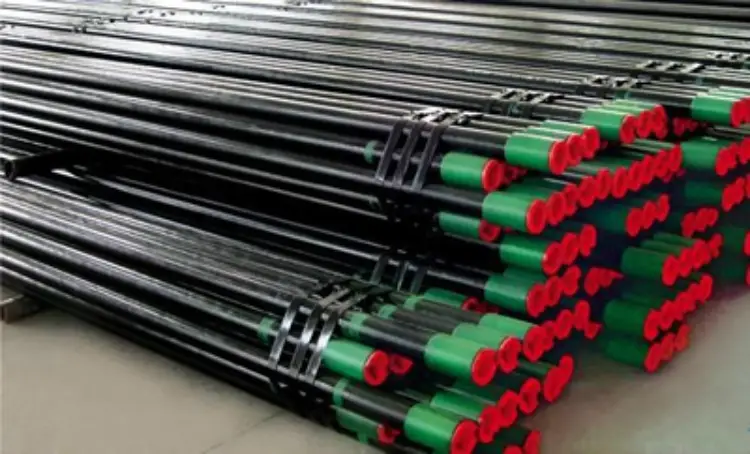
EN 10219 S460MH SSAW Pipe
EN 10219 S460MH SSAW Pipe: High-Strength Structural Hollow Section for Heavy Engineering
Comprehensive data sheet for EN 10219 S460MH spiral submerged arc welded (SSAW) pipe, including chemical composition, mechanical properties, physical properties, international equivalents, and application guidelines for structural engineering.
Cold forming, welding (SAW, SSAW), cutting, drilling, machining, hot-dip galvanizing
- Phone : +8618037372205
- Email : [email protected]
- WhatsApp: Contact via Whtsapp
- WeChat: +8618037372205
EN 10219 S460MH SSAW Pipe Introduction
EN 10219 S460MH SSAW pipe is a cold-formed welded structural hollow section made from thermomechanically rolled steel. It is designed for demanding structural applications where high strength and good toughness are required. The designation 'S460MH' indicates a minimum yield strength of 460 MPa for thicknesses up to 16 mm, thermomechanical rolling (M), and hollow section (H).
This material offers a fine-grained microstructure that provides excellent mechanical properties, including high yield and tensile strengths, combined with good ductility and weldability. The spiral submerged arc welding (SSAW) process allows large-diameter pipes to be produced with economic efficiency while maintaining uniform dimensional tolerances. Typical microstructure consists of ferrite and pearlite with fine grain size.
Key features:
- Minimum yield strength 460 MPa (t ≤ 16 mm)
- Excellent toughness down to -20°C (40 J impact energy)
- Good cold-forming capacity
- Weldable by all common methods
- Suitable for dynamic and static loading in construction
EN 10219 S460MH SSAW Pipe Chemical composition to EN 10219-1
The chemical composition of S460MH is strictly controlled to ensure the required mechanical properties and weldability. The steel is fully killed and fine-grain treated with an adequate amount of fine-grain forming elements (Nb, V, Ti). The maximum carbon equivalent (CEV) is typically 0.47% for thicknesses ≤ 40 mm. The limits shown are based on ladle analysis.
| Element | Standard value (wt.%) | Remarks |
|---|---|---|
| Carbon (C) | ≤0.16 | Max. |
| Silicon (Si) | ≤0.60 | Max. |
| Manganese (Mn) | ≤1.70 | Max. |
| Phosphorus (P) | ≤0.030 | Max. |
| Sulfur (S) | ≤0.025 | Max. |
| Nitrogen (N) | ≤0.025 | Max. |
| Aluminium (Altotal) | ≥0.020 | Min., fine-grain element |
| Niobium (Nb) | ≤0.05 | Max. |
| Vanadium (V) | ≤0.12 | Max. |
| Titanium (Ti) | ≤0.05 | Max. |
| Nickel (Ni) | ≤0.80 | Max., residual |
| Chromium (Cr) | ≤0.30 | Max., residual |
| Molybdenum (Mo) | ≤0.20 | Max., residual |
| Copper (Cu) | ≤0.55 | Max., residual |
EN 10219 S460MH SSAW Pipe Thermal and electrical physical properties
The physical properties are typical for thermomechanically rolled structural steel. They are provided for design purposes and are not mandatory standards. Values can vary slightly with welding and fabrication processes.
| Property | Typical value | Unit | Test conditions / remarks |
|---|---|---|---|
| Density (ρ) | 7850 | kg/m³ | Room temperature |
| Elastic modulus (E) | 210 | GPa | Room temperature |
| Shear modulus (G) | 81 | GPa | Room temperature |
| Poisson's ratio (ν) | 0.3 | – | Room temperature |
| Thermal expansion coefficient (α) | 12 × 10⁻⁶ | /K | 20°C to 100°C |
| Thermal conductivity (λ) | 50 | W/(m·K) | Room temperature |
| Specific heat capacity (cp) | 460 | J/(kg·K) | Room temperature |
| Electrical resistivity (ρe) | ~0.25 × 10⁻⁶ | Ω·m | Room temperature |
EN 10219 S460MH SSAW Pipe Mechanical properties to EN 10219-1
Mechanical properties depend on wall thickness. The values in the table apply to the finished hollow section. Tensile test specimens are taken in the longitudinal direction. For round sections, elongation values may be adjusted according to the standard. Impact test at -20°C gives minimum 40 J on standard 10×10 mm Charpy-V specimens.
| Property | Specified value | Unit | Test conditions / thickness range |
|---|---|---|---|
| Yield strength (ReH) | ≥460 | MPa | t ≤ 16 mm |
| Yield strength (ReH) | ≥440 | MPa | 16 < t ≤ 40 mm |
| Yield strength (ReH) | ≥410 | MPa | 40 < t ≤ 63 mm |
| Yield strength (ReH) | ≥400 | MPa | 63 < t ≤ 80 mm |
| Yield strength (ReH) | ≥380 | MPa | 80 < t ≤ 100 mm |
| Tensile strength (Rm) | 530 – 720 | MPa | t ≤ 16 mm |
| Tensile strength (Rm) | 530 – 720 | MPa | 16 < t ≤ 40 mm |
| Tensile strength (Rm) | 510 – 700 | MPa | 40 < t ≤ 63 mm |
| Tensile strength (Rm) | 500 – 690 | MPa | 63 < t ≤ 80 mm |
| Tensile strength (Rm) | 480 – 670 | MPa | 80 < t ≤ 100 mm |
| Elongation (A) | ≥17 | % | Longitudinal, L0=5.65√So, t ≤ 40 mm |
| Elongation (A) | ≥16 | % | 40 < t ≤ 63 mm |
| Elongation (A) | ≥15 | % | 63 < t ≤ 100 mm |
| Impact energy (KV2) | ≥40 | J | At -20°C, longitudinal, standard 10×10 mm |
| Bend test | No cracks | – | Mandrel diameter 2t, 180° bend, t ≤ 16 mm |
| Bend test | No cracks | – | Mandrel diameter 3t, 180° bend, 16 < t ≤ 40 mm |
EN 10219 S460MH SSAW Pipe Fully equivalent material standards and grades for substitution
| Country / Region | Standard | Grade | Remarks |
|---|---|---|---|
| Europe | EN 10219-1 | S460MH | The original standard; only this designation guarantees full compliance for hollow sections. |
EN 10219 S460MH SSAW Pipe Application Introduction
S460MH SSAW pipes are designed for heavy-duty structural applications where weight savings and high load-bearing capacity are critical. The combination of high strength, good ductility, and excellent weldability makes the material suitable for both static and dynamic structures. Spiral-welded pipes can be produced in large diameters (up to 2500 mm or more) with a wide range of wall thicknesses, providing design flexibility.
Product Applications: Structural columns and beams in high-rise buildings, Piling pipes and structural casings, Bridge piers and arch structures, Offshore jacket legs and bracing members, Tubular towers for wind turbines, Conveyor gallery frames, Masts for overhead lines and antennas
Processed into products: Spiral-welded structural pipes for load-bearing columns, Foundation piles with high vertical capacity, Truss chords and stiffeners in long-span bridges, Boom sections for cranes and excavators, Support structures for solar arrays, Heavy-duty scaffold tubes, Hydraulic cylinder bodies
Application industries: Civil engineering and building construction, Offshore platforms and marine structures, Bridge construction, Wind turbine towers and foundations, Heavy mechanical engineering, Mining and material handling, Energy transmission (poles, masts)
EN 10219 S460MH SSAW Pipe Similar or comparable alternative materials
| Country / Region | Standard | Grade | Remarks |
|---|---|---|---|
| Europe | EN 10025-4 | S460M / S460ML | Thermomechanical rolled plate, often used to form hollow sections; similar strength but impact requirements may differ (M: 40J at -20°C, ML: 27J at -50°C). |
| International | ISO 630-3 | S460M | Hot-rolled structural steel of thermomechanical rolling; comparable composition and strength but not specific to hollow sections. |
| USA | ASTM A572/A709 | Grade 65 | High-strength low-alloy structural steel; minimum yield 450 MPa, tensile 550 MPa; close but lower yield strength; not a direct pipe equivalent. |
| Japan | JIS G 3106 | SM570 | Welded structural steel; minimum yield 460 MPa (t≤16 mm), tensile 570-720 MPa; similar strength but different toughness and testing requirements. |
| China | GB/T 1591 | Q460D / Q460E | High-strength low-alloy structural steel; yield ≥460 MPa; impact energy 34J at -20°C (D) or -40°C (E); used for plates and sections but not directly for cold-formed hollow sections. |
Notes:
The S460MH grade is specially designed for cold-formed welded hollow sections. Welding procedures must follow recommendations for thermomechanically rolled steel, e.g., low-hydrogen processes and controlled heat input to avoid heat-affected zone softening. Preheating is generally not required for thicknesses up to 40 mm provided the carbon equivalent CEV ≤0.47. For fatigue-loaded structures, detail category according to EN 1993-1-9 should be applied. Dimensional tolerances and further requirements are found in EN 10219-2. Surface condition: mill finish, free of gross imperfections; supplementary corrosion protection (e.g., hot-dip galvanizing according to EN ISO 1461) is often applied for outdoor exposure.
- Share



