
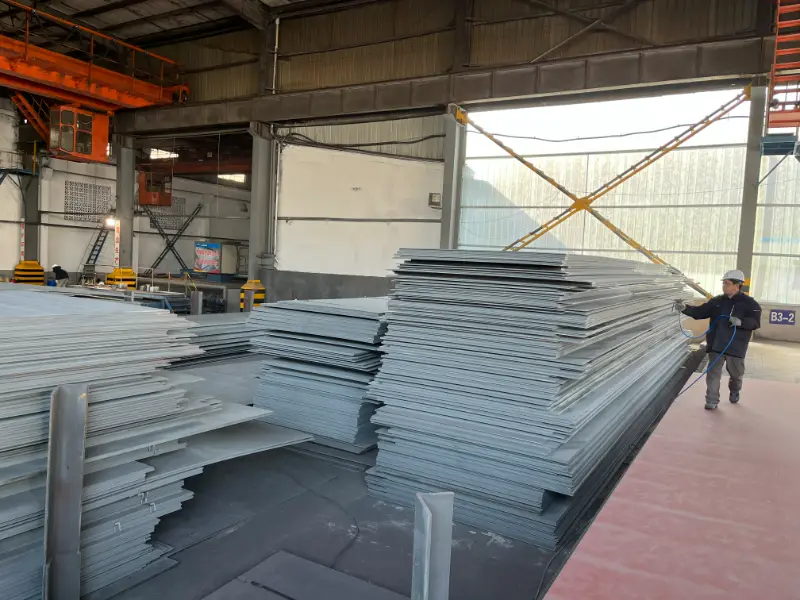
S460MLH Structural Hollow Section Steel to EN 10219
S460MLH Structural Hollow Section Steel to EN 10219 - Cold-Formed SSAW Pipe Properties
Complete material data for S460MLH structural steel hollow sections according to EN 10219-1, including chemical composition, mechanical properties, thermal and electrical physical properties, equivalent grades, and application guidelines for SSAW pipes.
Cold forming of thermomechanically rolled plate/strip, followed by submerged arc welding (SAW) for SSAW pipes; optional stress-relief heat treatment
- Phone : +8618037372205
- Email : [email protected]
- WhatsApp: Contact via Whtsapp
- WeChat: +8618037372205
S460MLH Structural Hollow Section Steel to EN 10219 Introduction
S460MLH is a structural steel grade defined in EN 10219-1 for cold-formed welded structural hollow sections of non-alloy and fine grain steels. It is produced from thermomechanically rolled steel (S460M) with low-temperature impact properties (down to -50°C) and is supplied in the form of circular, square, rectangular hollow sections or spiral submerged arc welded (SSAW) pipes. The steel combines high yield strength (minimum 460 MPa for thin walls) with good weldability and excellent notch toughness, making it suitable for demanding structural applications in offshore, bridge, and heavy machinery industries. The typical delivery condition is as-welded, with optional stress-relief heat treatment. It is primarily used where weight reduction and high load-bearing capacity are critical.
S460MLH Structural Hollow Section Steel to EN 10219 Chemical Composition
Chemical composition according to EN 10219-1:2006, Table 2. Values are maximum unless otherwise stated. Suitable elements such as Cr, Ni, Mo may be added for specific applications but are not mandatory beyond the limits shown. Nb, V, Ti are micro-alloying elements for grain refinement and precipitation strengthening.
| Element | Standard Value (%) | Remarks |
|---|---|---|
| Carbon (C) | ≤0.20 | |
| Silicon (Si) | ≤0.60 | |
| Manganese (Mn) | ≤1.70 | |
| Phosphorus (P) | ≤0.025 | |
| Sulfur (S) | ≤0.020 | |
| Niobium (Nb) | ≤0.05 | Grain refiner |
| Vanadium (V) | ≤0.13 | Precipitation strengthening |
| Aluminium (Al total) | ≥0.015 | Minimum for fine grain practice |
| Titanium (Ti) | ≤0.05 | Grain refiner |
| Nickel (Ni) | ≤0.10 | |
| Molybdenum (Mo) | ≤0.20 | |
| Nitrogen (N) | ≤0.025 |
S460MLH Structural Hollow Section Steel to EN 10219 Thermal and Electrical Physical Properties
Physical properties for S460MLH structural steel are typical for low-alloy structural steels. They may vary slightly depending on exact composition and manufacturing route. Density, elastic modulus, shear modulus, and Poisson's ratio are standard for steel. Thermal expansion, thermal conductivity, specific heat capacity, and electrical resistivity are provided for design and calculation purposes.
| Property | Standard Value | Unit | Test Condition |
|---|---|---|---|
| Density (ρ) | 7.85 | g/cm³ | Room temperature |
| Elastic modulus (E) | 210 | GPa | Room temperature |
| Shear modulus (G) | ≈81 | GPa | Room temperature |
| Poisson's ratio (ν) | 0.3 | — | Room temperature |
| Thermal expansion coefficient (α) | 12.0 × 10⁻⁶ | K⁻¹ | 20°C to 100°C |
| Thermal conductivity (λ) | ≈50 | W/(m·K) | 20°C |
| Specific heat capacity | ≈460 | J/(kg·K) | 20°C |
| Electrical resistivity (ρₑ) | ≈0.20 | μΩ·m | 20°C |
S460MLH Structural Hollow Section Steel to EN 10219 Mechanical Properties
Mechanical properties for S460MLH hollow sections in accordance with EN 10219-1:2006, Tables 3, 4, 5 and 6. Values apply to longitudinal direction test pieces. Yield strength and tensile strength depend on wall thickness. Bend test is performed with specimen axis parallel to the weld. Impact energy is guaranteed at -50°C for the MLH symbol.
| Property | Standard Required Value | Unit | Test Condition |
|---|---|---|---|
| Yield strength (ReH) | ≥460 | MPa | Wall thickness t ≤ 16 mm |
| Yield strength (ReH) | ≥440 | MPa | 16 mm < t ≤ 40 mm |
| Yield strength (ReH) | ≥420 | MPa | 40 mm < t ≤ 63 mm |
| Yield strength (ReH) | ≥400 | MPa | 63 mm < t ≤ 80 mm |
| Yield strength (ReH) | ≥380 | MPa | 80 mm < t ≤ 100 mm |
| Yield strength (ReH) | ≥370 | MPa | 100 mm < t ≤ 120 mm |
| Tensile strength (Rm) | 530 - 720 | MPa | All thicknesses |
| Elongation after fracture (A) | ≥17 | % | Longitudinal, t ≤ 40 mm, L₀=5.65√S₀ |
| Elongation after fracture (A) | ≥17 | % | Longitudinal, t > 40 mm |
| Bend test (mandrel diameter) | 3t (t ≤ 16 mm), 4t (16 < t ≤ 25 mm), 5t (25 < t ≤ 40 mm) | — | 180° bend, specimen axis parallel to weld |
| Impact energy (KV₂) | ≥27 (average of 3) | J | Longitudinal, -50°C |
| Impact energy (KV₂) | ≥19 (one individual) | J | Longitudinal, -50°C |
S460MLH Structural Hollow Section Steel to EN 10219 Completely Equivalent Material Standards and Replaceable Grades
| Country/Region | Standard | Grade | Remarks |
|---|---|---|---|
| European Union | EN 10219-1 | S460MLH | Original designation for cold-formed welded hollow sections |
| Germany | DIN EN 10219-1 | S460MLH | Identical adoption |
| United Kingdom | BS EN 10219-1 | S460MLH | Identical adoption |
| France | NF EN 10219-1 | S460MLH | Identical adoption |
S460MLH Structural Hollow Section Steel to EN 10219 Application Introduction
S460MLH is designed for heavy-duty welded structures where high yield strength (≥460 MPa) and excellent low-temperature toughness (down to -50°C) are required. The hollow section form, including SSAW pipes, provides high bending and torsional stiffness with relatively low weight. Typical applications include offshore platform legs, bridge chords, heavy crane booms, wind turbine towers, and structural pipe piles. The material is well suited for submerged arc welding and can be fabricated into complex welded assemblies. Due to its fine grain structure, it also exhibits good fatigue resistance.
Product Applications: SSAW (spiral submerged arc welded) pipes for piles and columns, Circular hollow sections (CHS) for truss girders, Square and rectangular hollow sections for crane booms and frames, Jack-up rig legs and spudcans, Offshore jacket structures, Wind turbine tower sections
Processed into products: Bridge main chords and cross beams, Offshore platform bracing members, Container crane spreader beams, Excavator booms and arms, Heavy-duty conveyor idler frames, Piled foundations and retaining wall elements
Application industries: Offshore and marine engineering, Bridge construction, Wind energy (tower and foundation), Heavy lifting and transport equipment, Architectural and high-rise building structures, Mining and earth-moving machinery
S460MLH Structural Hollow Section Steel to EN 10219 Similar or Approximate Substitute Materials
| Country/Region | Standard | Grade | Remarks |
|---|---|---|---|
| European Union | EN 10025-4 | S460ML | Base thermomechanically rolled steel; same strength and low-temperature toughness, but for flat products, not hollow sections |
| European Union | EN 10210-1 | S460MLH | Hot-finished hollow section version with identical strength and toughness; different manufacturing route |
| International | ISO 630-3 | S460M | Similar thermomechanically rolled structural steel, but may have slightly different impact requirements (depending on suffix) |
| China | GB/T 1591 | Q460D | Yield strength 460 MPa, impact at -20°C; not as low-temperature as MLH but close; supplied as plates or sections |
| USA | ASTM A572 | Grade 65 | Minimum yield 450 MPa, impact not guaranteed; suitable for general structural use but not a direct toughness equivalent |
Notes:
The values in this data sheet are based on EN 10219-1:2006 for S460MLH hollow sections. Actual properties may vary depending on the production process and thickness. For SSAW pipes, the weld seam properties match the base material when proper welding consumables and procedures are used. For combined thickness beyond the standard range, consult the manufacturer. The steel is generally weldable by all common methods, preheating may be required for thick sections. The M designation indicates thermomechanical rolling, which should not be confused with quenched and tempered steels; hot forming above 580°C may alter the mechanical properties.
- Share



