
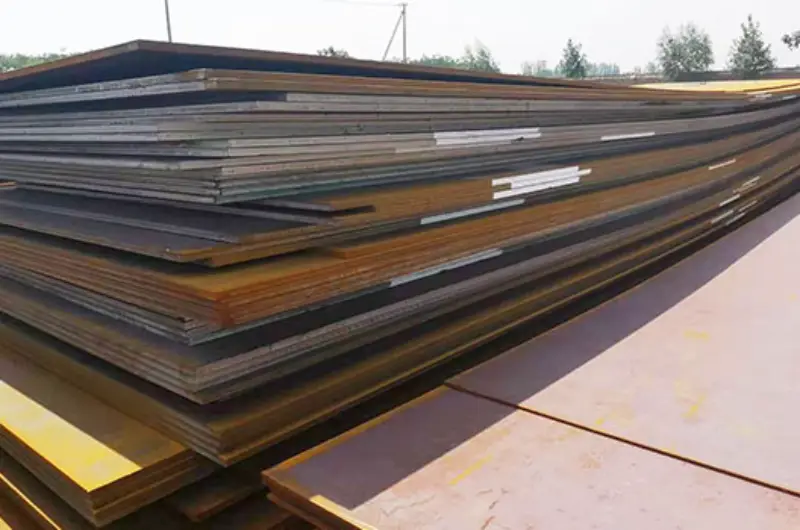
EN10219 S355MH Steel Hollow Section (SHS/RSH)
EN10219 S355MH Steel Hollow Section (SHS/RSH) Material Properties
Complete material data for S355MH steel square and rectangular hollow sections per EN 10219-1, covering chemical composition, mechanical and physical properties, and equivalent grades.
Cold forming, welding, bending, machining, cutting, drilling
- Phone : +8618037372205
- Email : [email protected]
- WhatsApp: Contact via Whtsapp
- WeChat: +8618037372205
EN10219 S355MH Steel Hollow Section Introduction
S355MH is a thermomechanically rolled fine‑grain structural steel specifically designed for cold‑formed welded hollow sections (SHS – square hollow sections / RHS – rectangular hollow sections) in accordance with EN 10219‑1. The 'M' denotes thermomechanical processing, which imparts a refined microstructure that combines high strength (minimum yield 355 MPa) with excellent toughness and weldability. Typical carbon equivalent values (CEV ≤ 0.39 %) ensure good cold‑forming and welding characteristics without preheating under normal conditions. The steel is supplied in the normalised or as‑rolled condition and is suitable for static and dynamic loads in structural engineering, bridges, offshore structures, and general mechanical applications. Hollow sections offer an efficient strength‑to‑weight ratio, torsional stability, and aesthetic appearance.
EN10219 S355MH Steel Hollow Section Chemical Composition
The chemical composition conforms to EN 10219‑1 for grade S355MH. Maximum limits are applicable unless a range is given. All values refer to ladle analysis. The steel is fully killed with aluminium and may contain microalloying elements (Nb, V, Ti) for grain refinement and precipitation strengthening.
| Element | Standard Value (wt%) | Remarks |
|---|---|---|
| Carbon (C) | ≤ 0.12 | Ladle analysis maximum |
| Silicon (Si) | ≤ 0.50 | |
| Manganese (Mn) | ≤ 1.60 | For long products, up to 1.70 |
| Phosphorus (P) | ≤ 0.030 | |
| Sulfur (S) | ≤ 0.025 | |
| Aluminium (Alₜₒₜ) | ≥ 0.020 | Total aluminium, for fully killed fine‑grain practice |
| Niobium (Nb) | ≤ 0.05 | Optional microalloying |
| Vanadium (V) | ≤ 0.10 | Optional microalloying |
| Titanium (Ti) | ≤ 0.05 | Optional microalloying |
| Nickel (Ni) | ≤ 0.30 | |
| Chromium (Cr) | ≤ 0.30 | |
| Molybdenum (Mo) | ≤ 0.10 | |
| Copper (Cu) | ≤ 0.35 | |
| Nitrogen (N) | ≤ 0.015 | Unless higher nitrogen content is specified |
| CEV (CET/CE) | ≤ 0.39 | Carbon equivalent value (CEV = C + Mn/6 + (Cr+Mo+V)/5 + (Ni+Cu)/15), for thickness ≤ 30 mm |
EN10219 S355MH Steel Hollow Section Physical Properties
Physical constants are typical for S355 fine‑grain structural steels and are not mandatory requirements of the standard. They are useful for design calculations involving thermal expansion, stiffness, and thermal conduction.
| Property | Standard Requirement | Unit | Test Condition |
|---|---|---|---|
| Density (ρ) | 7.85 | g/cm³ | At 20 °C |
| Elastic modulus (E) | 210 | GPa | At 20 °C |
| Shear modulus (G) | ≈ 81 | GPa | Calculated from E and ν |
| Poisson's ratio (ν) | 0.3 | - | Elastic range |
| Thermal expansion coefficient (α) | 12.0 × 10⁻⁶ | K⁻¹ | 20 °C – 100 °C |
| Thermal conductivity (λ) | 50 | W/(m·K) | At 20 °C |
| Specific heat capacity | 460 | J/(kg·K) | At 20 °C |
| Electrical resistivity (ρₑ) | 0.16 × 10⁻⁶ | Ω·m | At 20 °C |
EN10219 S355MH Steel Hollow Section Mechanical Properties
Mechanical properties are determined by standard tensile and impact tests on base metal. Values shown are minimum requirements for longitudinal test pieces, unless stated otherwise. For hollow sections, properties depend on wall thickness. Impact testing is performed at -20 °C (J2 quality).
| Property | Standard Requirement | Unit | Test Condition |
|---|---|---|---|
| Yield strength (ReH) | ≥ 355 | MPa | Nominal thickness (t) ≤ 16 mm |
| Yield strength (ReH) | ≥ 345 | MPa | 16 mm < t ≤ 40 mm |
| Yield strength (ReH) | ≥ 335 | MPa | 40 mm < t ≤ 63 mm |
| Yield strength (ReH) | ≥ 325 | MPa | 63 mm < t ≤ 80 mm |
| Tensile strength (Rm) | 470 – 630 | MPa | t ≤ 100 mm, longitudinal |
| Elongation after fracture (A) | ≥ 22 | % | t ≤ 40 mm, longitudinal, gauge length 5.65√S₀ |
| Elongation after fracture (A) | ≥ 21 | % | 40 mm < t ≤ 63 mm |
| Impact energy (KV₂) | ≥ 27 | J | At -20 °C, longitudinal, Charpy‑V, 10×10 mm, minimum individual value 75 % of average when testing 3 specimens |
| Bending test | Crack free after 180° bend | - | Mandrel diameter = 3 × t for t ≤ 16 mm; 4 × t for 16 mm < t ≤ 40 mm |
EN10219 S355MH Steel Hollow Section Fully Equivalent Material Standards and Replaceable Grades
| Country/Region | Standard | Grade | Remarks |
|---|---|---|---|
| European Union | EN 10219-1 | S355MH | Cold‑formed welded structural hollow sections |
| Germany | DIN EN 10219-1 | S355MH | German adoption of European standard |
| United Kingdom | BS EN 10219-1 | S355MH | British adoption |
| France | NF EN 10219-1 | S355MH | French adoption |
| Italy | UNI EN 10219-1 | S355MH | Italian adoption |
| Spain | UNE EN 10219-1 | S355MH | Spanish adoption |
| International | ISO 630-2 | S355H | Hot‑rolled structural steel; similar strength, different processing and delivery condition |
EN10219 S355MH Steel Hollow Section Application Introduction
S355MH hollow sections are widely used where high strength‑to‑weight ratio, good weldability, and sufficient toughness are required. The thermomechanical processing ensures excellent resistance to brittle fracture, making it suitable for dynamically loaded structures and low‑temperature environments.
Product Applications: Structural frames and space frames, Columns, beams, and trusses, Bridge piers and deck supports, Crane booms and jibs, Telecommunication towers, Agricultural equipment booms, Architectural canopies and facades
Processed into products: Welded connections and gusset plates, Bolted end‑plates and splice plates, Braced frame members, Hollow section trusses, Bent and formed corners, Machined end fittings
Application industries: Civil engineering and building construction, Infrastructure (bridges, towers, masts), Offshore and marine structures, Agricultural and forestry machinery, Automotive chassis and trailers, Material handling and conveyor systems, Renewable energy (wind turbine towers, solar trackers)
EN10219 S355MH Steel Hollow Section Similar or Substitute Material Recommendations
| Country/Region | Standard | Grade | Remarks |
|---|---|---|---|
| United States | ASTM A500 | Grade C | Cold‑formed welded hollow sections; yield min 345 MPa (50 ksi), tensile min 425 MPa; slightly lower toughness; CEV may differ |
| Japan | JIS G 3466 | STKR490 | Carbon steel square and rectangular tubes; yield min 325 MPa, tensile min 490 MPa; not fine‑grain treated |
| Australia/New Zealand | AS/NZS 1163 | C350L0 | Cold‑formed hollow sections; yield min 350 MPa, impact test optional; CEV controlled |
| International | EN 10210-1 | S355J2H | Hot‑finished hollow section; same strength level, fine‑grain, impact at -20 °C; superior surface finish and tighter tolerances |
Notes:
Welding: S355MH exhibits good weldability with low carbon equivalent (CE ≤ 0.39). Preheating is generally not required for thicknesses below 30 mm when using low hydrogen processes. Suitable welding methods: MAG, TIG, SAW, MMA. Corrosion protection: The steel is not inherently corrosion resistant; hot‑dip galvanizing, painting, or weathering steel alternatives should be considered for exposed applications. Tolerances: Dimensional and form tolerances conform to EN 10219‑2. Testing: Full compliance with EN 10219‑1 includes tensile, impact, flattening, and bend tests; supplementary non‑destructive testing of welds (e.g., UT, RT) may be agreed upon.
- Share



