
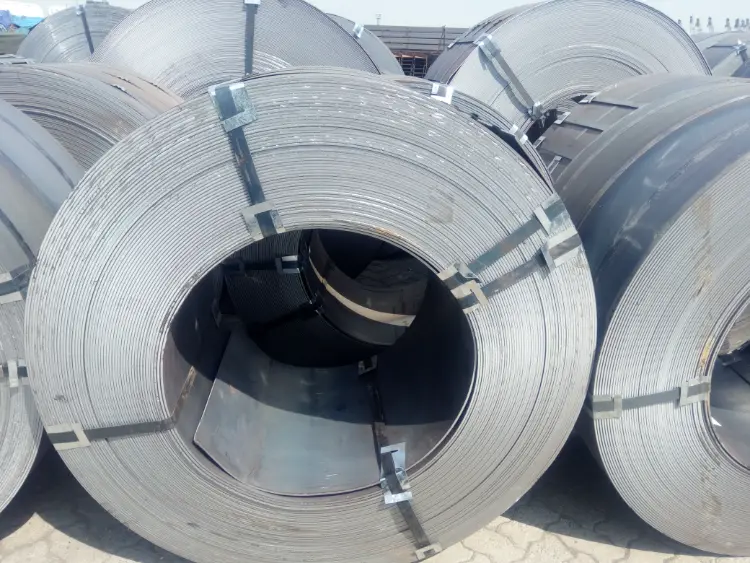
CCS AQ63 Shipbuilding Steel Coil
CCS AQ63 Shipbuilding Steel Coil | High-Strength Quenched & Tempered Plate
Detailed technical data for CCS AQ63 shipbuilding steel coil including chemical composition, mechanical properties, thermal and electrical properties, international equivalent grades and application guidelines.
Thermomechanical rolling (TMCP) followed by quenching and tempering; suitable for cold forming, flame cutting, welding
- Phone : +8618037372205
- Email : [email protected]
- WhatsApp: Contact via Whtsapp
- WeChat: +8618037372205
CCS AQ63 Shipbuilding Steel Coil Introduction
CCS AQ63 is a high-strength quenched and tempered shipbuilding steel grade certified by China Classification Society (CCS). It offers minimum yield strength of 620 MPa and belongs to the crack-arrest toughness class — designated for thick plates used in critical structural members of ships and offshore structures where low-temperature notch toughness is essential.
Key characteristics:
- Excellent strength-to-weight ratio allowing weight reduction in hull design
- Good weldability with low carbon equivalent (CEV typically ≤0.62)
- Reliable low-temperature impact toughness down to -20 °C (transverse 31 J min.)
- Homogeneous through-thickness properties for plates up to 150 mm
The steel is delivered in normalized or quenched-and-tempered condition and is available in a wide range of thicknesses as plates, coils, and cut-to-length sheets.
CCS AQ63 Shipbuilding Steel Coil Chemical Composition
Ladle analysis according to CCS Rules, Part 3, Chapter 2, Table 2.1.2.2(1) for grade AQ63.
- Low carbon equivalent (Ceq ≤0.62) ensures good weldability.
- Microalloying with Nb, V, Ti and controlled nitrogen levels refine grain size and improve toughness.
- Maximum limits for P and S are low to guarantee cleanliness and resistance to brittle fracture.
| Element | Specified Value (max, in %) | Remarks |
|---|---|---|
| C | ≤0.20 | |
| Si | 0.10–0.55 | |
| Mn | 0.90–1.60 | |
| P | ≤0.025 | |
| S | ≤0.025 | |
| Cr | ≤0.25 | |
| Ni | ≤0.80 | |
| Mo | ≤0.08 | For thickness >70 mm, Mo may be increased by agreement |
| Cu | ≤0.35 | |
| Als (acid soluble Al) | ≥0.015 | Minimum total Al |
| Nb | ≤0.05 | |
| V | ≤0.10 | |
| Ti | ≤0.02 | |
| N | ≤0.012 | If sufficient Al, Ti etc. exist to fix nitrogen |
| Ceq (IIW) | ≤0.62 | Typical value for Q+T condition |
CCS AQ63 Shipbuilding Steel Coil Thermal & Electrical Physical Properties
Physical constants for quenched and tempered steel of this strength level at room temperature, unless otherwise noted. Values are derived from literature and test data for similar 620–700 MPa yield-strength grades.
- Density slightly decreases with temperature.
- Thermal conductivity and specific heat capacity are essential for calculating cooling rates during welding.
- Electrical resistivity influences eddy current inspection.
| Property | Typical Value | Unit | Test Condition |
|---|---|---|---|
| Density (ρ) | 7.85 | g/cm³ | 20 °C |
| Modulus of Elasticity (E) | 205 | GPa | 20 °C, tension |
| Shear Modulus (G) | 80 | GPa | 20 °C, typical |
| Poisson's Ratio (ν) | 0.30 | — | Elastic range, 20 °C |
| Thermal Expansion Coefficient (α) | 12.0 | 10⁻⁶/K | 20–100 °C |
| Thermal Expansion Coefficient (α) | 13.0 | 10⁻⁶/K | 20–300 °C |
| Thermal Conductivity (λ) | 42 | W/(m·K) | 20 °C |
| Thermal Conductivity (λ) | 38 | W/(m·K) | 300 °C |
| Specific Heat Capacity (cₚ) | 490 | J/(kg·K) | 20–100 °C |
| Electrical Resistivity (ρₑ) | 0.22 | Ω·mm²/m | 20 °C |
| Curie Temperature | approx. 770 | °C | Ferromagnetic transition |
CCS AQ63 Shipbuilding Steel Coil Mechanical Properties
Tensile and impact requirements for AQ63 according to CCS Rules, Part 3, Chapter 2, Table 2.1.2.2(2). Test specimens are taken transverse to the rolling direction.
- Tensile strength range is 720–890 MPa, with minimum 17% elongation (L₀=5.65√S₀).
- Impact energy 31 J at -20 °C (Charpy V‑notch, transverse) for thicknesses ≥50 mm; for thinner plates the test temperature may be -10 °C.
- Through-thickness properties (Z‑test) can be ordered for critical applications.
| Property | Specified Value | Unit | Test Condition |
|---|---|---|---|
| Yield Strength (ReH) | ≥620 | MPa | Transverse, thickness ≤100 mm |
| Tensile Strength (Rm) | 720–890 | MPa | Transverse |
| Elongation (A) | ≥17 | % | L₀=5.65√S₀, transverse |
| Elongation (A₅₀) | ≥16 | % | L₀=50 mm, transverse (for reference) |
| Impact Energy (KV₂) | ≥31 | J | Charpy V‑notch, transverse, at -20 °C, thickness ≥50 mm |
| Impact Energy (KV₂) | ≥31 | J | At -10 °C for thickness <50 mm (optional) |
| Bend test (180°) | No cracks or defects | — | Bend diameter = 3t over former of 3t |
CCS AQ63 Shipbuilding Steel Coil Identical Standards & Replaceable Grades
| Country/Region | Standard | Grade | Remarks |
|---|---|---|---|
| Worldwide | IACS UR W11 | AQ63 | Unified Requirement for high-strength quenched and tempered steel |
| USA | ABS Rules | AQ63 | American Bureau of Shipping |
| France | BV Rules | AQ63 | Bureau Veritas |
| Norway/Germany | DNV Rules | E630 (VL E630) | DNV GL; corresponds to yield 620 MPa |
| UK | LR Rules | AH63 | Lloyd's Register; AH denotes high-strength quenched and tempered |
| Japan | NK Rules | AQ63 | ClassNK |
| Italy | RINA Rules | AQ63 | RINA |
| South Korea | KR Rules | AQ63 | Korean Register |
| Russia | RS Rules | AQ63 | Russian Maritime Register of Shipping |
| China | GB/T 712 | Q620D (FQ620D) | National steel for ships; FQ620D as quenched and tempered, –20 °C toughness |
CCS AQ63 Shipbuilding Steel Coil Application Introduction
CCS AQ63 is specifically designed for highly stressed welded structures in shipbuilding and offshore engineering. Its combination of high strength and good toughness makes it suitable for weight-critical components.
- Welding consumables should match the strength level (e.g., AWS A5.28 ER100S-G) and low-hydrogen practices must be followed.
- Preheating (typically 50–150 °C) and post-weld heat treatment are often not required for thicknesses up to 50 mm, but interpass temperature control is essential.
- Cold forming - minimum bending radius should be at least 3t for transverse bends, and formed parts may need stress relieving.
Product Applications: Coils for thin-walled sections (cut-to-length sheets), Heavy plates for hull shells, decks, and bottom structures, Wide flats for stiffeners and longitudinal girders, Hot-formed angles and channels for structural members, Pipe and tubular sections (when produced from plate)
Processed into products: Hull outer shell plating (ice-strengthened areas), Main deck and inner bottom plating, Hatch coamings and container cell guides, Rig leg rack teeth and chord members, Crane pedestals and slewing rings, Rudder horns and stock connections, Strut boxes and thrust blocks
Application industries: Shipbuilding (container ships, bulk carriers, tankers, naval vessels), Offshore oil & gas (jack-up rigs, semi-submersible platforms, FPSOs), Marine engineering (port cranes, heavy-lift barges, wind turbine installation vessels), Pressure vessels (when certified for marine service), Bridge construction (in aggressive marine environments)
CCS AQ63 Shipbuilding Steel Coil Comparable / Similar Alternative Grades
| Country/Region | Standard | Grade | Analysis / Remarks |
|---|---|---|---|
| China | GB/T 1591 | Q690D | High-strength low-alloy structural steel, YS ≥690 MPa; not specifically for shipbuilding, but mechanical similarity; requires supplementary certification for marine use |
| EU | EN 10025‑6 | S690QL | Quenched and tempered steel for structures; YS ≥690 MPa; toughness at –40 °C; requires 3.2 certification for marine use |
| USA | ASTM A514 | Grade Q (A514GrQ) | YS ≥690 MPa; quenched and tempered; lacks mandatory low-temperature toughness requirements of ship steel; may need extra testing |
| Japan | JIS G 3128 | SHY685 | High-yield-strength steel for welded structures; similar strength level; not directly approved by IACS |
| Worldwide | API 2W / 2Y | Grade 60 / 70 | Steel for offshore structures; YS ≥415 / 485 MPa; lower strength than AQ63 but often used in conjunction |
Notes:
- All data refers to the CCS Rules for Materials and Welding (2021 edition) and is in accordance with IACS UR W11.
- Mechanical properties may vary for thicknesses above 100 mm; such plates normally require additional through-thickness testing (Z‑direction).
- Steel in coil form is usually supplied in thicknesses 3–25 mm; plate thicknesses beyond this are available as quarto plates.
- For welding, adhere to CCS Guidelines for Welding Procedure Qualification and use consumables complying with IACS UR W17, W18.
- Ultrasonic testing (UT) according to EN 10160 or ASTM A578 is recommended for critical components.
- Share



