
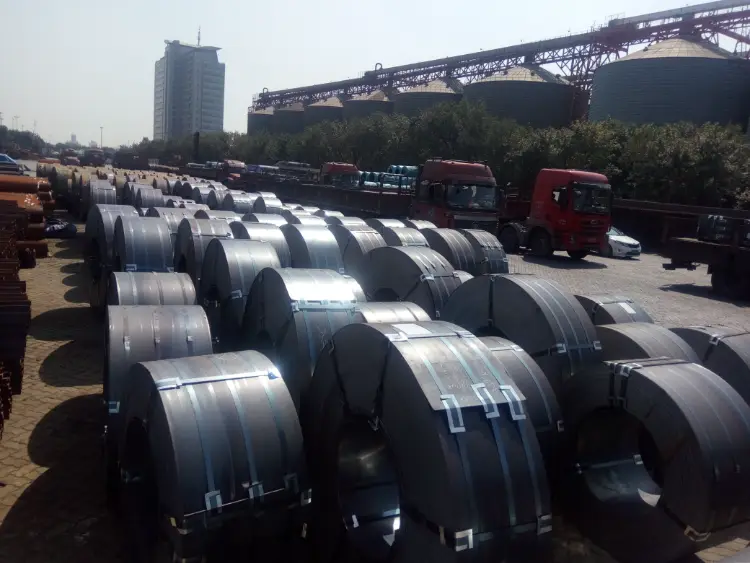
CCS FQ56 Shipbuilding Steel Coil
CCS FQ56 Shipbuilding Steel Coil - Extra-High Strength Quenched & Tempered Steel for Arctic Ship Structures
Comprehensive material data for CCS FQ56 shipbuilding steel coil, including chemical composition, mechanical properties, physical characteristics, international equivalents, and application guidance for marine and offshore construction.
Cutting, bending, forming, welding (with preheat and post‑weld heat treatment as required), machining, blast cleaning and coating
- Phone : +8618037372205
- Email : [email protected]
- WhatsApp: Contact via Whtsapp
- WeChat: +8618037372205
CCS FQ56 Shipbuilding Steel Coil Introduction
CCS FQ56 is an extra-high strength hull structural steel produced in coil form, classified under the China Classification Society (CCS) rules. It is a quenched and tempered (Q&T) fine grain steel with a minimum yield strength of 550 MPa (80 ksi). The 'F' designation indicates that the material is suited for service at -60 °C, offering exceptional low‑temperature toughness. FQ56 combines high strength with excellent weldability and impact properties, making it ideal for critical structural components in offshore platforms, ice‑class vessels, and large container ships. The coil form provides flexibility for downstream processing, such as cutting, forming, and welding of plates and profiles.
CCS FQ56 Shipbuilding Steel Coil Chemical Composition
Chemical limits are according to CCS Rules for extra‑high strength hull structural steels. Values represent the maximum unless a range is given. Microalloying elements such as Nb, V, Ti, and Al are carefully balanced to achieve fine grain size and high strength. Elements like Cu, Ni, and Cr provide additional corrosion resistance and hardenability.
- Carbon equivalent (CEV) is controlled to ensure good weldability.
| Element | Standard Value (max or range) | Remarks |
|---|---|---|
| Carbon (C) | 0.18 | max |
| Silicon (Si) | 0.55 | max |
| Manganese (Mn) | 0.90 – 1.60 | range |
| Phosphorus (P) | 0.025 | max |
| Sulfur (S) | 0.025 | max |
| Aluminum (Al) total | 0.015 min | min, acid‑soluble Al also acceptable |
| Niobium (Nb) | 0.05 | max |
| Vanadium (V) | 0.10 | max |
| Titanium (Ti) | 0.02 | max |
| Nickel (Ni) | 0.80 | max |
| Chromium (Cr) | 0.50 | max |
| Molybdenum (Mo) | 0.30 | max |
| Copper (Cu) | 0.50 | max |
| Nitrogen (N) | 0.009 | max, unless sufficient Al, Nb, V or Ti is present to fix nitrogen |
CCS FQ56 Shipbuilding Steel Coil Physical Properties
The following data represent typical physical properties for quenched and tempered high‑strength low‑alloy steels. Exact values may vary slightly depending on heat treatment and final microstructure. These properties are not part of the CCS certificate but are essential for design calculations, thermal management, and electrical insulation assessments.
| Property | Standard Value (approx.) | Unit | Test Condition |
|---|---|---|---|
| Density (ρ) | 7850 | kg/m³ | Room temperature |
| Modulus of Elasticity (E) | 205 | GPa | Room temperature |
| Shear Modulus (G) | 80 | GPa | Room temperature |
| Poisson's Ratio (ν) | 0.3 | – | Room temperature |
| Thermal Expansion (α) | 11.7 | 10⁻⁶/K | 20 – 100 °C |
| Thermal Expansion (α) | 12.5 | 10⁻⁶/K | 20 – 200 °C |
| Thermal Expansion (α) | 13.3 | 10⁻⁶/K | 20 – 400 °C |
| Thermal Conductivity (λ) | 42 | W/(m·K) | 20 °C |
| Thermal Conductivity (λ) | 38 | W/(m·K) | 200 °C |
| Specific Heat Capacity (c_p) | 460 | J/(kg·K) | 20 °C |
| Electrical Resistivity (ρ_e) | 0.25 | µΩ·m | Room temperature |
CCS FQ56 Shipbuilding Steel Coil Mechanical Properties
Properties refer to the quenched and tempered condition. Tensile testing is performed on transverse specimens, and impact testing on longitudinal specimens at the specified temperature for F‑quality steel (-60 °C). Elongation values depend on plate thickness. Bend tests are carried out using a mandrel diameter related to the material thickness. Impact energy values are average of three specimens; single minimum values also apply.
| Property | Standard Requirement | Unit | Test Condition |
|---|---|---|---|
| Yield Strength (ReH) | ≥ 550 | MPa | Room temperature, thickness ≤ 40 mm |
| Yield Strength (ReH) | ≥ 520 | MPa | Room temperature, 40 mm < t ≤ 80 mm |
| Tensile Strength (Rm) | 670 – 830 | MPa | Room temperature |
| Elongation (A5) | ≥ 18 | % | Gauge length 5.65√S0, t ≤ 40 mm |
| Elongation (A5) | ≥ 16 | % | 40 mm < t ≤ 80 mm |
| Impact Energy (KV2) | ≥ 47 (average) | J | -60 °C, longitudinal, t ≤ 50 mm |
| Impact Energy (KV2) | ≥ 33 (single) | J | -60 °C, longitudinal, t ≤ 50 mm |
| Bend Test (180°) | Mandrel diam. = 3t | - | t = specimen thickness, no cracks |
CCS FQ56 Shipbuilding Steel Coil Identical / Directly Equivalent Classification Society Grades
| Country / Region | Standard / Society | Grade | Remarks |
|---|---|---|---|
| International | IACS (Unified Requirement W11) | FQ56 | Harmonized grade across all IACS members |
| USA | ABS (American Bureau of Shipping) | EQ56 | FQ56 with same tensile and toughness requirements, -60 °C impact |
| Norway/Germany | DNV GL | LQ56 | Equivalent extra‑high strength, Q&T, -60 °C |
| UK | LR (Lloyd's Register) | FQ56 | Identical grade designation |
| France | BV (Bureau Veritas) | F56 | Same mechanical and chemical limits |
| Japan | NK (ClassNK) | KQ56 | FQ56 mapped to NK welding & material rules |
| Italy | RINA | F56 | Direct substitution |
| Korea | KR (Korean Register) | FQ56 | Same specification as CCS |
CCS FQ56 Shipbuilding Steel Coil Application Introduction
CCS FQ56 steel is designed for the highest strength requirements in marine and offshore environments where lightweight design and low‑temperature toughness are critical. Typical applications include hull structural members, decks, bulkheads, and members of movable offshore units. Processing recommendations: Preheat before welding according to thickness (typically 100-150 °C), use low‑hydrogen electrodes, and consider post‑weld heat treatment for thick sections. The coil form allows efficient nesting and automated fabrication.
Product Applications: Ice‑class vessels (icebreakers, Arctic tankers, LNG carriers), Ultra‑large container ships (hatch coamings, upper deck longitudinals), Jack‑up rigs (leg components, spudcans), Semi‑submersible platforms (column structures, bracings), Crane booms for heavy‑lift vessels, Offshore wind turbine transition pieces and monopiles
Processed into products: Shell plates and bottom plates of hulls, Longitudinals, stiffeners, and frames, Bulkheads and deck plating, Reinforced brackets and knees, Fatigue‑sensitive nodes in offshore trusses
Application industries: Shipbuilding, Offshore Oil & Gas, Renewable Energy (Offshore Wind Turbine Foundations), Heavy Engineering & Construction, Naval / Defence
CCS FQ56 Shipbuilding Steel Coil Similar / Alternative Materials with Comparable Performance
| Country / Region | Standard / Grade | Description | Remarks |
|---|---|---|---|
| China / International | CCS FQ51 | Yield min 500 MPa, same Q&T production, -60 °C impact | Slightly lower strength; may be used where design allows |
| Europe | EN 10025-6 S690QL | Yield min 690 MPa, Q&T, good low‑temp toughness | Higher strength; must check weldability and classification society approval |
| USA | ASTM A514/A514M Gr. S | Quenched & tempered alloy steel plate, yield ≥ 690 MPa | For structural applications; not certified for marine use unless specially approved |
| International | API 2W Grade 50 (TMCP) | Thermo‑mechanical controlled processed steel for offshore structures | May substitute with class approval; lower carbon equivalent |
Notes:
Welding considerations: The carbon equivalent (CEV) shall not exceed 0.50% for thicknesses up to 50 mm to avoid cold cracking. For thicker gauges, a lower CEV may be required. Additional testing: Ultrasonic examination per CCS requirements may be ordered for critical plates. Surface condition: As‑coiled steel may show mill scale; pickling and oiling or shot blasting can be applied for improved surface quality. Formability: Cold bending to small radii must follow the minimum bending ratio (3t for up to 90° bends) and may require intermediate stress‑relieving.
- Share



