
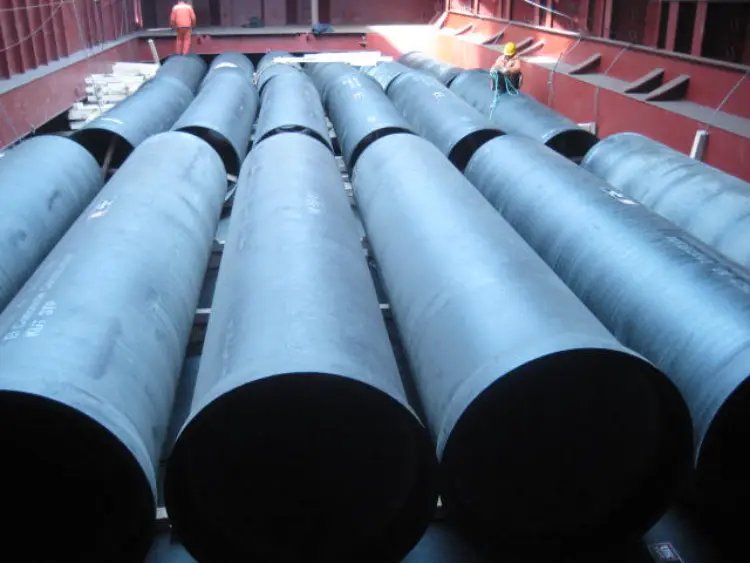
EN10219 S275MLH SHS/RHS Pipe
S275MLH Cold-Formed Hollow Section | EN 10219 Structural Steel Pipe
Detailed material data for EN 10219 S275MLH cold-formed structural hollow sections. Includes chemical composition, mechanical and thermal properties, international equivalents, and application guidance.
Cold forming from hot‑rolled strip (thermomechanical), longitudinal or spiral welding
- Phone : +8618037372205
- Email : [email protected]
- WhatsApp: Contact via Whtsapp
- WeChat: +8618037372205
EN10219 S275MLH SHS/RHS Pipe Introduction
S275MLH is a weldable fine-grain structural steel grade intended for cold-formed hollow sections according to EN 10219. It is produced by thermomechanical rolling (M) and supplied in the as‑formed condition. The grade is characterised by a minimum yield strength of 275 MPa, good toughness at low temperatures (‑50 °C, 27 J minimum), and excellent weldability due to its low carbon equivalent.
The steel belongs to the family of thermomechanically rolled fine‑grain steels, which offer a balanced combination of strength, ductility, and notch toughness without the need for normalizing after forming.
- Supplied mainly in square (SHS) and rectangular (RHS) cross‑sections, but also available as circular hollow sections.
- Suitable for static and dynamic loading in structural engineering, bridge construction, offshore applications, and machinery.
- The 'L' in the designation indicates longitudinal Charpy V‑notch testing, and the 'H' denotes hollow section.
EN10219 S275MLH SHS/RHS Pipe Chemical composition
The chemical composition complies with the requirements of EN 10219‑1 for steel grade S275MLH. All values are maximum unless a range is indicated. The steel is fully killed with a minimum aluminium content and follows strict limits on micro‑alloying elements to guarantee thermomechanical rolling response and good weldability.
| Element | Standard value (%) | Remarks |
|---|---|---|
| Carbon (C) | ≤ 0.16 | Ladle analysis |
| Silicon (Si) | ≤ 0.50 | |
| Manganese (Mn) | 0.50 – 1.60 | |
| Phosphorus (P) | ≤ 0.030 | |
| Sulfur (S) | ≤ 0.025 | |
| Aluminium total (Altot) | ≥ 0.020 | Minimum for fine‑grain practice |
| Niobium (Nb) | ≤ 0.05 | |
| Vanadium (V) | ≤ 0.10 | |
| Titanium (Ti) | ≤ 0.05 | |
| Nickel (Ni) | ≤ 0.30 | |
| Chromium (Cr) | ≤ 0.30 | Cr+Cu+Mo ≤ 0.60 |
| Molybdenum (Mo) | ≤ 0.10 | |
| Copper (Cu) | ≤ 0.35 | |
| Nitrogen (N) | ≤ 0.015 |
EN10219 S275MLH SHS/RHS Pipe Thermal and electrical physical properties
The physical properties listed below are typical for carbon‑manganese structural steels and are applicable for design calculations. The data refer to room temperature unless the test condition indicates a temperature range.
| Property | Standard value | Unit | Test condition |
|---|---|---|---|
| Density (ρ) | 7.85 | g/cm³ | 20 °C |
| Elastic modulus (E) | 210 | GPa | 20 °C |
| Shear modulus (G) | ≈ 81 | GPa | 20 °C |
| Poisson ratio (ν) | 0.3 | – | 20 °C |
| Thermal expansion coefficient (α) | 12.0 × 10‑6 | K‑1 | 20 – 100 °C |
| Thermal conductivity (λ) | 50 | W/(m·K) | 20 °C |
| Specific heat capacity (c) | 460 | J/(kg·K) | 20 °C |
| Electrical resistivity (ρe) | ≈ 0.20 | µΩ·m | 20 °C |
EN10219 S275MLH SHS/RHS Pipe Mechanical properties
These mechanical properties are extracted from EN 10219‑1 and apply to hollow sections tested in the longitudinal direction. The values are valid for wall thicknesses ≤ 40 mm unless otherwise noted. Strength values decrease slightly for greater thicknesses.
| Property | Standard requirement | Unit | Test condition |
|---|---|---|---|
| Upper yield strength (ReH) | ≥ 275 | MPa | t ≤ 16 mm |
| Upper yield strength (ReH) | ≥ 265 | MPa | 16 < t ≤ 40 mm |
| Upper yield strength (ReH) | ≥ 255 | MPa | 40 < t ≤ 63 mm |
| Tensile strength (Rm) | 420 – 580 | MPa | All thicknesses |
| Elongation (A) | ≥ 24 | % | Longitudinal, gauge 5.65√So, t ≤ 40 mm |
| Elongation (A) | ≥ 22 | % | Transverse, t ≤ 40 mm |
| Charpy V‑notch impact (KV2) | ≥ 27 | J | ‑50 °C, longitudinal |
EN10219 S275MLH SHS/RHS Pipe Fully equivalent material standards and substitutable grades
| Country/Region | Standard | Grade | Remarks |
|---|---|---|---|
| EU | EN 10219-1 | S275MLH | Original grade – cold‑formed, thermomechanically rolled hollow sections |
| EU | EN 10210-1 | S275J2H | Hot‑finished hollow section with similar tensile and toughness requirements; delivery condition differs (normalized/normalized rolled), no direct substitution without agreement |
| International | ISO 630-3 | S275M/S275ML (plate) | Plate material for subsequent cold forming; once formed and welded, properties may alter |
| Germany | DIN EN 10219-1 | S275MLH | Identical national adoption |
EN10219 S275MLH SHS/RHS Pipe Application Introduction
S275MLH hollow sections are used extensively in steel structures where a combination of reliable strength, ductility, and verified low‑temperature toughness is mandatory. The thermomechanical rolling process ensures a fine‑grained microstructure and consistent mechanical properties along the tube length, while the cold‑forming and welding operations allow tight dimensional tolerances and a wide range of sizes.
- Typical industries include building and civil engineering, offshore wind and oil & gas, heavy machinery, and transport infrastructure.
- The 'ML' designation confirms a guaranteed 27 J impact energy at ‑50 °C, making the steel suitable for cold climates and dynamic loading.
- Commonly supplied in lengths up to 18 m with surface finished as cold‑formed (optionally blast‑cleaned and painted).
Product Applications: Welded square hollow sections (SHS), Welded rectangular hollow sections (RHS), Circular hollow sections (CHS), Structural columns and beams, Truss members and bracing, Offshore platform legs and decks, Crane booms and jibs, Vehicle chassis rails, Wind turbine towers (internal platforms and transition pieces)
Processed into products: Columns for multi‑storey buildings, Roof trusses and space frames, Lattice tower legs, Pedestrian and road bridge chords, Pile guides and fender systems, Handrails and guardrails, Machine frames, Support structures for conveyors and silos, Signage gantries
Application industries: Steel construction and civil engineering, Offshore & marine structures, Bridge building, Mobile crane and lifting equipment, Agricultural machinery, Transmission towers and telecom masts, Mining and materials handling
EN10219 S275MLH SHS/RHS Pipe Grade recommendations with similar/interchangeable properties
| Country/Region | Standard | Grade | Remarks |
|---|---|---|---|
| EU | EN 10219-1 | S355MLH | Higher strength variant (355 MPa yield); toughness at ‑50 °C; suitable for heavier loads |
| EU | EN 10219-1 | S275J2H | Same yield strength, impact test at ‑20 °C instead of ‑50 °C; not suitable for low‑temperature service |
| EU | EN 10219-1 | S275NH/S275NLH | Normalized/normalized rolled grades; comparable strength but different delivery condition and less favourable price/performance ratio for cold‑formed sections |
| Japan | JIS G 3466 | STKR490 | Square/rectangular hollow section with 490 N/mm² tensile strength; Charpy requirements depend on option; design strength is higher |
Notes:
- Fabrication: S275MLH can be welded by all common arc welding processes. Preheating is usually not required for wall thicknesses up to 30 mm, but a welding procedure qualification should follow EN 1011‑2.
- Corrosion protection: The steel is not inherently corrosion resistant; hot‑dip galvanizing, painting, or other coating systems shall be applied as per project specification.
- Certification: Inspection documents according to EN 10204 type 2.2 or 3.1 are normally supplied. For critical applications, Charpy and tensile test reports are mandatory.
- CE marking: The product can be CE marked under the Construction Products Regulation when accompanied by a Declaration of Performance (DoP).
- Share



