
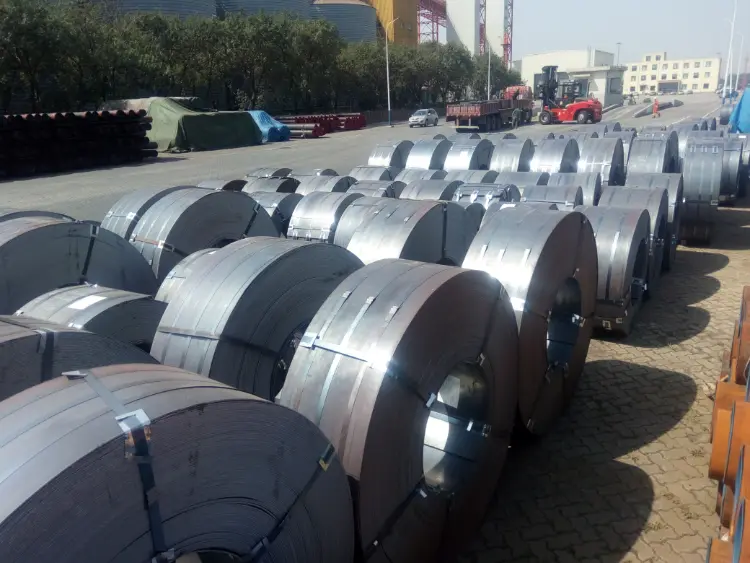
CCS EQ56 Shipbuilding Steel Coil
CCS EQ56 Shipbuilding Steel Coil - Ultra-High Strength Marine Plate for Advanced Vessels
Detailed material data of CCS EQ56 shipbuilding steel coil according to GB 712-2011 and CCS Rules. Covers chemical composition, mechanical properties, thermal/electrical physical properties, international equivalents, similar grades, and application guidance.
Hot rolling, controlled rolling (CR), thermo-mechanical control process (TMCP), normalizing (N), normalizing rolling (NR) as required; suitable for welding, bending, cutting, and forming
- Phone : +8618037372205
- Email : [email protected]
- WhatsApp: Contact via Whtsapp
- WeChat: +8618037372205
CCS EQ56 Shipbuilding Steel Coil Introduction
CCS EQ56 is an ultra-high-strength structural steel grade intended for shipbuilding and offshore engineering applications, certified by the China Classification Society (CCS). It belongs to the normalized or thermo-mechanically rolled fine-grain structural steel family with a minimum yield strength of 560 MPa and excellent low-temperature impact toughness down to -40°C.
Primary attributes:
- Outstanding weldability and cold formability for heavy-section components
- High resistance to brittle fracture in Arctic and deep-sea environments
- Available in coils, plates, and strips for automated shipyard processing
CCS EQ56 Shipbuilding Steel Coil Chemical Composition
The chemical requirements correspond to grade EQ56 as specified in GB 712-2011 and the CCS Rules for Materials and Welding. The steel is a low-carbon, microalloyed fine-grain steel with Nb, V, and Ti additions.
Note: CEV (Carbon Equivalent Value) is typically guaranteed, e.g., CEV ≤0.45% for TMCP delivery, to ensure reliable weldability.
| Element | Standard Value | Remarks |
|---|---|---|
| C | ≤0.20 | Melting analysis; CEV ≤0.43% (typical for TMCP) |
| Si | 0.10–0.55 | Deoxidation and strength |
| Mn | 0.90–1.60 | Grain refinement and strength |
| P | ≤0.025 | Controls embrittlement |
| S | ≤0.025 | Improves toughness and lamellar tearing resistance |
| Als (acid soluble aluminum) | ≥0.015 | Grain refining |
| Nb | 0.02–0.05 | Microalloying for grain refinement and precipitation strengthening |
| V | 0.05–0.10 | Optional microalloying |
| Ti | ≤0.02 | Grain boundary pinning; often 0.007–0.02 |
| Cu | ≤0.35 | Residual element |
| Cr | ≤0.20 | Residual; higher values may be allowed if agreed |
| Ni | ≤0.40 | Optional for toughness |
| Mo | ≤0.08 | Residual |
| N | ≤0.012 | Control of nitrogen content |
| Nb+V+Ti | ≤0.12 | Sum of microalloying elements |
| CEV (Carbon Equivalent) | ≤0.45 (typically) | Based on TMCP condition, according to CCS formula |
CCS EQ56 Shipbuilding Steel Coil Thermal and Electrical Physical Properties
The physical property values are typical for high-strength low-alloy structural steels and have not been specified in the mandatory standard. They are provided as guidance for design calculations.
Note: Actual values may vary slightly depending on the exact composition and condition. All data refer to 20°C unless noted.
| Property | Typical Value | Unit | Test Condition |
|---|---|---|---|
| Density (ρ) | 7.85 | g/cm³ | At 20°C |
| Modulus of elasticity (E) | 205–215 | GPa | At 20°C; average 210 GPa |
| Shear modulus (G) | 80–82 | GPa | Derived from E and Poisson ratio |
| Poisson's ratio (ν) | 0.28–0.30 | - | Elastic range |
| Thermal expansion coefficient (α) | 11.5–12.5 | 10⁻⁶/K | Range 20–100°C |
| Thermal conductivity (λ) | 42–48 | W/(m·K) | At 20°C |
| Specific heat capacity (cp) | 450–500 | J/(kg·K) | At 20°C |
| Electrical resistivity (ρ_e) | 0.20–0.25 | µΩ·m | At 20°C |
CCS EQ56 Shipbuilding Steel Coil Mechanical Properties
The following mechanical properties are based on transverse test pieces from coil/plate products in accordance with GB 712-2011 and CCS Rules. The yield and tensile values depend on the product thickness.
Important: Minimum impact energy of 31 J at -40°C (longitudinal) is required for the base material. All values are verified in the delivery condition.
| Property | Standard Requirement | Unit | Test Condition |
|---|---|---|---|
| Yield strength (ReH) | ≥560 | MPa | Thickness ≤50 mm, transverse |
| Yield strength (ReH) | ≥550 | MPa | Thickness >50–70 mm, transverse |
| Yield strength (ReH) | ≥540 | MPa | Thickness >70–100 mm, transverse |
| Tensile strength (Rm) | 670–830 | MPa | Thickness ≤50 mm, transverse |
| Tensile strength (Rm) | 670–830 | MPa | Thickness >50–100 mm, transverse |
| Elongation after fracture (A) | ≥17 | % | Gauge length 5.65√S₀, transverse, thickness ≤50 mm |
| Elongation after fracture (A) | ≥17 | % | Thickness >50–100 mm, transverse |
| Impact energy (KV₂) | ≥31 | J | -40°C, longitudinal, V-notch, thickness ≤50 mm |
| Impact energy (KV₂) | ≥31 | J | -40°C, longitudinal, V-notch, thickness >50–100 mm |
| Bend test (bending angle 180°) | d = 3a | - | Thickness ≤50 mm; a = specimen thickness |
| Bend test (bending angle 180°) | d = 4a | - | Thickness >50–100 mm; no cracks allowed |
CCS EQ56 Shipbuilding Steel Coil Completely Equivalent Material Standards and Replaceable Designations
| Country / Region | Standard / Classification Society | Designation | Remarks |
|---|---|---|---|
| China | CCS (China Classification Society) | EH56/EQ56 | Base grade; EQ56 for Arctic service |
| USA | ABS (American Bureau of Shipping) | EH56 | Identical minimum yield of 560 MPa |
| Norway/Germany | DNV (Det Norske Veritas) | E56 | Formerly NV E56; now DNV E56 |
| UK | LR (Lloyd's Register) | EH56 | Recognized equivalent for marine structures |
| France | BV (Bureau Veritas) | EH56 | Meets BV Rules for high-strength ship steel |
| Japan | NK (Nippon Kaiji Kyokai) | KE56 | Identical toughness at -40°C |
| South Korea | KR (Korean Register) | RE56 | Accepted alternative for Korean-flagged vessels |
| Italy | RINA (Registro Italiano Navale) | E56 | Corresponds to EQ56 requirements |
| Russia | RS (Russian Maritime Register of Shipping) | E56 | Approved thick plate specification |
CCS EQ56 Shipbuilding Steel Coil Application Introduction
CCS EQ56 steel coil is designed for demanding marine and offshore applications where high strength, low temperature toughness, and excellent weldability are essential. It is primarily used in weight-sensitive structures of large vessels and ice-class ships.
Key processing considerations:
- Edge preparation and welding must follow CCS-approved procedures; preheating is typically not required for TMCP grades up to moderate thickness.
- Cold forming with a recommended bending radius ≥3t for high-strength grades; hot forming must avoid critical temperature ranges.
- Surface inspection and ultrasonic testing to class requirements are mandatory for critical structural components.
Product Applications: Hull decks, bottoms, and side shells for VLOC/ULCS, Longitudinal stiffeners and transverse bulkheads, Ice belt regions of polar ships, Deck structures of cruise ships (where weight reduction is critical), Base plates and reinforcement pads for heavy lifting equipment
Processed into products: Stiffened panels used in ship hull assembly, Shear strakes and stringer plates, Cofferdam bulkheads and watertight doors, Heavy-lift crane booms and pedestal mounts, Transition rings for offshore wind monopiles, Weldments requiring Z-direction through-thickness properties (with additional Z-test)
Application industries: Shipbuilding (especially ultra-large container ships, bulk carriers, Arctic tankers), Offshore oil & gas (platform topsides, crane pedestals, leg structures), Marine engineering (lock gates, dock gates, heavy-lift structures), Renewable energy (offshore wind turbine substructures, transition pieces)
CCS EQ56 Shipbuilding Steel Coil Similar / Alternative Material Recommendations
| Country / Region | Standard / Grade | Designation | Remarks |
|---|---|---|---|
| EU | EN 10025-6 | S550QL | Quenched and tempered structural steel, min. yield 550 MPa; not specifically for shipbuilding but weldable; check EH requirements |
| EU | EN 10225 | S550G2+M | Fixed offshore structures, TMCP condition; yield 550 MPa, close strength level, but toughness usually -40°C or -50°C |
| International | ABS Rules | EH47 | Yield 460 MPa class; lower strength, but same low-temperature toughness (-40°C); may be used where lower strength is acceptable |
| International | ABS Rules | FH56 | Yield 560 MPa; same strength level but with -60°C impact requirement for Arctic service; more stringent than EQ56 |
| China | GB/T 1591 | Q550D | High-strength structural steel, min. yield 550 MPa, -20°C impact; not ship-specific; requires assessment for marine use |
| EU | EN 10025-6 | S690Q | Quenched and tempered, min. yield 690 MPa; higher strength, good toughness; may be considered when higher static strength is needed but requires welding procedure qualification |
Notes:
Additional remarks:
- For thicknesses over 25 mm, ultrasonic testing to class standard (e.g., CCS UTA) is usually required.
- If the steel is to be exposed to aggressive seawater environments, supplementary corrosion-resistant properties (e.g., Cu, Ni additions) may be agreed upon.
- CEV (Carbon Equivalent Value) for TMCP products is typically ≤0.45%; consult CCS Rules for welding qualification requirements.
- When the material is ordered as coil, tolerances regarding thickness, width, and flatness shall conform to GB/T 709 or CCS acceptance criteria.
- For Arctic service, the EQ56 grade may be produced with modified chemistry and tested with the Charpy V-notch at -40°C as mandatory; higher impact energies are achievable upon request.
- Share



