
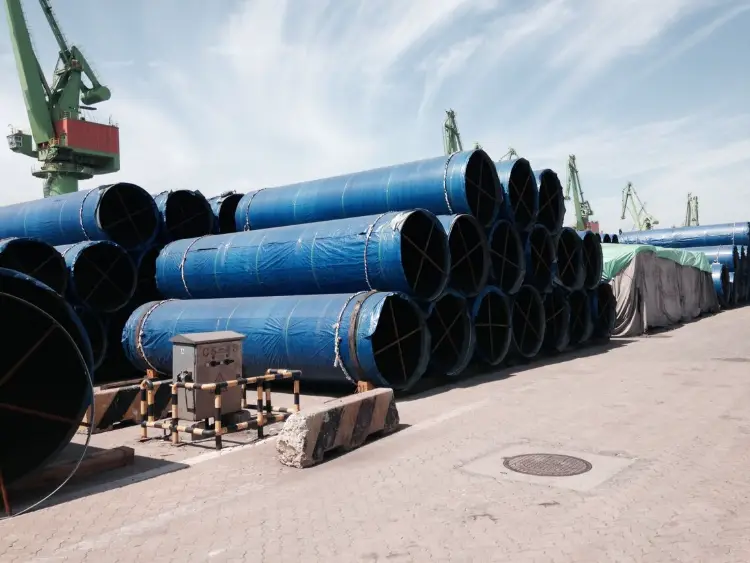
EN10219 S355MH LSAW Pipe
S355MH LSAW Pipe – EN 10219 High-Strength Thermomechanical Rolled Welded Hollow Section
Detailed material data for S355MH LSAW pipe according to EN 10219-1: cold-formed welded structural hollow section made from thermomechanically rolled fine-grain steel. Includes chemical composition, mechanical properties, physical data, equivalent grades, and application guidance.
Cold forming from thermomechanically rolled strip or plate, longitudinal SAW welding, optional post-weld stress relieving
- Phone : +8618037372205
- Email : [email protected]
- WhatsApp: Contact via Whtsapp
- WeChat: +8618037372205
EN10219 S355MH LSAW Pipe Introduction
S355MH is a thermomechanically rolled fine-grain structural steel grade specified in EN 10219-1 for cold-formed welded hollow sections. The LSAW (Longitudinal Submerged Arc Welded) pipe manufactured from this grade combines high yield strength (≥355 MPa for thin walls) with excellent toughness at low temperatures and good weldability. The thermomechanical rolling process refines the microstructure, enabling a lean chemical composition and a maximum carbon equivalent value (CEV ≤0.39) that ensures reliable field welding without excessive preheating.
- Minimum yield strength of 355 MPa for thicknesses ≤16 mm
- Guaranteed Charpy impact energy ≥40 J at –20 °C (t >10 mm)
- Tight control of micro-alloying elements (Nb, V, Ti) for grain refinement
- Cold-forming capability with a bend radius of 2t without cracking
S355MH LSAW pipes are widely used in heavy structural applications, offshore substructures, bridge piers, and crane booms, where high load-bearing capacity and low-temperature toughness are essential. The delivery condition is usually as-welded, with the option of stress-relief heat treatment upon request.
EN10219 S355MH LSAW Pipe Chemical Composition
The composition conforms to EN 10219-1, Table 2, for grade S355MH. Values are maxima unless a range is indicated. The fine-grain structure is achieved through controlled micro-alloying additions (Nb, V, Ti), and the carbon equivalent (CEV) is restricted to ensure good weldability without high preheating temperatures.
| Element | Standard Value | Remarks |
|---|---|---|
| C | ≤ 0.14% | Improves weldability |
| Si | ≤ 0.50% | Deoxidiser |
| Mn | ≤ 1.50% | Strength and toughness balance |
| P | ≤ 0.035% | Phosphorus, detrimental to toughness |
| S | ≤ 0.030% | Sulphur, influences machinability |
| Nb | ≤ 0.05% | Grain refiner, strengthens by precipitation |
| V | ≤ 0.10% | Grain refiner, may be present with Nb |
| Ti | ≤ 0.05% | Grain refiner, also fixes nitrogen |
| Al (total) | ≥ 0.015% | Minimum for fine grain practice; also deoxidises |
| N | ≤ 0.015% | Nitrogen, controlled to avoid ageing |
| Cu | ≤ 0.55% | Residual element from scrap |
| Cr | ≤ 0.30% | Residual element |
| Ni | ≤ 0.30% | Residual element |
| Mo | ≤ 0.10% | Residual element |
| CEV | ≤ 0.39 | Carbon equivalent value = C+Mn/6+(Cr+Mo+V)/5+(Ni+Cu)/15 |
EN10219 S355MH LSAW Pipe Thermal & Electrical Physical Properties
Physical properties are not specified in EN 10219 and are taken from general references for low-alloy structural steels and EN 1993-1-1. The values are typical for S355MH at ambient temperature (20 °C) unless otherwise noted. Variations may occur depending on exact composition and processing history. These data are suitable for design calculations.
| Property | Standard Requirement | Unit | Test Conditions |
|---|---|---|---|
| Density (ρ) | 7850 | kg/m³ | At 20 °C |
| Young's modulus (E) | 210 | GPa | At 20 °C |
| Shear modulus (G) | ≈ 81 | GPa | At 20 °C, calculated from E and ν |
| Poisson's ratio (ν) | 0.3 | — | At 20 °C |
| Coefficient of thermal expansion (α) | 12.0 × 10⁻⁶ | 1/K | Mean value between 20 °C and 100 °C |
| Thermal conductivity (λ) | 50 | W/(m·K) | At 20 °C |
| Specific heat capacity (c) | 460 | J/(kg·K) | At 20 °C |
| Electrical resistivity (ρ_e) | ≈ 0.16 × 10⁻⁶ | Ω·m | At 20 °C |
EN10219 S355MH LSAW Pipe Mechanical Properties
The mechanical properties are extracted from EN 10219-1, Table 5, for S355MH. Values apply to the finished hollow section after cold forming and welding. The yield strength is thickness dependent; elongation and impact values are given for the longitudinal direction unless otherwise stated. Impact testing is mandatory for thicknesses >10 mm at –20 °C.
| Property | Standard Requirement | Unit | Test Conditions |
|---|---|---|---|
| Minimum yield strength (ReH) | 355 | MPa | Wall thickness t ≤ 16 mm; cold-formed and welded condition |
| Minimum yield strength (ReH) | 345 | MPa | Wall thickness 16 < t ≤ 40 mm |
| Minimum yield strength (ReH) | 335 | MPa | Wall thickness 40 < t ≤ 63 mm |
| Tensile strength (Rm) | 470 – 630 | MPa | All thicknesses |
| Elongation after fracture (A) | ≥ 22 | % | Longitudinal, gauge length 5.65√S0; for t ≤ 40 mm |
| Elongation after fracture (A) | ≥ 20 | % | Transverse, gauge length 5.65√S0; for t ≤ 40 mm (if applicable to welded sections) |
| Charpy V-notch impact energy (KV2) | ≥ 40 | J | At –20 °C, longitudinal; mandatory for t > 10 mm |
| Bend test (transverse bend) | No cracks | — | Bend angle 180°; mandrel diameter = 2t (t = wall thickness); test on a strip cut from the hollow section |
EN10219 S355MH LSAW Pipe Fully Equivalent Standards & Replaceable Designations
| Country/Region | Standard | Grade | Remarks |
|---|---|---|---|
| European Union | EN 10219-1 | S355MH | Exactly the grade under consideration; thermomechanically rolled, cold-formed welded hollow section. |
| European Union | EN 10025-4 | S355M | Parent plate/coil grade for thermomechanically rolled structural steels; properties are very similar but apply to flat products, not hollow sections; may serve as a substitute for base material in welded fabrications. |
EN10219 S355MH LSAW Pipe Application Introduction
S355MH LSAW pipe is favoured where high structural integrity, low-temperature toughness, and efficient weldability are required. Its fine-grain structure and controlled carbon equivalent allow site welding with minimal preheat, making it economical for large fabrications. The cold-formed longitudinal seam weld ensures a smooth internal surface and consistent wall thickness, beneficial for hydrodynamic applications and corrosion protection systems.
Product Applications: Structural columns and beams for framed buildings, Piling pipes for foundation and retaining walls, Offshore wind turbine monopiles and jackets, Crane main chords and jib members, Transmission line towers and poles, Heavy-duty scaffolding and shoring towers, Pipe trusses for roofs and long-span structures
Processed into products: Monopile and transition piece for offshore wind, Main boom section of crawler crane, Bridge pier and arch rib segments, Deck support beams in ship hulls, Heavy-duty trailer frame rails, Lattice mast components for drilling rigs, Structural ring stiffeners in tanks and silos
Application industries: Structural engineering (high-rise buildings, stadiums, airports), Bridge construction (piers, arches, trusses), Offshore and marine structures (platform jackets, monopiles, subsea frames), Heavy lifting and transport (crane booms, mobile crane chassis), Wind energy (turbine towers, transition pieces, foundation piles), Shipbuilding (deck structures, crane pedestals), Mining and earthmoving equipment (loader arms, dump truck bodies)
EN10219 S355MH LSAW Pipe Similar / Alternative Materials
| Country/Region | Standard | Grade | Remarks |
|---|---|---|---|
| European Union | EN 10210-1 | S355J2H | Hot-finished structural hollow section with min. yield 355 MPa and –20 °C impact toughness; similar strength but different production route (hot rolling vs. cold forming) and slightly different composition limits. |
| European Union | EN 10210-1 | S355K2H | Hot-finished hollow section with –20 °C impact toughness and higher guaranteed toughness (K2); strength comparable. |
| USA | ASTM A572 / A572M | Grade 50 [345] | High-strength low-alloy structural steel with 345 MPa yield; does not include thermomechanical rolling specification and impact temperature is typically higher (e.g., –18 °C for Grade 50). |
| USA | ASTM A500 / A500M | Grade C | Cold-formed welded carbon steel hollow structural sections; min. yield 345 MPa; no specific thermomechanical or fine-grain requirements. |
| UK (former) | BS 4360 | 50D | Similar strength level with –20 °C impact; now superseded by EN 10025-4 S355M plate. |
Notes:
Welding recommendations: Due to the low carbon equivalent (CEV ≤0.39), S355MH can be welded with common processes (SAW, SMAW, GMAW) without excessive preheating. For wall thicknesses up to about 30 mm, preheat is generally not required at ambient temperatures above +5 °C. However, follow the consumable manufacturer's guidelines and perform a welding procedure qualification when needed. Post-weld heat treatment (stress relieving at 530–580 °C) may be applied for thick sections or severe service, but consult the supplier because prolonged holding at high temperature can affect the thermomechanical properties. For cold forming beyond the bend test radius (2t), contact the manufacturer. The LSAW weld is typically a full-penetration double-sided submerged arc weld that is ultrasonically or radiographically inspected; the weld metal tensile strength overmatches the base metal to ensure joint integrity.
- Share



