
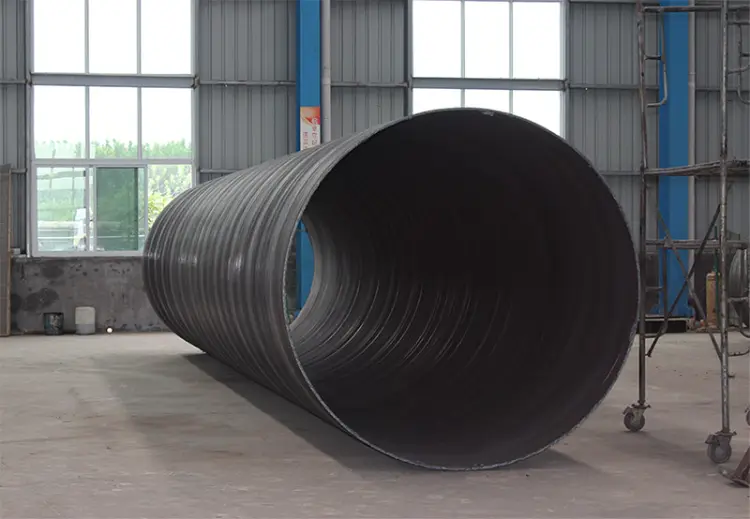
EN10219 S355MLH LSAW Pipe
EN10219 S355MLH LSAW Pipe: High-Strength Steel for Low-Temperature Structural Applications
Comprehensive material data for EN10219 S355MLH LSAW steel pipe, including chemical composition, mechanical and physical properties, international equivalents, and application guidance.
Thermomechanical rolling (M), cold forming, welding (submerged arc - LSAW), normalising rolling possible for some equivalents
- Phone : +8618037372205
- Email : [email protected]
- WhatsApp: Contact via Whtsapp
- WeChat: +8618037372205
EN10219 S355MLH LSAW Pipe Introduction
S355MLH is a thermomechanically rolled fine-grain structural steel for cold-formed welded hollow sections, as specified in EN 10219-1. It offers a minimum yield strength of 355 MPa and excellent low-temperature impact toughness at -50 °C, making it suitable for demanding applications in structural engineering, offshore platforms, bridges, and heavy machinery. LSAW (Longitudinal Submerged Arc Welding) pipes are produced by bending and welding steel plates. The material achieves its superior mechanical properties through a controlled rolling process, eliminating the need for subsequent heat treatment. Its weldability, combined with high strength and toughness, allows for efficient fabrication of large-diameter, thick-walled pipes used in energy infrastructure, building construction, and piling.
- Minimum yield strength 355 MPa (t ≤ 16 mm)
- Charpy impact energy ≥ 27 J at -50 °C
- Fine-grain structure with microalloying elements
- Suitable for cold forming and welding
EN10219 S355MLH LSAW Pipe Chemical Composition
The chemical composition of S355MLH is controlled to achieve fine ferritic-pearlitic microstructure and adequate weldability. The limits comply with EN 10219-1. Microalloying elements (Nb, V, Ti) refine the grain and provide strength through precipitation hardening. The carbon equivalent value (CEV) is limited to ensure good field weldability, typically CEV ≤ 0.39% for thickness ≤ 30 mm (optionally ≤ 0.43% for higher thickness). Deoxidation with aluminium is mandatory, indicated by the 'H' suffix.
| Element | Specified Value (max) | Remarks |
|---|---|---|
| Carbon (C) | ≤ 0.14 | |
| Silicon (Si) | ≤ 0.50 | |
| Manganese (Mn) | ≤ 1.60 | |
| Phosphorus (P) | ≤ 0.030 | |
| Sulfur (S) | ≤ 0.025 | |
| Nitrogen (N) | ≤ 0.015 | |
| Aluminium (Al total) | ≥ 0.015 | fully killed steel |
| Niobium (Nb) | ≤ 0.05 | optional microalloying element |
| Vanadium (V) | ≤ 0.12 | optional microalloying element |
| Titanium (Ti) | ≤ 0.05 | optional microalloying element |
| Nickel (Ni) | ≤ 0.30 | |
| Copper (Cu) | ≤ 0.55 | |
| Molybdenum (Mo) | ≤ 0.20 | |
| Chromium (Cr) | ≤ 0.30 | |
| Boron (B) | not specified | residual only |
| Nb+V+Ti | ≤ 0.15 | sum if individually controlled |
| CEV | ≤ 0.39 (t ≤ 30mm) | CEV = C + Mn/6 + (Cr+Mo+V)/5 + (Ni+Cu)/15 |
EN10219 S355MLH LSAW Pipe Physical Properties
The listed physical properties are representative for low-alloy structural steels similar to S355 and can be used for design purposes. The values are based on EN 1993-1-1 and general material data sheets. The density and elastic modulus show negligible variation for the S355MLH grade. Thermal conductivity decreases with increasing temperature, while specific heat capacity increases.
| Property | Typical Value | Unit | Condition / Temperature |
|---|---|---|---|
| Density (ρ) | 7850 | kg/m³ | at 20 °C |
| Modulus of elasticity (E) | 210 | GPa | 20 °C |
| Shear modulus (G) | 81 | GPa | 20 °C |
| Poisson ratio (ν) | 0.3 | — | 20 °C |
| Coefficient of thermal expansion (α) | 12.0 × 10⁻⁶ | K⁻¹ | 20–100 °C |
| Coefficient of thermal expansion (α) | 12.5 × 10⁻⁶ | K⁻¹ | 20–200 °C |
| Coefficient of thermal expansion (α) | 13.0 × 10⁻⁶ | K⁻¹ | 20–300 °C |
| Thermal conductivity (λ) | 50 | W/(m·K) | 20 °C |
| Thermal conductivity (λ) | 45 | W/(m·K) | 100 °C |
| Thermal conductivity (λ) | 40 | W/(m·K) | 200 °C |
| Specific heat capacity (cp) | 460 | J/(kg·K) | 20 °C |
| Specific heat capacity (cp) | 500 | J/(kg·K) | 200 °C |
| Specific heat capacity (cp) | 550 | J/(kg·K) | 400 °C |
| Electrical resistivity (ρe) | 0.15 – 0.20 × 10⁻⁶ | Ω·m | at 20 °C |
EN10219 S355MLH LSAW Pipe Mechanical Properties
The mechanical properties are determined according to EN 10219-1 using test specimens taken from the finished hollow section. The values depend on the nominal thickness (t). Impact tests are performed in the longitudinal direction at -50 °C. For wall thickness reduction (>10% for cold-formed without heat treatment), full-section tensile test requirements may apply. The bending test is usually carried out over a former with diameter 3t (t ≤ 16 mm) or 4t (t > 16 mm).
| Property | Required Value | Unit | Test Condition / Thickness |
|---|---|---|---|
| Upper yield strength (ReH) | ≥ 355 | MPa | t ≤ 16 mm |
| Upper yield strength (ReH) | ≥ 345 | MPa | 16 < t ≤ 40 mm |
| Upper yield strength (ReH) | ≥ 335 | MPa | 40 < t ≤ 63 mm |
| Upper yield strength (ReH) | ≥ 325 | MPa | 63 < t ≤ 80 mm |
| Upper yield strength (ReH) | ≥ 315 | MPa | 80 < t ≤ 100 mm |
| Tensile strength (Rm) | 470 – 630 | MPa | t ≤ 63 mm |
| Tensile strength (Rm) | 450 – 630 | MPa | 63 < t ≤ 100 mm |
| Elongation after fracture (A) | ≥ 22 | % | longitudinal, t ≤ 40 mm, L0 = 5.65√S0 |
| Elongation after fracture (A) | ≥ 20 | % | longitudinal, 40 < t ≤ 63 mm |
| Elongation after fracture (A) | ≥ 19 | % | longitudinal, 63 < t ≤ 100 mm |
| Impact energy (KV2) | ≥ 27 | J | -50 °C, longitudinal, full-size specimen |
| Bending test | no cracks | former diameter: 3t (t ≤ 16); 4t (t > 16), 180° bend |
EN10219 S355MLH LSAW Pipe Fully Equivalent Material Standards and Substitute Grades
| Country/Region | Standard | Grade | Remarks |
|---|---|---|---|
| European Union | EN 10219-1 | S355MLH | Original standard; cold-formed welded structural hollow sections |
| International | ISO 10799-2:2011 | S355MLH | Cold-formed welded structural hollow sections of non-alloy and fine grain steels |
| Germany | DIN EN 10219-1 | S355MLH | Identical adoption |
| United Kingdom | BS EN 10219-1 | S355MLH | Identical adoption |
| France | NF EN 10219-1 | S355MLH | Identical adoption |
| Italy | UNI EN 10219-1 | S355MLH | Identical adoption |
| Spain | UNE EN 10219-1 | S355MLH | Identical adoption |
| Sweden | SS-EN 10219-1 | S355MLH | Identical adoption |
| China | GB/T 3091-2015 (partial) | Q355D (~S355J2H) | Not fully equivalent; impact temperature -20°C; check for ML requirement |
| Japan | JIS G 3466 | STKR490 | Similar strength; impact properties depend on quality class |
EN10219 S355MLH LSAW Pipe Application Introduction
S355MLH LSAW pipes are used in a wide range of load-bearing structures where a combination of high strength, excellent low-temperature toughness, and good weldability is required. Their LSAW production allows large diameters and thick walls, making them ideal for critical infrastructure. The thermomechanical rolling eliminates the need for post-weld heat treatment in most cases. Typical industries and products include:
Product Applications: Structural hollow profiles for columns and trusses, Longitudinal submerged arc welded (LSAW) line pipes for water and slurry, Large-diameter piling pipes (spiral welded alternative is also possible), Tubular components for offshore wind turbine foundations, Mechanical tubes for high-load applications (e.g., hydraulic piston casings)
Processed into products: Columns and bracing members in multi-storey building frames, Bridge piers and arch ribs, Jacket legs and bracing for offshore platforms, Tower flanges and door frame sections for wind turbines, Heavy-duty axle housings and telescopic boom sections for mobile cranes, Piles, caissons, and foundation pipes for marine terminals
Application industries: Construction and civil engineering (high-rise buildings, stadiums, bridges), Offshore and marine engineering (platform legs, jacket structures, piles), Energy sector (wind turbine towers, transmission poles, LNG piping supports), Transport infrastructure (heavy vehicle components, rail structures), Industrial machinery (crane booms, hydraulic cylinder bodies, machine frames)
EN10219 S355MLH LSAW Pipe Similar or Alternative Material Grades
| Country/Region | Standard | Grade | Remarks |
|---|---|---|---|
| European Union | EN 10210-1 | S355MLH | Hot-finished structural hollow sections, same mechanical properties but different manufacturing route; typically more consistent residual stress distribution |
| European Union | EN 10219-1 | S355J2H | Lower impact temperature rating (-20 °C) but otherwise similar; cheaper option for less demanding low-temp service |
| European Union | EN 10219-1 | S460MLH | Higher strength grade (460 MPa yield) with same ML classification; suitable for weight-saving designs |
| USA | ASTM A572/A572M | Grade 50 [345] Type 1 | No low-temperature impact guarantee unless ordered with optional requirement; use ASTM A709 Grade 50T for impact-tested structural steel |
| USA | ASTM A500/A500M | Grade C | Cold-formed welded structural tubing, yield ~345 MPa, impact test not standard |
| USA | ASTM A847/A847M | Grade 50 | Weathering steel hollow sections with similar strength; not directly equivalent |
| International | ISO 630-2:2011 | S355ML | Plate steel for general construction; can be used to fabricate pipes if formed and welded; same thermomechanical rolling and low-temperature properties |
| Russia | GOST 19281-2014 | 10G2BD (10Г2БД) | Similar strength and low temperature impact; different manufacturing standard |
Notes:
The material is suitable for hot-dip galvanising. For welding, low-hydrogen processes are recommended. The carbon equivalent (CEV) should be checked from the inspection certificate for cold-cracking risk assessment. For thicknesses above 30 mm, higher CEV limits may apply as agreed between purchaser and manufacturer. Welding consumables should match the strength and toughness class (e.g., filler metal with 3.5% Ni for -50 °C impact). The LSAW pipes are usually supplied with a 3.1 certificate according to EN 10204.
- Share



