
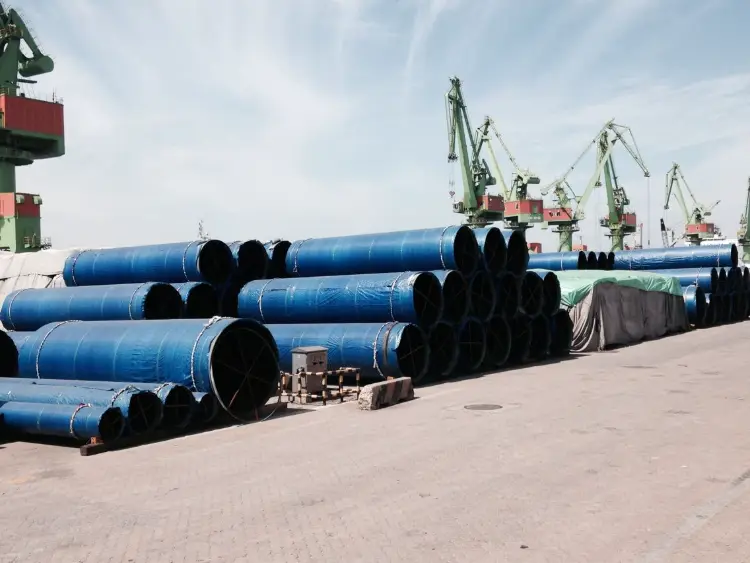
EN 10219 S275MLH LSAW Pipe
EN10219 S275MLH LSAW Pipe: Low-Temperature Structural Hollow Sections
Detailed material data for S275MLH steel grade according to EN 10219, including chemical composition, mechanical properties, physical properties, equivalent grades, and application guide for LSAW pipes.
Cold forming, welding (LSAW), cutting, drilling, machining, bending, coating
- Phone : +8618037372205
- Email : [email protected]
- WhatsApp: Contact via Whtsapp
- WeChat: +8618037372205
EN 10219 S275MLH LSAW Pipe Introduction
S275MLH is a thermomechanically rolled, fine-grain structural steel grade for cold-formed welded structural hollow sections, specified in EN 10219-1. It is designed for low-temperature applications, offering a minimum yield strength of 275 MPa and guaranteed Charpy V-notch impact energy of 27 J at -50 °C. The 'M' indicates thermomechanical rolling, 'L' stands for low-temperature toughness, and 'H' denotes hollow sections. Supplied in the form of longitudinal submerged arc welded (LSAW) pipes, this material combines excellent weldability, high strength, and good ductility, making it ideal for demanding structural and engineering constructions in cold climates.
EN 10219 S275MLH LSAW Pipe Chemical Composition
The chemical composition of S275MLH is defined in EN 10219-1, Table 2. The steel is a fine-grain quality with mandatory aluminium content and optional microalloying elements (Nb, V, Ti) to achieve grain refinement. The sum of niobium, vanadium, and titanium shall not exceed 0.22 %; individual limits are Nb ≤0.05 %, V ≤0.12 %, Ti ≤0.05 %. These elements ensure the specified low-temperature impact properties.
| Element | Standard Value (max unless range) | Remarks |
|---|---|---|
| C (Carbon) | 0.13 | |
| Si (Silicon) | 0.50 | |
| Mn (Manganese) | 1.50 | |
| P (Phosphorus) | 0.025 | |
| S (Sulfur) | 0.020 | |
| Al (Aluminium, total) | ≥ 0.020 | Minimum for fine-grain steel |
| Nb (Niobium) | ≤ 0.05 | Optional microalloy; Nb+V+Ti ≤ 0.22 |
| V (Vanadium) | ≤ 0.12 | Optional microalloy |
| Ti (Titanium) | ≤ 0.05 | Optional microalloy |
EN 10219 S275MLH LSAW Pipe Thermal and Electrical Physical Properties
These physical properties are typical for carbon-manganese structural steels and are not part of the standard requirements. They provide useful data for design calculations involving temperature changes, heat transfer, or electrical conductivity. Actual values may vary slightly with specific chemistry and manufacturing conditions.
| Property | Standard Required Value | Unit | Test Condition |
|---|---|---|---|
| Density (ρ) | 7.85 | g/cm³ | Room temperature |
| Modulus of elasticity (E) | 210 | GPa | Room temperature |
| Shear modulus (G) | ~80 | GPa | Room temperature |
| Poisson's ratio (ν) | 0.3 | - | Room temperature |
| Thermal expansion coefficient (α) | 12 × 10⁻⁶ | 1/K | 20 – 100 °C |
| Thermal conductivity (λ) | ~50 | W/(m·K) | Room temperature |
| Specific heat capacity (cp) | 450 – 480 | J/(kg·K) | Room temperature |
| Electrical resistivity (ρ_e) | ~0.22 × 10⁻⁶ | Ω·m | Room temperature |
EN 10219 S275MLH LSAW Pipe Mechanical Properties
The mechanical properties apply to wall thicknesses ≤ 16 mm in the as-delivered condition. Values are minimum unless otherwise stated. The Charpy impact test is performed on longitudinal specimens at -50 °C. Bending test requirements follow EN 10219-1: 180° bend around a former with diameter 2t for thickness ≤16 mm, without cracking.
| Property | Standard Required Value | Unit | Test Condition |
|---|---|---|---|
| Yield strength (ReH) | ≥ 275 | MPa | Ambient temperature; wall thickness ≤16 mm |
| Tensile strength (Rm) | 370 – 530 | MPa | Ambient temperature; wall thickness ≤16 mm |
| Elongation after fracture (A) | ≥ 24 | % | Longitudinal; gauge length 5.65√So |
| Charpy V-notch impact energy (KV) | ≥ 27 | J | Longitudinal; at -50 °C |
| Bending test (bend angle 180°) | No cracks; mandrel diameter = 2×wall thickness | - | For wall thickness ≤16 mm |
EN 10219 S275MLH LSAW Pipe Completely Equivalent Material Standards and Substitutable Grades
| Country/Region | Standard | Grade | Remarks |
|---|---|---|---|
| Europe | EN 10219-1 | S275MLH | Same standard – cold-formed hollow sections |
| Europe | EN 10210-1 | S275MLH | Hot-finished structural hollow section; identical grade designation and property requirements |
| UK | BS EN 10219-1 | S275MLH | British adoption of EN 10219 |
| Germany | DIN EN 10219-1 | S275MLH | German edition; identical requirements |
EN 10219 S275MLH LSAW Pipe Application Introduction
S275MLH in LSAW pipe form is a versatile material for structural applications requiring reliable performance at sub-zero temperatures. Its thermomechanical rolling route ensures a fine, uniform grain structure that delivers a combination of high strength, excellent toughness, and good weldability. It is widely used in heavy construction, offshore, and mechanical engineering.
Product Applications: LSAW steel pipes and tubes for structural support, Cold-formed welded hollow sections for columns and trusses, Jacket legs and braces for offshore platforms, Tubular piles for deep foundations, Boom and mast sections for cranes and excavators
Processed into products: Circular hollow section (CHS) columns and struts, Square and rectangular hollow section beams, Welded tubular joints (Y, K, T connections), Pipe spools for process plant structural racks, End closures and flanges welded to tubular sections
Application industries: Construction and civil engineering (bridges, stadiums, high-rise buildings), Offshore and marine structures (platforms, wind turbine towers, flare booms), Mining and heavy machinery (boom sections, crane structural members), Transportation (railway bridges, vehicle frames), Energy (transmission towers, LNG terminal structural components)
EN 10219 S275MLH LSAW Pipe Similar or Comparable Material Substitutions
| Country/Region | Standard | Grade | Remarks |
|---|---|---|---|
| Europe | EN 10219-1 | S275MH | Same yield strength but impact only at -20 °C; not suitable for -50 °C service |
| Europe | EN 10219-1 | S355MLH | Higher strength (355 MPa yield); similar low-temperature toughness |
| USA | ASTM A572 / A572M | Grade 50 (Type 1) | Comparable yield strength but no guaranteed low-temperature impact; additional testing required |
| USA | API 5L | X52 PSL2 | Pipeline steel with similar strength; Charpy at lower temperatures can be ordered |
| International | ISO 3183 | L290 (X42) | Slightly lower yield, but similar toughness levels for low-temperature service when specified |
Notes:
- Wall thicknesses above 16 mm may require reduced mechanical values; consult the standard for specifics.
- For welding, preheating is not generally required for moderate thicknesses, but the carbon equivalent (CEV) should be calculated to confirm weldability.
- Galvanizing and painting are commonly applied for corrosion protection; hot-dip galvanizing is possible with proper silicon control.
- S275MLH can be supplied with impact testing at -50 °C as a mandatory option, with average absorbed energy ≥27 J.
- Share



