
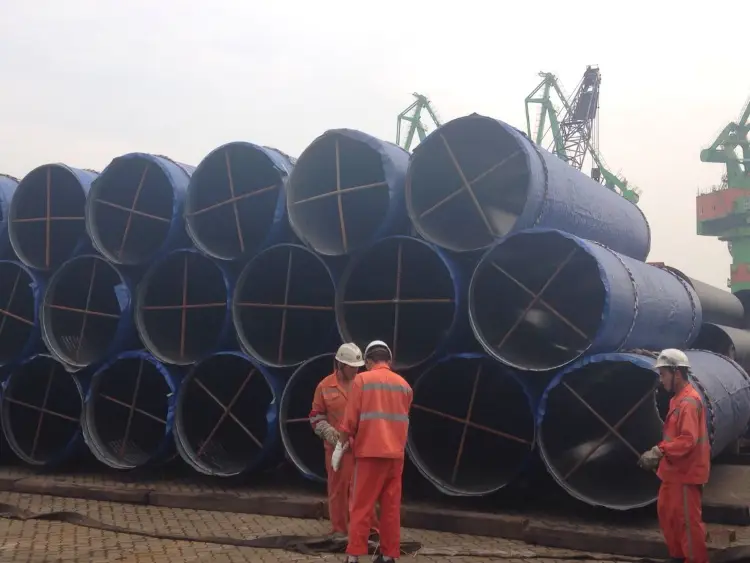
EN 10219 S275MH LSAW Pipe
EN 10219 S275MH LSAW Pipe: High-Strength Thermomechanical Rolled Hollow Section for Critical Structures
Comprehensive material data for EN 10219 S275MH LSAW pipe: chemical composition, mechanical properties, thermal and electrical characteristics, international equivalents, and application guidance.
Cold forming and longitudinal submerged arc welding of thermomechanically rolled plate/coil; suitable for welding, bending, and machining
- Phone : +8618037372205
- Email : [email protected]
- WhatsApp: Contact via Whtsapp
- WeChat: +8618037372205
EN 10219 S275MH LSAW Pipe Introduction
EN 10219 S275MH LSAW pipe is a cold-formed welded structural hollow section manufactured from thermomechanically rolled fine-grain structural steel S275M in accordance with EN 10025-4. The suffix 'H' denotes hollow profile. LSAW (Longitudinal Submerged Arc Welded) pipes are produced by forming and welding steel plates, offering large diameters and wall thicknesses suitable for heavy structural applications. S275MH provides a minimum yield strength of 275 MPa for thinner sections, good weldability, and guaranteed impact toughness down to -20°C. This grade is widely used in construction, offshore structures, bridges, and mechanical engineering where weight saving and reliability are required. The steel is supplied in normalized or as-rolled condition with high dimensional accuracy and consistent mechanical properties in compliance with EN 10219-1 and -2.
EN 10219 S275MH LSAW Pipe Chemical Composition
Chemical composition limits as per EN 10025-4:2004 for grade S275M, which is the base material for S275MH hollow sections. Values represent heat analysis; product analysis may differ within the permitted tolerances of the standard. The steel is characterized by a lean alloy design with controlled microalloying elements (Nb, V, Ti) to achieve fine grain size and strength through thermomechanical rolling.
- Carbon equivalent (CEV) is limited to ensure weldability.
- Sulfur and phosphorus are kept low to enhance toughness and formability.
| Chemical Element | Nominal Value (%) | Remarks |
|---|---|---|
| Carbon (C) | ≤ 0.18 | Heat analysis; for t ≤ 40 mm |
| Silicon (Si) | ≤ 0.50 | |
| Manganese (Mn) | ≤ 1.50 | For t ≤ 40 mm |
| Phosphorus (P) | ≤ 0.030 | |
| Sulfur (S) | ≤ 0.025 | |
| Niobium (Nb) | ≤ 0.05 | Optional microalloying |
| Vanadium (V) | ≤ 0.12 | Optional microalloying |
| Titanium (Ti) | ≤ 0.05 | Optional microalloying |
| Aluminum (Al) | ≥ 0.015 (total) | Usually present for grain refinement |
| Nitrogen (N) | ≤ 0.015 | |
| Copper (Cu) | ≤ 0.55 | May be present as residual |
| CEV (Carbon Equivalent) | ≤ 0.39 | Based on heat analysis using IIW formula; for t ≤ 40 mm |
EN 10219 S275MH LSAW Pipe Thermal and Electrical Physical Properties
Physical properties are typical for structural steels of this composition and density, at room temperature unless otherwise stated. These values are not specified in the material standard but are essential for engineering design involving thermal load, heat transfer, and electromagnetic behavior. They represent average values for carbon‑manganese fine‑grain steels.
- Density is taken as 7850 kg/m³ for weight calculations.
- Modulus of elasticity varies slightly with temperature.
- Thermal properties apply to the range 20°C to 100°C unless noted.
| Property | Typical Value | Unit | Test Condition / Remark |
|---|---|---|---|
| Density (ρ) | 7850 | kg/m³ | Room temperature |
| Modulus of Elasticity (E) | 210 | GPa | Room temperature, tensile loading |
| Shear Modulus (G) | ≈ 81 | GPa | Calculated from E and ν |
| Poisson's Ratio (ν) | 0.3 | — | Room temperature |
| Thermal Expansion Coefficient (α) | 12.0 × 10⁻⁶ | K⁻¹ | 20°C to 100°C |
| Thermal Conductivity (λ) | 50 | W/(m·K) | Room temperature |
| Specific Heat Capacity (c) | 460 | J/(kg·K) | Room temperature |
| Electrical Resistivity (ρₑ) | 0.16 | μΩ·m | Room temperature |
EN 10219 S275MH LSAW Pipe Mechanical Properties
Mechanical properties for S275MH hollow sections according to EN 10219-1:2006. Values are specified for longitudinal direction and vary with wall thickness. The strength requirements ensure adequate load-bearing capacity, while elongation and impact toughness provide assurance against brittle fracture. Testing conditions include room temperature tensile test and Charpy V-notch impact test at -20°C.
- Yield strength (ReH) decreases with increasing wall thickness due to the nature of thermomechanical processing.
- Elongation is measured on a gauge length of 5.65√S₀.
| Property | Minimum / Specified Value | Unit | Test Condition |
|---|---|---|---|
| Yield Strength (ReH) | 275 | MPa | Wall thickness T ≤ 16 mm |
| Yield Strength (ReH) | 265 | MPa | 16 < T ≤ 40 mm |
| Yield Strength (ReH) | 255 | MPa | 40 < T ≤ 63 mm |
| Yield Strength (ReH) | 245 | MPa | 63 < T ≤ 80 mm |
| Yield Strength (ReH) | 235 | MPa | 80 < T ≤ 100 mm |
| Yield Strength (ReH) | 225 | MPa | 100 < T ≤ 120 mm |
| Tensile Strength (Rm) | 370 - 530 | MPa | T ≤ 100 mm |
| Tensile Strength (Rm) | 360 - 520 | MPa | 100 < T ≤ 120 mm |
| Elongation (A) | ≥ 24 | % | Gauge length 5.65√S₀; T ≤ 40 mm |
| Elongation (A) | ≥ 23 | % | 40 < T ≤ 63 mm |
| Elongation (A) | ≥ 22 | % | 63 < T ≤ 100 mm |
| Elongation (A) | ≥ 22 | % | 100 < T ≤ 120 mm |
| Charpy Impact Energy (KV) | ≥ 40 | J | Longitudinal; -20°C; T ≤ 40 mm |
| Charpy Impact Energy (KV) | ≥ 40 | J | Longitudinal; -20°C; 40 < T ≤ 60 mm |
| Charpy Impact Energy (KV) | ≥ 27 | J | Longitudinal; -20°C; 60 < T ≤ 100 mm |
| Charpy Impact Energy (KV) | ≥ 27 | J | Longitudinal; -20°C; 100 < T ≤ 120 mm |
EN 10219 S275MH LSAW Pipe Fully Equivalent Material Standards and Substitutable Grades
| Country / Region | Standard | Grade Designation | Remarks |
|---|---|---|---|
| European Union | EN 10210-1 (hot finished) | S275MH | Hot-finished structural hollow section; same strength and toughness grade, different production route. |
| European Union | EN 10025-4 (plates/strips) | S275M | Base steel for cold forming; not a hollow section, but equivalent chemical and mechanical requirements. |
| International | ISO 630-3 | S275M | Thermomechanical rolled structural steel plate; equivalent to EN 10025-4 S275M. |
EN 10219 S275MH LSAW Pipe Application Introduction
EN 10219 S275MH LSAW pipes are engineered for demanding structural applications where large diameters, high strength, and good weldability are required. Their fine‑grain microstructure and guaranteed Charpy toughness at -20°C make them suitable for offshore, bridge, and heavy construction projects. LSAW pipes are often chosen for columns, piles, bracing members, and as components in fabricated girders or trusses. The ability to supply long sections with tailored wall thicknesses gives designers flexibility in optimizing steel weight and cost.
Product Applications: Structural columns and posts, Foundation piles (bearing and sheet piles), Truss chords and web members, Conveyor gallery frames, Transmission line poles, Rolled and welded beams of tubular cross-section
Processed into products: Steel building frames (HSS columns, trusses), Bridge arches and piers, Offshore platform legs and bracings, Monopile foundations for wind turbines, Crane booms and lattice structures, Pipe rack modules in industrial plants
Application industries: Civil and building construction, Offshore oil & gas (jackets, topsides, conductors), Bridge engineering, Renewable energy (wind turbine towers, monopiles), Mining and material handling, Heavy machinery and crane manufacturing
EN 10219 S275MH LSAW Pipe Similar / Alternative Material Recommendations
| Country / Region | Standard | Grade Designation | Remarks |
|---|---|---|---|
| European Union | EN 10219-1 | S275J2H | Normalized or cold-formed hollow section with similar yield strength and better low-temperature toughness (-20°C). Slightly different chemical composition and rolling process. |
| European Union | EN 10210-1 | S355J2H | Higher strength (ReH ≥ 355 MPa) hot-finished hollow section; may allow weight reduction. Requires design adaptation. |
| USA | ASTM A500 | Grade C | Cold-formed welded structural tubing with similar yield strength (345 MPa), but not identical impact requirements. |
| USA | ASTM A572 | Grade 42 | Structural steel plate with 290 MPa yield; not a hollow section but can be used for fabricated sections. |
Notes:
Additional considerations:
- For wall thicknesses above 40 mm, reduction in impact energy and elongation must be factored into design.
- Welding consumables and preheat should be selected according to the carbon equivalent and relevant welding standards (e.g., AWS D1.1, ISO 15614).
- When ordering LSAW pipes, dimensional tolerances (diameter, wall thickness, straightness) shall be specified per EN 10219-2.
- Coating and corrosion protection (e.g., hot-dip galvanizing, painting) can be applied; the steel composition is compatible with common coating systems.
- For fatigue-loaded structures, the fatigue classification of welded hollow sections should be verified according to EN 1993-1-9.
- Share



