
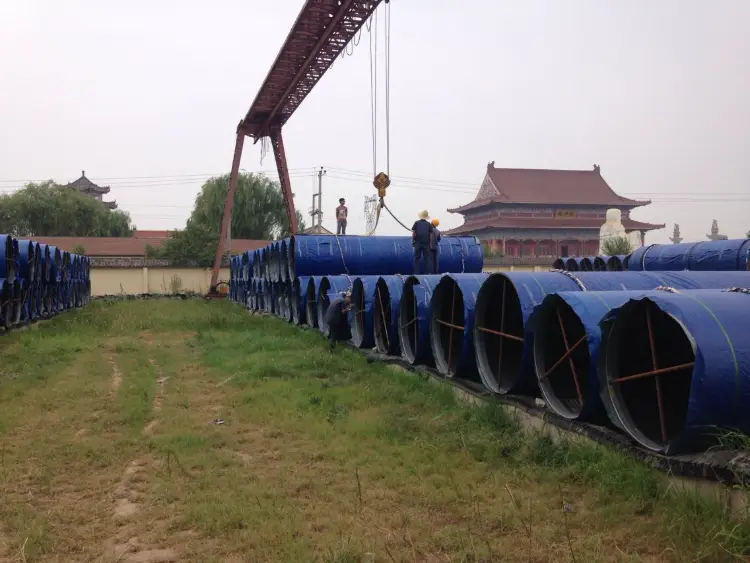
EN 10219 S460NLH LSAW Pipe
EN 10219 S460NLH LSAW Pipe: Fine‑Grain High‑Strength Hollow Section for Arctic‑Grade Structures
Detailed material data for EN 10219 S460NLH LSAW steel pipes: chemical, mechanical, thermal properties, international equivalents, and applications in demanding structural and offshore environments.
Cold forming, submerged‑arc welding (SAW/LSAW), normalizing rolling, optional post‑weld heat treatment
- Phone : +8618037372205
- Email : [email protected]
- WhatsApp: Contact via Whtsapp
- WeChat: +8618037372205
EN 10219 S460NLH LSAW Pipe Introduction
S460NLH is a cold‑formed welded structural hollow section conforming to EN 10219‑1. Manufactured from normalized fine‑grain steel, it offers a minimum yield strength of 460 MPa and guaranteed 27 J impact energy at ‑50 °C. The LSAW (Longitudinal Submerged Arc Welding) process enables large‑diameter pipes with high‑quality longitudinal seams. The material combines excellent weldability, good ductility, and reliable low‑temperature toughness, making it ideal for heavy‑duty structural applications in arctic climates, offshore platforms, bridges, and tall buildings. S460NLH is typically supplied in the normalized‑rolled (+N) condition, with optional through‑thickness testing (Z‑quality) available upon agreement.
EN 10219 S460NLH LSAW Pipe Chemical Composition
The chemical composition of S460NLH complies with EN 10219‑1 for fine‑grain structural steels. Maximum limits for alloying elements ensure good weldability and low‑temperature toughness. The carbon equivalent value (CEV) is restricted based on product thickness to improve cold‑cracking resistance.
| Element | Standard Value (max %) | Remarks |
|---|---|---|
| Carbon (C) | 0.20 | Max |
| Silicon (Si) | 0.60 | Max |
| Manganese (Mn) | 1.00 – 1.70 | Range |
| Phosphorus (P) | 0.030 | Max |
| Sulfur (S) | 0.025 | Max |
| Aluminum (Al total) | 0.020 | Min |
| Niobium (Nb) | 0.05 | Max |
| Vanadium (V) | 0.20 | Max |
| Titanium (Ti) | 0.05 | Max |
| Chromium (Cr) | 0.30 | Max |
| Nickel (Ni) | 0.80 | Max |
| Molybdenum (Mo) | 0.20 | Max |
| Copper (Cu) | 0.55 | Max |
| Nitrogen (N) | 0.025 | Max |
| CEV* | 0.47 – 0.53 | Max, depending on thickness (EN 10219‑1) |
EN 10219 S460NLH LSAW Pipe Thermal and Electrical Physical Properties
These values are typical for fine‑grain structural steel at room temperature and may vary slightly with composition and processing. They are not mandatory per the standard but are useful for design and thermal analysis.
| Property | Typical Value | Unit | Condition |
|---|---|---|---|
| Density (ρ) | 7850 | kg/m³ | 20 °C |
| Elastic Modulus (E) | 210 | GPa | 20 °C |
| Shear Modulus (G) | 81 | GPa | 20 °C |
| Poisson's Ratio (ν) | 0.3 | — | 20 °C |
| Thermal Expansion (α) | 11.1 | 10⁻⁶/K | 20–100 °C |
| Thermal Expansion | 12.5 | 10⁻⁶/K | 20–200 °C |
| Thermal Conductivity (λ) | 50 | W/(m·K) | 20 °C |
| Specific Heat Capacity (cₚ) | 460 | J/(kg·K) | 20 °C |
| Electrical Resistivity (ρₑ) | 0.22 | µΩ·m | 20 °C |
EN 10219 S460NLH LSAW Pipe Mechanical Properties
Tensile and impact properties are determined on longitudinal specimens taken from the hollow section. Requirements vary with wall thickness. The L in S460NLH denotes minimum 27 J impact energy at ‑50 °C. Bend tests verify formability and absence of cracks.
| Property | Value | Unit | Test Condition |
|---|---|---|---|
| Yield Strength (ReH) | ≥460 | MPa | t ≤ 16 mm |
| Yield Strength (ReH) | ≥440 | MPa | 16 < t ≤ 40 mm |
| Yield Strength (ReH) | ≥430 | MPa | 40 < t ≤ 63 mm |
| Yield Strength (ReH) | ≥410 | MPa | 63 < t ≤ 80 mm |
| Tensile Strength (Rm) | 550 – 720 | MPa | t ≤ 100 mm |
| Elongation (A) | ≥17 | % | t ≤ 40 mm, longitudinal, L₀=5.65√S₀ |
| Elongation (A) | ≥17 | % | 40 < t ≤ 63 mm, longitudinal |
| Elongation (A) | ≥17 | % | 63 < t ≤ 100 mm, longitudinal |
| Impact Energy (KV₂) | ≥27 | J | ‑50 °C, longitudinal, V‑notch |
| Bend Test | No cracks | — | 180° bend, mandrel diameter 3t (t = wall thickness) |
EN 10219 S460NLH LSAW Pipe Completely Equivalent Standards and Replaceable Grades
| Country/Region | Standard | Grade | Remarks |
|---|---|---|---|
| Europe | EN 10219‑1 | S460NLH | Identical – cold‑formed hollow sections, fine‑grain steel |
| Germany | DIN EN 10219‑1 | S460NLH | Identical |
| United Kingdom | BS EN 10219‑1 | S460NLH | Identical |
| France | NF EN 10219‑1 | S460NLH | Identical |
| Italy | UNI EN 10219‑1 | S460NLH | Identical |
| International (ISO) | ISO 630‑3 | S460NL | For plates and flat bars; not a hollow section grade, but identical chemical and mechanical basis |
EN 10219 S460NLH LSAW Pipe Application Introduction
S460NLH LSAW pipes are designed for heavy structural applications that demand high strength and guaranteed low‑temperature toughness. Their excellent weldability and ductility make them a preferred choice in demanding environments. The longitudinal submerged‑arc welded (LSAW) process enables the production of large‑diameter, thick‑walled pipes with consistent quality.
Product Applications: Large‑diameter structural columns and piles, Offshore platform legs, braces, and jacket structures, Bridge piers, arches, and box girders, Wind turbine tubular towers, Boom and chord sections for lattice‑boom cranes, Structural hollow sections for stadiums and long‑span roofs
Processed into products: Welded main chords and bracings, End rings and flanges for tubular connections, Transition pieces for offshore wind monopiles, Node cans and joint cans, Truss elements and space frames, Lattice tower legs and cross‑arms
Application industries: Offshore and marine engineering, Bridge construction, Wind energy (tower and foundation structures), Heavy machinery and crane manufacturing, High‑rise and industrial building frames, Arctic infrastructure and pipeline support
EN 10219 S460NLH LSAW Pipe Similar/Alternative Material Recommendations
| Country/Region | Standard | Grade | Remarks |
|---|---|---|---|
| Europe | EN 10219‑1 | S460NH | Same strength class, but minimum impact temperature 0 °C (N) instead of ‑50 °C (NL). Suitable if low‑temperature toughness is not required. |
| Europe | EN 10219‑1 | S460MLH | Thermomechanical rolled (M), same yield and ‑50 °C impact. Alternative production route with slightly different chemical limits; often interchangeable. |
| Europe | EN 10025‑3 | S460NL | Hot‑rolled plate for structural steelwork. Equivalent strength and toughness; can be used when fabricating welded sections from plate. |
| USA | ASTM A572/A572M | Grade 65 | Minimum yield 450 MPa; similar strength range. Low‑temperature impact toughness available only with supplementary specification (e.g., CVN at ‑50 °C). |
| USA | ASTM A913/A913M | Grade 65 | High‑strength low‑alloy structural steel with 450 MPa yield; not directly a hollow section grade. |
| Japan | JIS G 3444 | STKN490B | Tensile strength class 490 N/mm², roughly comparable to S460. Typically used for structural tubes; verify low‑temperature toughness requirements. |
Notes:
- LSAW pipe specifics: Mother plates are normalized rolled before forming and welding. The longitudinal weld is made by submerged‑arc process, typically double‑sided. Full non‑destructive testing (UT/RT) is usually applied.
- Weldability: Good, with standard precautions. Preheat may be required based on CEV and combined thickness, especially for high‑restraint joints. PWHT is generally not required but can be applied if needed.
- Low‑temperature service: Guaranteed Charpy energy of 27 J at ‑50 °C makes S460NLH LSAW pipe suitable for arctic and cryogenic structural applications without separate qualification.
- Through‑thickness properties: Upon agreement, Z‑quality (Z15, Z25, Z35) can be provided for improved resistance to lamellar tearing.
- Corrosion protection: Standard unprotected steel; usually supplied with temporary shop primer. Appropriate coating or cathodic protection should be considered for long‑term service in aggressive environments.
- Share



