
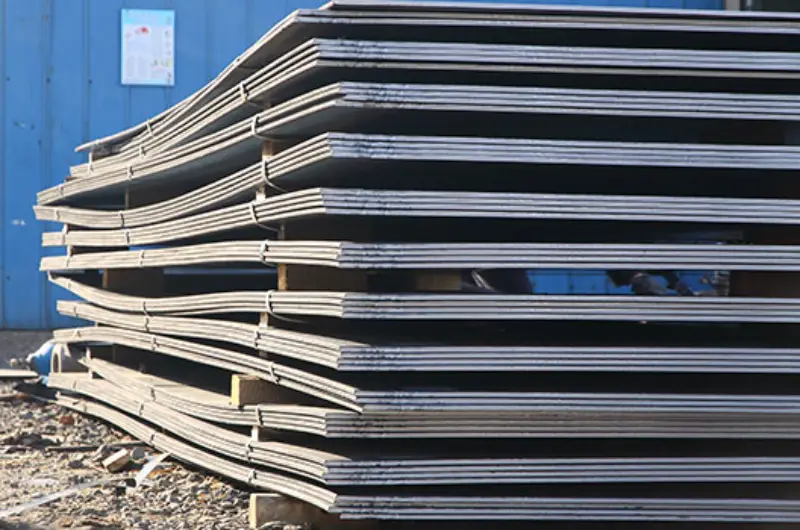
EN10219 S275NLH Cold-Formed Hollow Section
EN10219 S275NLH Cold-Formed Hollow Section: Low-Temperature Toughness Structural Tube
Explore EN10219 S275NLH SHS/RHS pipe: a fine-grain normalized structural hollow section with guaranteed impact toughness at -50°C, used in low-temperature structural applications.
Cold forming, high-frequency welding, normalized or normalized-rolled, cutting, drilling, welding, galvanizing
- Phone : +8618037372205
- Email : [email protected]
- WhatsApp: Contact via Whtsapp
- WeChat: +8618037372205
EN10219 S275NLH Cold-Formed Hollow Section Introduction
EN10219 S275NLH is a cold-formed welded structural hollow section made from fine-grain normalized or normalized-rolled steel. The designation 'S' indicates structural steel, '275' specifies the minimum yield strength in MPa for thickness ≤16 mm, 'N' denotes a normalized or normalized-rolled delivery condition, 'L' confirms impact properties tested at -50°C, and 'H' stands for hollow section. It offers excellent low-temperature notch toughness, good weldability, and consistent mechanical properties, making it suitable for demanding structural and engineering applications where high reliability at subzero temperatures is required.
EN10219 S275NLH Cold-Formed Hollow Section Chemical Composition
The chemical composition complies with EN 10219-1:2006, Table 2 for grade S275NLH. The steel is fully killed, fine-grain treated with a minimum aluminum content and optional microalloying (Nb, V) to ensure strength and low-temperature toughness. Maximum thickness applicable: ≤40 mm.
| Element | Standard Value (%) | Remarks |
|---|---|---|
| C (Carbon) | ≤ 0.18 | Maximum |
| Si (Silicon) | ≤ 0.50 | Maximum |
| Mn (Manganese) | 0.50 – 1.50 | Range |
| P (Phosphorus) | ≤ 0.030 | Maximum |
| S (Sulfur) | ≤ 0.025 | Maximum |
| Altotal (Aluminium, total) | ≥ 0.020 | Minimum, grain refinement |
| Nb (Niobium) | ≤ 0.05 | Maximum |
| V (Vanadium) | ≤ 0.12 | Maximum |
| Nb+V | ≤ 0.12 | Combined maximum |
| Cu (Copper) | ≤ 0.55 | Maximum, can be higher if agreed |
| Cr (Chromium) | ≤ 0.30 | Maximum, residual |
| Ni (Nickel) | ≤ 0.30 | Maximum, residual |
| Mo (Molybdenum) | ≤ 0.10 | Maximum, residual |
| Ti (Titanium) | ≤ 0.05 | Maximum, optional |
EN10219 S275NLH Cold-Formed Hollow Section Thermal and Electrical Physical Properties
The following physical properties are typical for normalized fine-grain structural steels and are not mandatory test requirements of EN 10219. They serve for design calculations. Values are given at room temperature unless otherwise stated.
| Property | Typical Value | Unit | Test Conditions / Temperature |
|---|---|---|---|
| Density (ρ) | 7850 | kg/m³ | At 20 °C |
| Modulus of Elasticity (E) | 210 | GPa | At 20 °C |
| Shear Modulus (G) | ≈ 81 | GPa | At 20 °C |
| Poisson's Ratio (ν) | 0.3 | - | At 20 °C |
| Thermal Expansion Coefficient (α) | 12.0 | 10⁻⁶/K | 20 – 100 °C |
| Thermal Expansion Coefficient (α) | 12.5 | 10⁻⁶/K | 20 – 200 °C |
| Thermal Conductivity (λ) | 50 | W/(m·K) | At 20 °C |
| Specific Heat Capacity (cp) | 460 | J/(kg·K) | At 20 °C |
| Electrical Resistivity (ρe) | ≈ 0.15 | 10⁻⁶ Ω·m | At 20 °C |
EN10219 S275NLH Cold-Formed Hollow Section Mechanical Properties
Mechanical properties are valid for room temperature testing in delivery condition +N. Tensile testing is performed on longitudinal strip samples taken from the hollow section. Charpy V-notch impact tests are performed at -50 °C and must meet the minimum absorbed energy for the specified wall thickness.
| Property | Standard Requirement | Unit | Test Conditions |
|---|---|---|---|
| Yield Strength (ReH) | ≥ 275 | MPa | Wall thickness t ≤ 16 mm |
| Yield Strength (ReH) | ≥ 265 | MPa | 16 < t ≤ 40 mm |
| Tensile Strength (Rm) | 370 – 530 | MPa | All thicknesses ≤ 40 mm |
| Elongation (A) | ≥ 24 | % | Longitudinal, t ≤ 40 mm, proportional specimen l0=5.65√S0 |
| Charpy Impact (KV2) | ≥ 27 | J | Longitudinal, -50 °C, full-size specimen (t ≥10 mm) |
| Charpy Impact (KV2) | ≥ 27 | J | Sub-size specimen, if 5≤t<10 mm, minimum energy adjusted proportionally |
| Bend Test | No cracks | - | Bend angle 180°, mandrel diameter 2t for t≤16 mm; 3t for 16 |
EN10219 S275NLH Cold-Formed Hollow Section Fully Equivalent Material Standards and Substitute Grades
| Country / Region | Standard | Grade | Remarks |
|---|---|---|---|
| European Union | EN 10210-1:2006 | S275NLH | Hot-finished hollow section with identical chemical and mechanical requirements, fully interchangeable. |
| European Union | EN 10219-1:2006 | S275NLH | The original grade; cold-formed welded hollow section. |
| European Union | EN 10025-3:2019 | S275NL | Plates and bars of the same fine-grain normalized steel; used as base material before cold forming. |
EN10219 S275NLH Cold-Formed Hollow Section Application Introduction
EN10219 S275NLH hollow sections combine moderate strength with guaranteed impact toughness at -50 °C. They are ideal for structures exposed to low ambient temperatures, dynamic loading, or fatigue conditions. The fine-grain normalized microstructure ensures homogeneous properties across the section and excellent weldability. Typical applications favour square (SHS), rectangular (RHS), and circular (CHS) profiles for efficient bending and compression resistance.
Product Applications: Arctic drilling modules and structures, Cold-climate bridges and pedestrian walkways, Offshore platform legs and braces, Lattice towers for wind turbines, Container-handling cranes and gantry structures, LNG storage tank support frames, Railway wagon underframes, Earthquake-resistant structural frames
Processed into products: Columns and beams in cold-environment buildings, Truss chord members and bracing, Jacket legs for offshore platforms, Rotors and hubs for small wind turbines, Boom and jib sections for mobile cranes, Vehicle chassis rails and cross-members, Lifting and spreader beams, Bolted or welded framework nodes
Application industries: Offshore and marine engineering, Bridge construction, Wind energy (towers, foundations), Crane and heavy machinery manufacturing, Low-temperature storage and cryogenic structures, Steel building frames in arctic/cold climates, Transport and trailer equipment, Mining and earth-moving machinery
EN10219 S275NLH Cold-Formed Hollow Section Similar or Comparable Substitute Materials
| Country / Region | Standard | Grade | Remarks |
|---|---|---|---|
| European Union | EN 10219-1 | S275J2H | Lower toughness, impact tested at -20 °C, otherwise similar strength; suitable for less demanding low-temperature applications. |
| European Union | EN 10219-1 | S355NLH | Higher strength (ReH ≥355 MPa), similar low-temperature toughness (-50 °C); weight reduction possible. |
| European Union | EN 10210-1 | S275J2H | Hot-finished hollow section with -20 °C toughness; similar strength but higher temperature limit. |
| USA | ASTM A572/A572M | Grade 42 (290 MPa) / Grade 50 (345 MPa) | Notch toughness at low temperature only when supplemented with ASTM A709 requirements; strength levels differ. |
| USA | ASTM A500 | Grade B (317 MPa yield) | Cold-formed hollow section, but no guaranteed low-temperature toughness; not equivalent for cryogenic use. |
| International | ISO 630-3 | E275D | Structural plates with -20 °C toughness; similar strength but lower toughness class; acceptable only if design criteria relaxed. |
Notes:
- All S275NLH hollow sections are supplied with inspection certificate 3.1 per EN 10204 unless otherwise agreed.
- For hollow sections with wall thickness <5 mm, impact test sub-size specimens must meet proportional minimum energy (e.g., 27 J × width/10 mm).
- Welding consumables should be selected to match the low-temperature toughness requirements; preheating is generally not necessary for thicknesses below 40 mm when using low-hydrogen processes.
- Post-weld heat treatment is not required for normalized grades, but stress relieving may be applied if needed.
- Dimensional tolerances comply with EN 10219-2; typical corner radii and straightness are standard for cold-formed hollow sections.
- Share



