
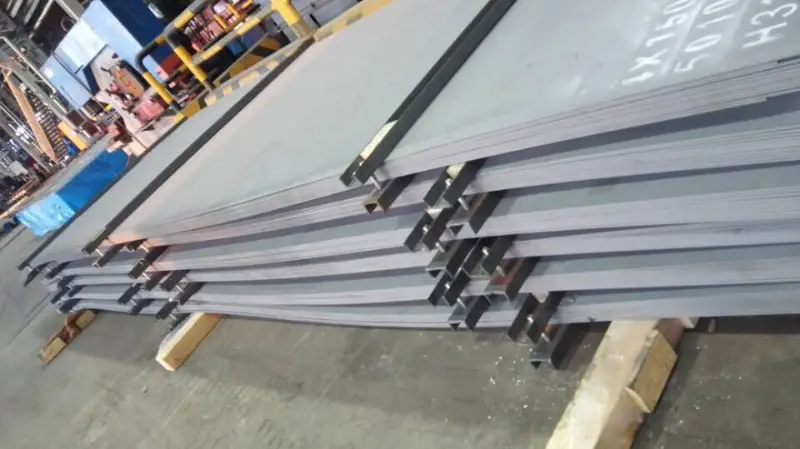
309S (S30908) Austenitic Stainless Steel Plate & Coil
309S (S30908) Austenitic Stainless Steel Plate & Coil – High-Temperature Oxidation Resistance
Complete technical data for 309S (UNS S30908) stainless steel plate and coil: chemical composition, mechanical and thermal properties, international equivalents, and application guidelines.
Hot rolling, cold rolling, forming, welding, stamping, deep drawing
- Phone : +8618037372205
- Email : [email protected]
- WhatsApp: Contact via Whtsapp
- WeChat: +8618037372205
309S Austenitic Stainless Steel Plate & Coil Introduction
Austenitic 309S (UNS S30908) stainless steel is a low-carbon, high-chromium-nickel alloy designed for elevated-temperature service. It offers superior oxidation resistance up to 1100°C (continuous) and excellent resistance to sulfidation and carburization. The low carbon content minimizes carbide precipitation during welding, preserving intergranular corrosion resistance. Compared to 304, 309S provides significantly better high-temperature strength and scaling resistance, making it ideal for furnace components, heat exchangers, and thermal processing equipment.
- Excellent oxidation and scaling resistance
- Good high-temperature strength
- Low carbon content for welded applications
- Resistant to thermal fatigue
309S Austenitic Stainless Steel Plate & Coil Chemical Composition
Chemical composition in accordance with ASTM A240/A240M for 309S stainless steel. All values are maximum unless a range is specified. The alloy is a balanced Cr-Ni formulation to provide optimum oxidation resistance while maintaining austenitic structure.
| Element | Content (%) | Remarks |
|---|---|---|
| Carbon (C) | 0.08 max | Low carbon for weldability |
| Manganese (Mn) | 2.00 max | — |
| Phosphorus (P) | 0.045 max | — |
| Sulfur (S) | 0.030 max | — |
| Silicon (Si) | 1.00 max | — |
| Chromium (Cr) | 22.0 – 24.0 | Primary oxidation-resistance element |
| Nickel (Ni) | 12.0 – 15.0 | Austenite stabilizer |
| Iron (Fe) | Balance | — |
309S Austenitic Stainless Steel Plate & Coil Thermal and Electrical Physical Properties
Physical properties for 309S stainless steel in the annealed condition. Values are representative for temperatures between 20°C and 1000°C. Thermal expansion and thermal conductivity are critical for evaluating thermal fatigue and heat transfer performance.
| Property | Standard Requirement | Unit | Test Condition |
|---|---|---|---|
| Density (ρ) | 7.90 | g/cm³ | at 20°C |
| Elastic Modulus (E) | 200 | GPa | at 20°C |
| Shear Modulus (G) | 77 | GPa | at 20°C |
| Poisson's Ratio (ν) | 0.30 | — | at 20°C |
| Thermal Expansion (α) | 14.4 | 10⁻⁶/K | 20–100°C |
| Thermal Expansion (α) | 16.0 | 10⁻⁶/K | 20–315°C |
| Thermal Expansion (α) | 17.0 | 10⁻⁶/K | 20–538°C |
| Thermal Expansion (α) | 18.4 | 10⁻⁶/K | 20–650°C |
| Thermal Conductivity (λ) | 15.6 | W/m·K | at 100°C |
| Thermal Conductivity (λ) | 18.7 | W/m·K | at 300°C |
| Thermal Conductivity (λ) | 21.5 | W/m·K | at 500°C |
| Specific Heat Capacity | 500 | J/kg·K | 0–100°C |
| Electrical Resistivity (ρ_e) | 0.78 | µΩ·m | at 20°C |
309S Austenitic Stainless Steel Plate & Coil Mechanical Properties
Minimum mechanical properties at room temperature for solution-annealed plate according to ASTM A240/A240M. Performance values depend on the plate thickness and specific heat treatment. Tensile and yield strengths are guaranteed minimums; elongation is measured on a 50 mm (2 in.) gauge length.
| Property | Standard Requirement | Unit | Test Condition |
|---|---|---|---|
| Tensile Strength (Rm) | 515 min | MPa | Room temperature, annealed |
| Yield Strength (ReH, 0.2% offset) | 205 min | MPa | Room temperature, annealed |
| Elongation at Break (A) | 40 min | % | in 50 mm (2 in.), plate thickness ≤ 19 mm |
| Brinell Hardness | 217 max | HBW | annealed |
| Rockwell Hardness | 95 max | HRB | annealed |
309S Austenitic Stainless Steel Plate & Coil Exact Equivalent Material Standards and Substitute Grades
| Country/Region | Standard | Grade | Remarks |
|---|---|---|---|
| USA | ASTM A240/A240M | 309S (UNS S30908) | Original standard grade |
| EU | EN 10088-2 / EN 10088-3 | 1.4833 (X6CrNi22-13) | Chemically equivalent |
| Japan | JIS G4304 / JIS G4305 | SUS 309S | Identical composition |
| China | GB/T 3280 / GB/T 4237 | 06Cr23Ni13 (old 0Cr23Ni13) | Slight carbon range difference (≤0.08%) |
| ISO | ISO 4954 | X6CrNi22-13 | International equivalent |
309S Austenitic Stainless Steel Plate & Coil Application Introduction
309S stainless steel is designed for high-temperature service where resistance to oxidation and scaling are primary requirements. It can be used in both oxidizing and reducing atmospheres, as well as in environments containing sulfur compounds. Due to its toughness and formability, it lends itself to a wide range of fabricated sheet metal products.
Product Applications: Industrial furnace components (radiant tubes, muffles, retorts), Annealing covers and boxes, Burner nozzles and flame holders, Boiler baffles and tube supports, Kiln linings and hangers
Processed into products: Furnace conveyors and belts, Heat exchanger tubesheets and expansion bellows, Tube supports and pyrolyzer radiants, Expansion joints, Stack liners
Application industries: Petrochemical refineries, Heat treatment and industrial furnace manufacturing, Power generation (boilers, superheater parts), Cement and lime kilns, Automotive exhaust and emission control systems, Waste incineration plants
309S Austenitic Stainless Steel Plate & Coil Recommended Similar / Alternative Materials
| Country/Region | Standard | Grade | Remarks |
|---|---|---|---|
| USA | ASTM A240 | 310S (S31008) | Higher Cr and Ni for more severe oxidation up to 1150°C, but more expensive |
| USA | ASTM A240 | 304H (S30409) | Lower alloy content; suitable for intermittent high-temperature service in less corrosive environments |
| EU | EN 10088-2 | 1.4845 (X8CrNi25-21) | Higher Cr and Ni, similar to 310S, used for extreme thermal cycling |
Notes:
309S exhibits excellent scaling resistance in continuous service up to 1100°C and intermittent service up to 980°C. Long-term exposure in the range of 550–850°C should be minimized to avoid sigma phase embrittlement. The material is readily weldable by all common processes, but post-weld annealing is recommended for critical applications to restore optimum corrosion resistance.
- Share



