
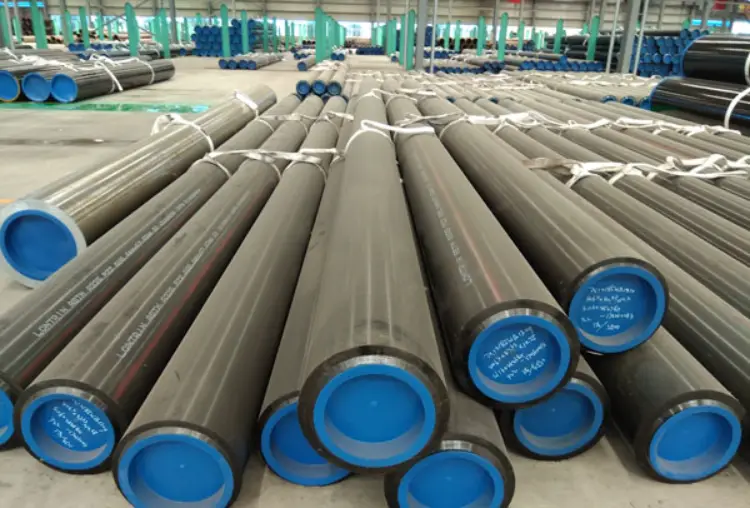
EN10219 S275NH SHS/RSH Section Pipe
EN10219 S275NH SHS/RSH: High-Strength Structural Hollow Section Pipe
Comprehensive data for EN10219 S275NH steel hollow sections (SHS/RSH) including chemical composition, mechanical properties, thermal and electrical properties, equivalent grades and applications.
Cold forming, welding, bending, cutting, drilling
- Phone : +8618037372205
- Email : [email protected]
- WhatsApp: Contact via Whtsapp
- WeChat: +8618037372205
EN10219 S275NH SHS/RSH Section Pipe Introduction
S275NH is a normalized/normalized rolled weldable fine-grain structural steel defined in EN 10219 for cold-formed welded structural hollow sections of non-alloy and fine grain steels. It is supplied as square (SHS) or rectangular (RHS) pipes. The grade offers a minimum yield strength of 275 MPa, good weldability, and reliable toughness at low temperatures (impact tested at -20 °C). It is widely used in construction, bridges, and mechanical engineering where both static and dynamic loads are present. The "N" denotes normalized or normalized rolled condition, while "H" indicates hollow section product.
EN10219 S275NH SHS/RSH Section Pipe Chemical Composition
The chemical composition of S275NH complies with the requirements for fine-grain structural steels in EN 10219-1. Fine grain practice is achieved by the addition of aluminium or other grain-refining elements such as niobium, vanadium, or titanium. The values below are the maximum limits unless a range is given.
| Element | Standard Value | Remarks |
|---|---|---|
| Carbon (C) | ≤ 0.20 | |
| Silicon (Si) | ≤ 0.50 | |
| Manganese (Mn) | 0.60 – 1.60 | |
| Phosphorus (P) | ≤ 0.030 | |
| Sulphur (S) | ≤ 0.025 | |
| Aluminium (Al) total | ≥ 0.015 | or acid soluble Al ≥ 0.013 |
| Niobium (Nb) | ≤ 0.05 | |
| Vanadium (V) | ≤ 0.05 | |
| Titanium (Ti) | ≤ 0.05 | |
| Chromium (Cr) | ≤ 0.30 | |
| Nickel (Ni) | ≤ 0.30 | |
| Molybdenum (Mo) | ≤ 0.08 | |
| Copper (Cu) | ≤ 0.35 | |
| Nitrogen (N) | ≤ 0.015 | |
| Carbon Equivalent (CEV) | ≤ 0.43 | CEV = C + Mn/6 + (Cr+Mo+V)/5 + (Ni+Cu)/15 |
EN10219 S275NH SHS/RSH Section Pipe Thermal and Electrical Physical Properties
The following physical properties are typical for structural carbon steel grades and can be used for S275NH. Actual values may vary slightly depending on the exact composition and temperature. The data are provided for design calculations and thermal analysis.
| Property | Standard Value | Unit | Test Condition |
|---|---|---|---|
| Density (ρ) | 7850 | kg/m³ | at 20 °C |
| Modulus of elasticity (E) | 210 | GPa | at 20 °C |
| Shear modulus (G) | ≈ 81 | GPa | at 20 °C |
| Poisson's ratio (ν) | 0.3 | – | at 20 °C |
| Thermal expansion coefficient (α) | 11.7 | 10⁻⁶ K⁻¹ | 20–100 °C |
| Thermal expansion coefficient (α) | 12.5 | 10⁻⁶ K⁻¹ | 20–200 °C |
| Thermal expansion coefficient (α) | 13.2 | 10⁻⁶ K⁻¹ | 20–400 °C |
| Thermal conductivity (λ) | 50 | W/(m·K) | at 20 °C |
| Thermal conductivity (λ) | 45 | W/(m·K) | at 200 °C |
| Specific heat capacity (c) | 460 | J/(kg·K) | at 20 °C |
| Electrical resistivity (ρe) | 0.20 – 0.25 | μΩ·m | at 20 °C |
EN10219 S275NH SHS/RSH Section Pipe Mechanical Properties
Mechanical properties for S275NH hollow sections are taken from EN 10219-1. Properties depend on wall thickness t. All values apply to longitudinal test pieces. The bend test is performed with a mandrel diameter according to the specified ratios, and the piece shall not show cracks or defects.
| Property | Standard Value | Unit | Condition |
|---|---|---|---|
| Yield strength (ReH) | ≥ 275 | MPa | t ≤ 16 mm |
| Yield strength (ReH) | ≥ 265 | MPa | 16 mm < t ≤ 40 mm |
| Yield strength (ReH) | ≥ 255 | MPa | 40 mm < t ≤ 63 mm |
| Yield strength (ReH) | ≥ 245 | MPa | 63 mm < t ≤ 80 mm |
| Yield strength (ReH) | ≥ 235 | MPa | 80 mm < t ≤ 100 mm |
| Tensile strength (Rm) | 370 – 530 | MPa | t ≤ 100 mm |
| Elongation (A) | ≥ 24 | % | t ≤ 40 mm, longitudinal |
| Elongation (A) | ≥ 23 | % | 40 mm < t ≤ 63 mm, longitudinal |
| Elongation (A) | ≥ 22 | % | 63 mm < t ≤ 100 mm, longitudinal |
| Bend test (mandrel diameter) | 3t | – | t ≤ 16 mm, 180° bend |
| Bend test (mandrel diameter) | 4t | – | 16 mm < t ≤ 40 mm, 180° bend |
| Bend test (mandrel diameter) | 5t | – | 40 mm < t ≤ 63 mm, 180° bend |
| Bend test (mandrel diameter) | 6t | – | 63 mm < t ≤ 100 mm, 180° bend |
| Impact energy (KV) at -20 °C | ≥ 27 | J | longitudinal, Charpy V-notch |
EN10219 S275NH SHS/RSH Section Pipe Fully Equivalent Standards and Substitute Grades
| Country/Region | Standard | Grade | Remarks |
|---|---|---|---|
| European Union | EN 10219-1 | S275NH | Direct standard for cold-formed welded fine-grain structural hollow sections. |
| European Union | EN 10025-3 | S275N | Base material specification for normalized fine-grain structural steels (plates and wide flats); not itself a hollow section. |
EN10219 S275NH SHS/RSH Section Pipe Application Introduction
S275NH hollow sections are predominantly used in welded, bolted, or riveted steel structures subjected to static and dynamic loads. The normalized fine-grain structure ensures consistent mechanical properties and excellent weldability. Suitable for low-temperature applications. Typical application areas include:
Product Applications: Building frameworks and space frames, Columns, beams, and trusses, Bridge piers and decks, Crane jibs and booms, Offshore platform members, Scaffolding and falsework, Wind turbine towers, Solar panel support structures
Processed into products: Welded hollow section joints (nodes), Brackets and connecting plates, Base plates and anchoring elements, Bracing elements, Structural support arms, Purlins and girts (when square/rectangular sections are selected), Custom-fabricated structural parts
Application industries: Construction and civil engineering, Bridge building, Offshore and marine structures, Mechanical and plant engineering, Crane and heavy equipment manufacturing, Transmission towers and masts, Stadium and exhibition hall structures
EN10219 S275NH SHS/RSH Section Pipe Similar or Comparable Substitute Grades
| Country/Region | Standard | Grade | Remarks |
|---|---|---|---|
| European Union | EN 10219-1 | S275J2H | Non-alloy structural hollow section with impact tested at -20 °C; comparable yield strength but not fine-grain treated. |
| European Union | EN 10219-1 | S275MH | Thermomechanical rolled fine-grain hollow section with similar strength; alternative when thickness below limits. |
| European Union | EN 10219-1 | S355NH | Higher strength (355 MPa yield) fine-grain hollow section; may be substituted where increased strength is acceptable. |
| United States | ASTM A500/A500M | Grade C | Cold-formed welded carbon steel structural tubing; 50 ksi yield (345 MPa); slightly higher strength, not fine-grain. |
| International | ISO 630-3 | S275N | Normalized structural steel plate; equivalent base steel but not hollow section product. |
Notes:
- The data given are for general guidance; always refer to the latest version of EN 10219-1 for exact specifications.
- For hollow sections, the specified wall thickness t is the nominal thickness. Tolerances apply as per EN 10219-2.
- Carbon Equivalent (CEV) limits must be observed to ensure good weldability.
- Fine grain practice must be verified by the presence of a sufficient amount of grain refining elements (e.g., Al, Nb, V, Ti).
- For design, reduction of yield strength at elevated temperatures should be considered according to EN 1993-1-2.
- Share



