
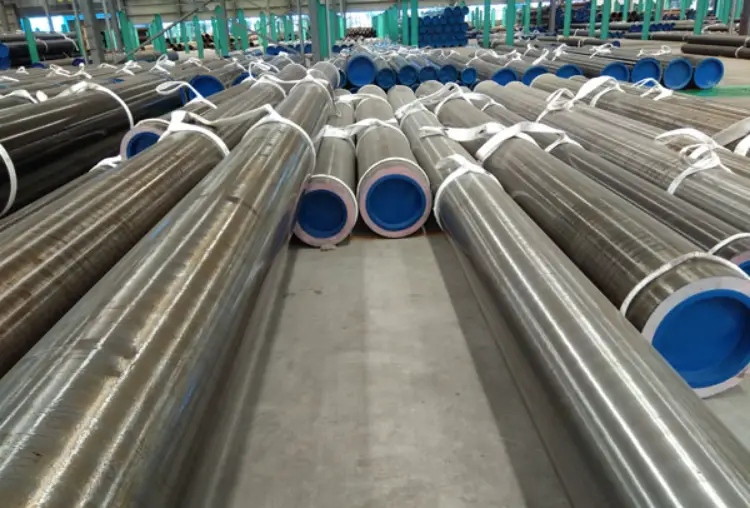
EN 10219 S355K2H SHS/RHS Pipe
EN10219 S355K2H Structural Hollow Section: Chemical & Mechanical Properties, Equivalents
Complete data sheet for S355K2H steel to EN 10219: cold-formed welded square/rectangular hollow sections. Chemical composition, mechanical properties at various thicknesses, thermal/electrical physical properties, international equivalents and similar steel grades.
Cold forming by bending and welding (ERW, SAW, laser). Suitable for further processing: cutting, machining, drilling, bending, welding, hot-dip galvanizing.
- Phone : +8618037372205
- Email : [email protected]
- WhatsApp: Contact via Whtsapp
- WeChat: +8618037372205
EN 10219 S355K2H SHS/RHS Pipe Introduction
EN10219 S355K2H is a cold-formed welded structural hollow section made from fine-grain non-alloy structural steel. The designation indicates a minimum yield strength of 355 MPa at room temperature, a K2 quality with guaranteed Charpy impact energy of 40 J at -20°C, and hollow section (H). This grade combines high strength with excellent toughness, making it suitable for demanding structural applications, especially in low-temperature environments. Typical products include square (SHS), rectangular (RHS) and circular (CHS) hollow sections. The steel is fully killed, fine-grain treated, and weldable. It is widely used in construction, bridges, offshore structures, and heavy machinery.
Key features:
- High yield strength of 355 MPa in thicknesses ≤16 mm
- Good low-temperature impact toughness (40 J at -20°C)
- Excellent weldability with low carbon equivalent (CEV ≤0.45 for t ≤30 mm)
- Uniform mechanical properties through the wall thickness
- Available in a wide range of sizes and profiles according to EN 10219-2
EN 10219 S355K2H SHS/RHS Pipe Chemical Composition
Chemical composition according to EN 10219-1:2006 for S355K2H, based on the requirements of S355K2 from EN 10025-2 with adjustments for hollow section production. The steel is fully killed and fine-grain treated. Limits ensure good weldability and low-temperature toughness.
| Chemical Element | Standard Value (wt%) | Remarks |
|---|---|---|
| C (Carbon) | ≤0.22 | For thicknesses ≤40 mm; for greater thicknesses max. 0.20 (as per EN 10025-2) |
| Si (Silicon) | ≤0.55 | |
| Mn (Manganese) | ≤1.60 | Higher Mn improves strength and hardenability |
| P (Phosphorus) | ≤0.025 | Strict limit for K2 quality (toughness) |
| S (Sulfur) | ≤0.025 | Strict limit for K2 quality (toughness) |
| N (Nitrogen) | ≤0.012 | For nitrogen-binding elements are used (Al, V, Nb, Ti) |
| Altotal (Aluminium, total) | ≥0.020 | Fine-grain practice; acid-soluble Al may also be specified |
| Nb (Niobium) | ≤0.05 | Optional grain-refining element; contributes to Nb+V+Ti ≤0.22 |
| V (Vanadium) | ≤0.12 | Optional grain-refining element |
| Ti (Titanium) | ≤0.05 | Optional grain-refining element |
| Nb+V+Ti | ≤0.22 | Sum of grain-refining elements if combination is used |
| Cu (Copper) | ≤0.55 | Residual element; may be adjusted for weathering resistance |
| CEV (Carbon Equivalent Value) | ≤0.45 (for t ≤30 mm); ≤0.47 (30 < t ≤40 mm); agreement for thicker sections | CEV = C+Mn/6+(Cr+Mo+V)/5+(Ni+Cu)/15; guarantees weldability without preheat in many cases |
EN 10219 S355K2H SHS/RHS Pipe Thermal and Electrical Physical Properties
Representative values for non-alloy structural steel similar to S355K2H at room temperature. These data are not part of EN 10219 but are derived from general material science references for carbon-manganese steels. They are useful for design calculations, thermal analysis, and process engineering.
| Property | Typical Value | Unit | Test Condition / Temperature |
|---|---|---|---|
| Density (ρ) | 7850 | kg/m³ | 20°C |
| Elastic Modulus (E) | 210 | GPa | 20°C, static |
| Shear Modulus (G) | 81 | GPa | 20°C, calculated from E and ν |
| Poisson's Ratio (ν) | 0.30 | - | 20°C, elastic range |
| Coefficient of Thermal Expansion (α) | 12.0 × 10⁻⁶ | K-1 | Range 20°C to 100°C |
| Coefficient of Thermal Expansion (α) | 12.5 × 10⁻⁶ | K-1 | Range 20°C to 200°C |
| Coefficient of Thermal Expansion (α) | 13.0 × 10⁻⁶ | K-1 | Range 20°C to 300°C |
| Thermal Conductivity (λ) | 50 | W/(m·K) | 20°C |
| Thermal Conductivity (λ) | 45 | W/(m·K) | 200°C |
| Thermal Conductivity (λ) | 40 | W/(m·K) | 400°C |
| Specific Heat Capacity (cp) | 460 | J/(kg·K) | 20°C to 200°C |
| Electrical Resistivity (ρe) | 0.20 – 0.25 | μΩ·m | 20°C; depends on exact composition |
EN 10219 S355K2H SHS/RHS Pipe Mechanical Properties
Tensile and impact properties for S355K2H hollow sections according to EN 10219-1:2006, Tables 4 and 5. The values apply to longitudinal test specimens taken from the finished product. Yield strength (ReH) and tensile strength (Rm) are specified for the wall thickness at the test location. Charpy V-notch impact test at -20°C requires 40 J minimum (longitudinal).
| Property | Minimum Value | Unit | Test Condition |
|---|---|---|---|
| Yield Strength (ReH) | 355 | MPa | Wall thickness t ≤16 mm |
| Yield Strength (ReH) | 345 | MPa | Wall thickness 16 < t ≤40 mm |
| Yield Strength (ReH) | 335 | MPa | Wall thickness 40 < t ≤63 mm |
| Yield Strength (ReH) | 325 | MPa | Wall thickness 63 < t ≤80 mm |
| Yield Strength (ReH) | 315 | MPa | Wall thickness 80 < t ≤100 mm |
| Yield Strength (ReH) | 295 | MPa | Wall thickness 100 < t ≤120 mm |
| Tensile Strength (Rm) | 470 - 630 | MPa | All thicknesses |
| Elongation (A) on proportional gauge length L0=5.65√S0 | 22 | % | Wall thickness t ≤40 mm |
| Elongation (A) | 21 | % | Wall thickness 40 < t ≤63 mm |
| Elongation (A) | 20 | % | Wall thickness 63 < t ≤100 mm |
| Elongation (A) | 19 | % | Wall thickness 100 < t ≤120 mm |
| Bend Test (180°) | No cracks | - | Mandrel diameter: 2.0 t for t ≤16 mm |
| Bend Test (180°) | No cracks | - | Mandrel diameter: 2.5 t for 16 < t ≤30 mm |
| Bend Test (180°) | No cracks | - | Mandrel diameter: 3.0 t for 30 < t ≤63 mm |
| Bend Test (180°) | No cracks | - | Mandrel diameter: 4.0 t for 63 < t ≤120 mm |
| Charpy V-notch Impact Energy (KV) | 40 | J | At -20°C, longitudinal test pieces, standard 10x10 mm; sub-size specimens require adjusted requirements |
EN 10219 S355K2H SHS/RHS Pipe Fully Equivalent Standards & Substitute Designations
| Country/Region | Standard | Designation | Remarks |
|---|---|---|---|
| European Union / EEA | EN 10219 | S355K2H | Cold-formed welded structural hollow section; K2 quality (40 J at -20°C) |
| United Kingdom | BS EN 10219 | S355K2H | British adoption of EN 10219 – identical technical requirements |
| Germany | DIN EN 10219 | S355K2H | German adoption; may be supplemented by DIN 17124 or Stahl-Eisen-Werkstoffblatt SEW 092 |
| France | NF EN 10219 | S355K2H | French adoption; fully equivalent |
EN 10219 S355K2H SHS/RHS Pipe Application Introduction
S355K2H hollow sections offer an optimal balance of strength, toughness and weldability, making them suitable for a wide range of structural and mechanical engineering projects. Below are typical application fields, finished products, and specific components that can be fabricated from this material.
Product Applications: Structural frameworks for multi-storey buildings, Bridge main girders, arches, cross-bracing, Offshore platform legs and bracing members, Wind turbine towers (tubular or lattice), Crane booms and jibs, Railway wagon underframes, Piling and foundation tubes, Architectural exposed steelwork (columns, trusses)
Processed into products: Columns and compression members, Beams and girders (I-shape substitute), Truss chords and diagonals, Bracing elements, Stub columns and base plates, Welded built-up box sections, Corner and intermediate posts in structures, Brackets, cleats, and connecting plates
Application industries: Civil engineering and building construction, Bridge building (road, railway, pedestrian), Offshore and marine structures (platforms, jackets, topsides), Wind energy (turbine towers, foundations), Heavy machinery and equipment manufacturing, Transport and logistics (trailer frames, container handling), Mining and quarrying (conveyor gantries, crusher supports), Agricultural and forestry machinery, Stadiums, airports, exhibition halls (large-span roof structures)
EN 10219 S355K2H SHS/RHS Pipe Closely Related / Similar Substitute Materials
| Country/Region | Standard | Designation | Remarks |
|---|---|---|---|
| EU | EN 10219 | S355J2H | Same hollow section standard but Charpy requirement only 27 J at -20°C (J2 quality). Higher toughness S355K2H is preferred for critical applications |
| EU | EN 10210 | S355NH | Hot-finished hollow section with normalised fine-grain structure. Minimum yield 355 MPa, thickness-dependent, and impact 40 J at -20°C. Often used interchangeably with S355K2H |
| EU | EN 10025-2 | S355K2 | Base steel plate/section. The same chemical and mechanical base; when fabricated into hollow sections, K2 quality from this standard is comparable |
| USA | ASTM A500/A500M | Grade C | Cold-formed welded structural tubing. Min. yield 345 MPa (50 ksi), tensile 425 MPa; no mandatory low-temperature impact requirement. Not a direct toughness equivalent |
| Japan | JIS G 3466 | STKR490 | Square/rectangular structural hollow section. Min. yield 325 MPa, tensile 490-610 MPa; impact properties not standard. Mechanical values differ from S355K2H |
| International | ISO 10799-2 | S355K2H (suggested) | ISO standard for cold-formed welded structural hollow sections. While the designation is reserved, the published standard does not yet fully cover K2 quality with -20°C impact. Close in strength |
Notes:
Welding: S355K2H is readily weldable by all common processes (SMAW, GMAW, FCAW, SAW). Low hydrogen consumables are recommended to avoid cold cracking. Preheating may be required based on carbon equivalent (CEV) and section thickness; typical preheat for CEV ≤0.45 and thickness <30 mm is minimum 20°C. For thicker sections, follow EN 1011-2 guidelines.
Hot-dip galvanizing: The steel can be hot-dip galvanized without issues; the Si+Mn range falls within the Sandelin range for some casts, but continuous galvanizing or thermal diffusion galvanizing may be considered for better coating appearance.
Certification: Can be supplied with EN 10204 inspection certificates 3.1 or 3.2. CE marking to EN 1090-1 is possible for structural components.
Availability: Wide dimensional range according to EN 10219-2; square hollow sections from 20x20 mm up to 400x400 mm and rectangular up to 500x300 mm, wall thicknesses from 1.5 mm to 20 mm (cold-formed). Larger dimensions may be available by special arrangement.
- Share



