
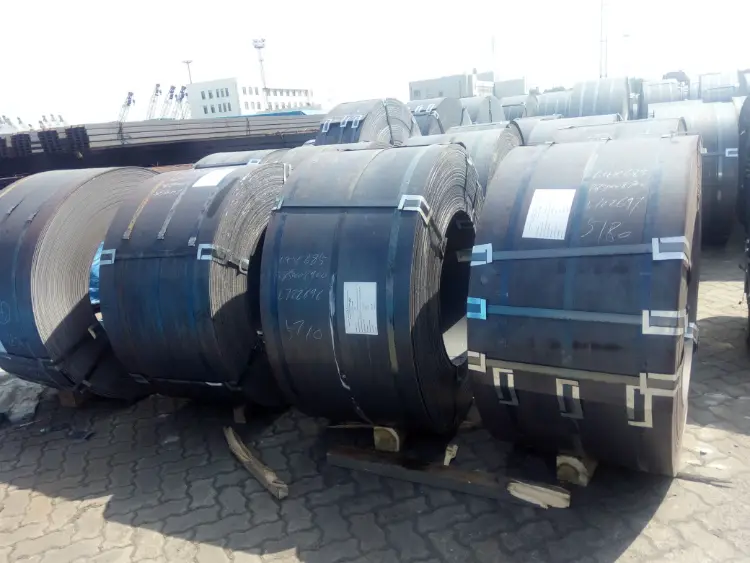
CCS AQ56 Shipbuilding Steel Coil
CCS AQ56 Shipbuilding Steel Coil: High-Strength Hull Structural Material Data
Comprehensive material data for CCS AQ56 shipbuilding steel coil, covering chemical composition, mechanical properties, physical data, and international equivalents.
Hot rolling, Thermo-Mechanical Controlled Processing (TMCP), Normalizing, Welding, Cutting, Cold forming
- Phone : +8618037372205
- Email : [email protected]
- WhatsApp: Contact via Whtsapp
- WeChat: +8618037372205
CCS AQ56 Shipbuilding Steel Coil Introduction
CCS AQ56 is a high-strength shipbuilding steel grade certified by the China Classification Society (CCS). It is primarily used for critical hull and offshore structural components that demand high load-bearing capacity and excellent toughness, especially at low temperatures. Key features include:
- Minimum yield strength of 420 MPa
- Excellent weldability for complex shipbuilding fabrication
- Guaranteed low-temperature impact toughness, typically at -40°C
- Supplied as thermo-mechanically controlled processed (TMCP) coils, providing a fine-grained microstructure for enhanced strength and ductility
- Complies with the strict safety and quality requirements of the CCS Rules for the Classification of Sea-going Steel Ships
CCS AQ56 Shipbuilding Steel Coil Chemical Composition
The chemical composition of CCS AQ56 steel is precisely controlled to achieve a fine-grain structure and the specified mechanical properties. The ladle analysis values comply with CCS rules. Carbon equivalent (CEV) is typically controlled to guarantee excellent field weldability, usually based on the formula CEV = C + Mn/6 + (Cr+Mo+V)/5 + (Ni+Cu)/15.
| Element | Standard Value (max) | Remarks |
|---|---|---|
| Carbon (C) | 0.18 | Typical for improved weldability |
| Silicon (Si) | 0.10 ~ 0.50 | Deoxidation element |
| Manganese (Mn) | 0.90 ~ 1.60 | Contributes to strength and toughness |
| Phosphorus (P) | 0.025 | Impurity, kept low for toughness |
| Sulfur (S) | 0.025 | Impurity, kept low for ductility |
| Chromium (Cr) | 0.25 | Optional; residual element |
| Nickel (Ni) | 0.40 | Optional; improves low-temperature toughness |
| Molybdenum (Mo) | 0.08 | Optional; enhances strength at high temperatures |
| Copper (Cu) | 0.35 | Optional; provides a measure of corrosion resistance |
| Niobium (Nb) | 0.02 ~ 0.05 | Grain refining element |
| Vanadium (V) | 0.05 ~ 0.10 | Grain refining and precipitation strengthening |
| Titanium (Ti) | 0.000 ~ 0.020 | Helps prevent grain growth in heat-affected zone |
| Aluminum (Al) | 0.015 min | Acid-soluble; used for deoxidation and grain refinement |
CCS AQ56 Shipbuilding Steel Coil Thermal and Electrical Physical Properties
Physical constants are provided for general engineering calculations, such as weight estimation, structural stiffness analysis, heat transfer simulations, and electrical assessments. These values are typical for high-strength low-alloy (HSLA) steel at room temperature (approx. 20°C) unless otherwise stated. Important considerations:
- Density is used for structural weight calculations
- Elastic moduli are critical for finite element analysis (FEA) of hull structures
- Thermal expansion and conductivity are essential for welding procedure design and distortion prediction
| Property | Standard Requirement Value | Unit | Test Condition |
|---|---|---|---|
| Density (ρ) | 7850 (approx) | kg/m³ | At 20°C |
| Elastic Modulus (E) | 210 (approx) | GPa | At 20°C |
| Shear Modulus (G) | 81 (approx) | GPa | At 20°C |
| Poisson's Ratio (ν) | 0.3 (approx) | - | At 20°C |
| Thermal Expansion Coefficient (α) | 12.0 (approx) | 10⁻⁶/K | For temperature range 20 ~ 100°C |
| Thermal Conductivity (λ) | 45 ~ 50 (approx) | W/(m·K) | At 20°C |
| Specific Heat Capacity | 460 ~ 480 (approx) | J/(kg·K) | At 20°C |
| Electrical Resistivity (ρ_e) | 0.20 ~ 0.25 (approx) | µΩ·m | At 20°C |
CCS AQ56 Shipbuilding Steel Coil Mechanical Properties
Mechanical properties are evaluated on transverse test pieces from plates or coil-produced flats. The tensile test evaluates strength and elongation, while the Charpy V-notch impact test certifies the steel's ability to resist brittle fracture at low temperatures. A bending test confirms formability and structural integrity. Key parameters include:
- Minimum tensile properties for the specified thickness range
- Guaranteed impact energy absorption at -40°C
- 180-degree bend test performance with a specified former diameter
| Property | Standard Requirement | Unit | Test Condition |
|---|---|---|---|
| Yield Strength (ReH) | 420 (min) | MPa | Test at 20°C; For thickness ≤50 mm |
| Tensile Strength (Rm) | 520 ~ 680 | MPa | Test at 20°C; For thickness ≤50 mm |
| Elongation (A) | 19 (min) | % | Gauge length 5.65√S₀; Test at 20°C |
| Bend Test (Bend former diameter) | 3a (for t ≤ 20 mm); 4a (for 20 < t ≤ 50 mm) | mm | 180° bending test; a = specimen thickness. No cracks. |
| Impact Energy (KV, longitudinal) | 34 (min) | J | Charpy V-notch; Test at -40°C; Average of 3 specimens |
| Impact Energy (KV, transverse) | 24 (min) | J | Charpy V-notch; Test at -40°C; Average of 3 specimens |
CCS AQ56 Shipbuilding Steel Coil Completely Equivalent Material Standards and Replaceable Grades
| Country/Region | Standard | Grade | Remarks |
|---|---|---|---|
| International | IACS UR W11 | AH420, DH420, EH420, FH420 | IACS unified requirements; suffix correspondence depends on impact test temperature. EH420 is a direct parallel for AQ56. |
| USA | ASTM A131/A131M | Grade EH42 | Requires verification of direct equivalent certification; generally interchangeable. |
| Norway/Germany | DNVGL Rules / BV Rules / LR Rules | EH420 (Previously EH42) | Certified by any IACS member society, indicating full technical equivalence. |
| European Union | EN 10025-6 | S420ML | Thermo-mechanically rolled; M specifies delivery condition. -L suffix defines low-temperature toughness testing at -50°C, which may exceed AQ56 requirements. |
CCS AQ56 Shipbuilding Steel Coil Application Introduction
CCS AQ56 steel coil is an advanced high-strength low-alloy (HSLA) material designed for severe marine environments. Its high strength-to-weight ratio allows for reduced hull weight and increased payload capacity, while its excellent toughness ensures operational safety in cold climates. The TMCP delivery condition guarantees consistent properties essential for automated welding processes. Best practices for application include:
- Strict adherence to preheating and interpass temperature controls during welding
- Use of matching or undermatching welding consumables to ensure weld metal toughness
- Consideration of cold forming radius limits to prevent strain aging
- Suitable for applications requiring longevity and high fatigue resistance under cyclic wave loading
Product Applications: Large ocean-going container ships and bulk carriers hulls, Polar-class vessel ice-strengthened structures, Jack-up rig legs and rack systems, Semi-submersible platform decks and columns, Heavy-lift crane booms for floating cranes
Processed into products: Main deck and sheer strake plating, Bottom shell and bilge keel plates, Longitudinal and transverse watertight bulkheads, Hatch coaming and main girder webs, Tubular joint can sections for offshore jackets
Application industries: Shipbuilding (merchant and naval vessels), Offshore oil and gas (platforms, FPSOs), Marine engineering (dredgers, crane vessels), Bridge construction (pontoon sections), Renewable energy (offshore wind turbine foundations)
CCS AQ56 Shipbuilding Steel Coil Similar/Comparable Alternative Material Recommendations
| Country/Region | Standard | Grade | Remarks |
|---|---|---|---|
| Japan | JIS G 3106 | SM490YA / SM490YB | Similar strength level but requires careful comparison of guaranteed low-temperature (-40°C) impact toughness. Y suffix indicates weldability. |
| USA | API 2Y | Grade 42 | Similar yield strength (≥ 414 MPa) for offshore structural tubular applications; may have stricter notch toughness requirements for critical service. |
| European Union | EN 10025-4 | S420M | Thermo-mechanically rolled fine-grain structural steel with equivalent strength. The N designation (e.g. S420N) is a normalized alternative. |
| China | GB/T 712 | DH420/EH420 | Chinese national standard for shipbuilding steel. EH420 is the most technically similar grade to CCS AQ56, specifically for low-temperature service. |
Notes:
Certification: The material must be produced at a CCS-approved steel mill and stamped with the CCS stamp and grade. Full traceability to a heat number and a 3.1 inspection certificate per EN 10204 is mandatory. Welding: High heat input welding methods, such as electro-gas or electro-slag welding, require additional qualification testing to verify the toughness of the heat-affected zone (HAZ). The typical maximum recommended heat input is around 3.5 kJ/mm for single-pass welding unless specifically qualified otherwise. Tolerances: Thickness, width, and flatness tolerances for coils intended for shipbuilding should be in accordance with CCS requirements or an agreed-upon international standard.
- Share



