
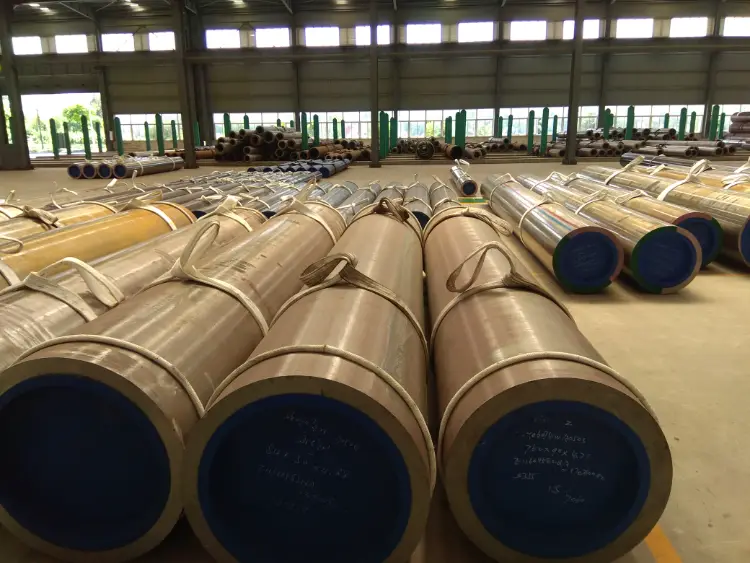
EN 10219 S355J2H SHS/RHS Pipe
EN 10219 S355J2H SHS/RHS Pipe: High-Strength Structural Hollow Section with -20°C Impact Toughness
Comprehensive technical data for S355J2H cold-formed welded structural hollow sections (square/rectangular) per EN 10219, including chemical, mechanical, thermal, and electrical properties, equivalents, and application guidance.
Cold forming, welding, hot-dip galvanizing, machining, cutting, drilling, bending (with appropriate radius)
- Phone : +8618037372205
- Email : [email protected]
- WhatsApp: Contact via Whtsapp
- WeChat: +8618037372205
EN 10219 S355J2H SHS/RHS Pipe Introduction
S355J2H is a weldable, fine-grain structural steel hollow section defined in EN 10219 (cold-formed welded structural hollow sections of non-alloy and fine grain steels). It offers a minimum yield strength of 355 MPa for thicknesses up to 16 mm and guaranteed impact toughness of 27 J at -20°C (J2). The designation 'H' indicates hollow section, typically supplied in square (SHS) and rectangular (RHS) shapes. This grade is widely used in construction, machinery, and offshore applications where a combination of high strength, good weldability, and low-temperature toughness is required. The steel is delivered in the as-welded or normalized condition, with a controlled chemical composition to ensure excellent forming and welding characteristics.
EN 10219 S355J2H SHS/RHS Pipe Chemical Composition
The chemical composition is according to EN 10219-1 for grade S355J2H. Limits apply to the heat analysis. Micro-alloying elements like Nb, V, and Ti may be added singly or in combination for grain refinement. The carbon equivalent value (CEV) is controlled for weldability, typically CEV ≤ 0.45% (for thickness ≤ 16 mm).
- Single values are maximum unless otherwise stated.
- For product analysis, permissible deviations apply per the standard.
| Element | Specified Value (max %) | Remarks |
|---|---|---|
| Carbon (C) | 0.22 | ≤ 16 mm thickness; 0.24% for 16–40 mm |
| Silicon (Si) | 0.55 | |
| Manganese (Mn) | 1.60 | For long products, may be increased to 1.70% |
| Phosphorus (P) | 0.035 | |
| Sulfur (S) | 0.035 | |
| Nitrogen (N) | 0.012 | Aluminium-containing steel; 0.015% otherwise |
| Aluminium (Al) total | ≥ 0.020 | When used as grain-refining element |
| Niobium (Nb) max | 0.05 | Optional micro-alloying element |
| Vanadium (V) max | 0.12 | Optional micro-alloying element |
| Titanium (Ti) max | 0.05 | Optional micro-alloying element |
| Nb + V + Ti | 0.22 | When all three are used |
| Copper (Cu) | 0.55 | Residual element |
| Chromium (Cr) | 0.30 | Residual element |
| Nickel (Ni) | 0.30 | Residual element |
| Molybdenum (Mo) | 0.10 | Residual element |
| Carbon Equivalent (CEV) | ≤ 0.45 (typical) | Based on thickness and composition |
EN 10219 S355J2H SHS/RHS Pipe Thermal and Electrical Physical Properties
Physical properties are typical for fine-grain structural steel at room temperature, unless otherwise indicated. These values are not mandatory in EN 10219 but represent commonly accepted data for S355J2H and similar low-carbon steels.
- Properties may vary slightly with manufacturing route and section thickness.
- For precise design, refer to Eurocode 3 (EN 1993-1-1).
| Property | Typical Value | Unit | Conditions |
|---|---|---|---|
| Density (ρ) | 7850 | kg/m³ | At 20°C |
| Modulus of elasticity (E) | 210 | GPa | Room temperature |
| Shear modulus (G) | 81 | GPa | Room temperature |
| Poisson's ratio (ν) | 0.3 | - | Room temperature |
| Thermal expansion coefficient (α) | 12.0 × 10⁻⁶ | /K | 20–100°C |
| Thermal expansion coefficient (α) | 12.5 × 10⁻⁶ | /K | 20–200°C |
| Thermal expansion coefficient (α) | 13.5 × 10⁻⁶ | /K | 20–300°C |
| Thermal conductivity (λ) | 50 | W/(m·K) | At 20°C |
| Specific heat capacity (cₚ) | 460 | J/(kg·K) | At 20°C |
| Electrical resistivity (ρₑ) | 0.25 | µΩ·m | At 20°C |
EN 10219 S355J2H SHS/RHS Pipe Mechanical Properties
Mechanical properties according to EN 10219-1 for S355J2H hollow sections. The values are for longitudinal test pieces taken from the finished product. For sections with wall thickness ≤ 16 mm, the minimum yield strength is 355 MPa. Impact energy is guaranteed at -20°C.
- Bend test requirements: mandrel diameter = 3 × thickness for longitudinal bend; transverse bend per standard.
- Impact test uses V-notch specimens (KV) ≥ 27 J.
| Property | Specified Value | Unit | Test Conditions |
|---|---|---|---|
| Yield strength (ReH) | ≥ 355 | MPa | Wall thickness ≤ 16 mm, room temperature |
| Yield strength (ReH) | ≥ 345 | MPa | Wall thickness 16–40 mm |
| Tensile strength (Rm) | 510 – 680 | MPa | All thicknesses |
| Elongation (A) | ≥ 22 | % | Gauge length 5.65√So, longitudinal |
| Elongation (A) | ≥ 20 | % | Gauge length 5.65√So, transverse |
| Impact energy (KV) | ≥ 27 | J | At -20°C, V-notch, longitudinal |
| Bend test (mandrel diameter) | 3T | - | Longitudinal bend, T = wall thickness, 180° |
EN 10219 S355J2H SHS/RHS Pipe Full Equivalent Material Standards and Substitutable Grades
| Country/Region | Standard | Grade | Remarks |
|---|---|---|---|
| Europe | EN 10219-1 | S355J2H | Original grade; cold-formed welded hollow section |
| Europe | EN 10210-1 | S355J2H | Hot-finished hollow section (direct equivalent in terms of steel quality but different manufacturing route) |
EN 10219 S355J2H SHS/RHS Pipe Application Introduction
S355J2H hollow sections are employed where contradictory requirements of high strength, good weldability, and ductile behavior are needed. The guaranteed -20°C impact energy makes them suitable for outdoor structures in moderate climates. Their closed shape provides excellent torsional rigidity and an attractive appearance.
- Industries: Construction, infrastructure, machinery, renewable energy, shipbuilding.
- Products: Columns, beams, trusses, bridges, towers, crane jibs, scaffolding, and barriers.
- Components: Machined connectors, end plates, brackets, bracing members, and welded assemblies.
Product Applications: Multi-story building frames, Pedestrian and road bridges, Roof trusses and space frames, Transmission towers, Mobile crane booms, Trailer chassis, Scaffolding systems
Processed into products: Column base plates, Beam-to-column connectors, Truss node joints, Bearing stiffeners, Welded brackets and cleats, Pinned connections, Gusset plates
Application industries: Building and construction, Bridge engineering, Heavy machinery and equipment, Wind turbine towers, Agricultural machinery, Offshore structures, Railway infrastructure
EN 10219 S355J2H SHS/RHS Pipe Similar / Closely Related Alternative Grades
| Country/Region | Standard | Grade | Remarks |
|---|---|---|---|
| Europe | EN 10219-1 | S355J0H | Similar strength, impact energy at 0°C (instead of -20°C); less costly |
| Europe | EN 10219-1 | S355K2H | Higher toughness, impact energy at -20°C, but with stricter chemical limits; suitable for severe low-temperature service |
| Europe | EN 10025-2 | S355J2 | Open sections (plates and bars); identical steel quality, but not a hollow section |
| Europe | EN 10219-1 | S275J2H | Lower yield strength (275 MPa) with similar low-temperature toughness |
| USA | ASTM A500 | Grade C | Rebar / structural tubing, 345 MPa yield, 427 MPa tensile; different testing and dimensions |
| Japan | JIS G 3466 | STKR490 | Square/rectangular carbon steel structural tubing with 325–490 MPa tensile range |
Notes:
Note: Dimensions and tolerances for square/rectangular hollow sections are given in EN 10219-2. The CEV limitation ensures good field weldability without preheating under normal conditions. For galvanizing, a silicon content ≤ 0.04% or 0.15–0.22% is sometimes specified to control coating thickness. Always consult the final application environment when selecting subgrade (J0, J2, K2).
- Share



