
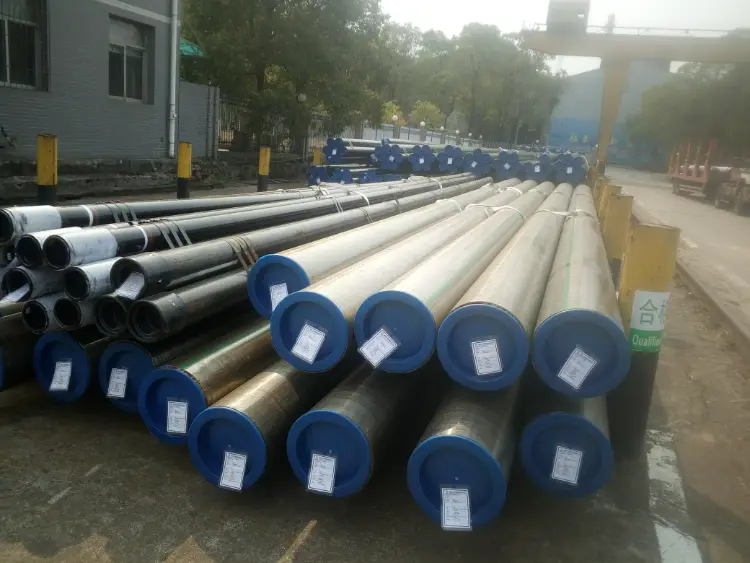
EN 10219 S355J0H SHS/RHS Pipe
EN 10219 S355J0H SHS/RHS Pipe - Cold-Formed Structural Hollow Section
S355J0H is a cold-formed welded structural hollow section according to EN 10219, made from non-alloy structural steel with minimum yield strength of 355 MPa and 27 J impact energy at 0 °C.
Cold forming and high frequency induction welding (ERW); possible subsequent normalizing or stress-relieving upon agreement
- Phone : +8618037372205
- Email : [email protected]
- WhatsApp: Contact via Whtsapp
- WeChat: +8618037372205
EN 10219 S355J0H SHS/RHS Pipe Introduction
S355J0H is a structural steel grade specified in EN 10219 for cold-formed welded hollow sections of non-alloy and fine grain steels. It is characterized by a minimum yield strength of 355 MPa and a guaranteed impact toughness of at least 27 J at 0 °C (J0 designation). The 'H' indicates application for hollow sections. The material is typically supplied as square hollow sections (SHS), rectangular hollow sections (RHS), or circular hollow sections (CHS).
- Fine grain practice ensures good weldability and toughness.
- Suitable for welded, bolted, and riveted structures.
- CEV (carbon equivalent value) is controlled to ensure reliable welding without preheating.
- Available in various wall thicknesses up to 40 mm, with properties adjusted accordingly.
EN 10219 S355J0H SHS/RHS Pipe Chemical Composition
Chemical composition according to EN 10219-1 for grade S355J0H, maximum values unless a range is indicated. CEV ≤ 0.45 for t ≤ 16 mm, ≤ 0.45 for 16 < t ≤ 40 mm, ≤ 0.46 for 40 < t ≤ 65 mm. The steel shall contain grain refining elements such as aluminium, niobium, vanadium, titanium. When aluminium is used as a grain refiner, Al total ≥ 0.020% or Al/N ≥ 2 shall be observed.
| Element | Value (%) | Remarks |
|---|---|---|
| Carbon (C) | ≤ 0.22 | |
| Silicon (Si) | ≤ 0.55 | |
| Manganese (Mn) | ≤ 1.60 | A max. range of 1.60 between min. and max. on product analysis |
| Phosphorus (P) | ≤ 0.035 | |
| Sulfur (S) | ≤ 0.035 | |
| Nitrogen (N) | ≤ 0.009 | |
| Copper (Cu) | ≤ 0.55 | For copper-bearing steel |
| Niobium (Nb) | ≤ 0.05 | If added as grain refiner; sum Nb+V+Ti ≤ 0.22 |
| Vanadium (V) | ≤ 0.12 | If added; sum Nb+V+Ti ≤ 0.22 |
| Titanium (Ti) | ≤ 0.12 | If added; sum Nb+V+Ti ≤ 0.22 |
| Aluminium (Al) | ≥ 0.020 total | When used as grain refining element; or Al/N ≥ 2 |
| CEV (typical) | ≤ 0.45 | For thicknesses ≤ 16 mm; formula: C+Mn/6+(Cr+Mo+V)/5+(Ni+Cu)/15 |
EN 10219 S355J0H SHS/RHS Pipe Physical Properties
These values are typical for non-alloy structural steels at room temperature unless noted. They are not mandatory specification requirements but are representative for design calculations. Values may vary slightly with exact composition and temperature.
| Property | Typical Value | Unit | Condition |
|---|---|---|---|
| Density (ρ) | 7850 | kg/m³ | 20 °C |
| Modulus of elasticity (E) | 210 | GPa | 20 °C |
| Shear modulus (G) | ≈ 81 | GPa | 20 °C, calculated from E and ν |
| Poisson's ratio (ν) | 0.3 | — | 20 °C (elastic range) |
| Thermal expansion coefficient (α) | 12.0 × 10⁻⁶ | K⁻¹ | 100 °C; 20–100 °C range |
| Thermal expansion coefficient (α) | 12.5 × 10⁻⁶ | K⁻¹ | 200 °C; 20–200 °C range |
| Thermal expansion coefficient (α) | 13.5 × 10⁻⁶ | K⁻¹ | 400 °C; 20–400 °C range |
| Thermal conductivity (λ) | ≈ 50 | W/(m·K) | 20 °C |
| Specific heat capacity (cp) | ≈ 460 | J/(kg·K) | 20 °C |
| Electrical resistivity (ρe) | ≈ 0.22 × 10⁻⁶ | Ω·m | 20 °C |
EN 10219 S355J0H SHS/RHS Pipe Mechanical Properties
Mechanical properties are for longitudinal test pieces taken from hollow sections. Yield strength (ReH) and tensile strength (Rm) vary with wall thickness. Impact energy (KV) tested at 0 °C. Bending performance is assured by the chemical and process controls; no separate bend test required per standard.
| Property | Required Value | Unit | Test Condition |
|---|---|---|---|
| Yield strength (ReH) | ≥ 355 | MPa | t ≤ 16 mm |
| Yield strength (ReH) | ≥ 345 | MPa | 16 < t ≤ 40 mm |
| Yield strength (ReH) | ≥ 335 | MPa | 40 < t ≤ 65 mm |
| Tensile strength (Rm) | 470 – 630 | MPa | t ≤ 16 mm |
| Tensile strength (Rm) | 470 – 630 | MPa | 16 < t ≤ 40 mm |
| Tensile strength (Rm) | 450 – 610 | MPa | 40 < t ≤ 65 mm |
| Elongation after fracture (A) | ≥ 20 | % | Longitudinal, L0=5.65√S0; t ≤ 40 mm |
| Elongation after fracture (A) | ≥ 18 | % | Longitudinal, L0=5.65√S0; 40 < t ≤ 65 mm |
| Impact energy (KV) | ≥ 27 | J | 0 °C, V-notch, longitudinal; average of three tests, one individual min. 70% |
| Bend test | No mandatory bend test | Shape and material ensure sufficient formability |
EN 10219 S355J0H SHS/RHS Pipe Full Equivalents – Identical or Directly Replaceable Standards and Grades
| Country / Region | Standard | Grade | Remarks |
|---|---|---|---|
| Europe | EN 10210 | S355J0H | Hot finished hollow section; same chemistry and mechanical properties, but hot forming may give different tolerances and residual stress pattern. Directly interchangeable. |
| International | ISO 630-2 | E355C | Structural steel; long products, not specifically hollow sections, but equivalent grade for fine grain structural steel with J0 quality. |
| United States | ASTM A500 | Grade C | Cold-formed welded hollow sections; yield strength 345 MPa (50 ksi) min, tensile 425 MPa min. Strength slightly lower but often used as alternative. Impact toughness not specified. |
EN 10219 S355J0H SHS/RHS Pipe Application Introduction
S355J0H hollow sections are widely used in construction and engineering where a combination of high strength, good weldability, and adequate toughness at low ambient temperatures is needed. The cold-formed and welded manufacturing allows a wide range of square, rectangular and circular dimensions with economical production.
- Typical applications include trusses, columns, beams, frames, and lattice structures.
- Suitable for dynamically and statically loaded structures.
- Can be exposed to moderate corrosive environments when protected by paint or hot-dip galvanizing.
Product Applications: Structural steel frameworks (columns, beams, roof trusses), Pedestrian and vehicular bridges, Offshore platform substructures (walkways, handrails), Crane booms and lifting devices, Solar panel mounting structures, Stadium and exhibition hall roofs, Scaffolding and temporary works
Processed into products: Hollow structural profiles cut to length for fabrication, Welded truss chord members and braces, Column and beam-to-column connections, Machine frames and chassis, Space frames and domes, Pipe racks and cable trays, Trailer and vehicle sub-frames
Application industries: Building and infrastructure construction, Bridge engineering, Offshore and marine structures, Mining and heavy machinery, Transmission towers and telecom masts, Agricultural and forestry equipment, Transport and rail vehicle bodies
EN 10219 S355J0H SHS/RHS Pipe Similar / Alternative Materials – Comparable Performance
| Country / Region | Standard | Grade | Remarks |
|---|---|---|---|
| Europe | EN 10219 | S355J2H | Same yield strength; impact energy guaranteed at -20 °C (J2). Suitable when lower temperature toughness is required. |
| Europe | EN 10219 | S275J0H | Lower yield strength (275 MPa) but similar toughness class; used for less demanding structural applications. |
| Japan | JIS G 3466 | STKR490 | Carbon steel square and rectangular hollow sections; min. yield 325 MPa (t ≤ 16 mm), lower strength, not exact equivalent. |
| Europe | EN 10025-2 | S355J0 | Hot rolled structural steel plates and sections; similar strength and toughness but not hollow sections. Can be fabricated into welded boxes. |
Notes:
Weldability: The steel is fully weldable with all standard arc welding processes. Preheat and interpass temperatures may be required for thicker sections and when the CEV is close to the maximum allowed. Corrosion protection: Hollow sections are normally supplied with a light oil coating; hot-dip galvanizing or paint systems are recommended for outdoor exposure. Tolerances: Dimensions and shape tolerances are in accordance with EN 10219-2. Certification: EN 10204 type 2.2 or 3.1 inspection certificates can be supplied.
- Share



