
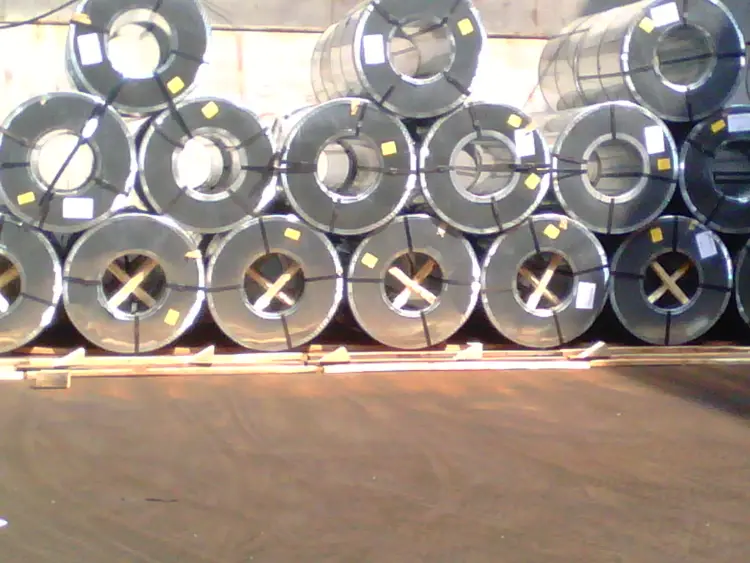
CCS FQ51 Shipbuilding Steel Coil
CCS FQ51 Shipbuilding Steel Coil - Quenched & Tempered High Strength Hull Plate
Comprehensive technical data for CCS FQ51 shipbuilding steel coil: chemical composition, mechanical properties, thermal and electrical characteristics, international equivalents, and application guide. Compliant with CCS Rules for Classification of Sea-going Steel Ships.
Hot rolling, Quenching and Tempering (Q), Cutting, Bending, Welding, Machining, Forming
- Phone : +8618037372205
- Email : [email protected]
- WhatsApp: Contact via Whtsapp
- WeChat: +8618037372205
CCS FQ51 Shipbuilding Steel Coil Introduction
CCS FQ51 is a quenched and tempered high-strength shipbuilding steel grade certified by the China Classification Society (CCS). It belongs to the high-strength structural steel series with a minimum yield strength of 510 MPa. The 'F' designation indicates a fine-grain, low-temperature toughness grade tested at -60°C. FQ51 offers excellent weldability, notch toughness, and strength, making it suitable for critical structural components in offshore and marine applications. Typically supplied in plate or coil form with a quenched and tempered delivery condition, this steel ensures reliable performance under severe service conditions.
CCS FQ51 Shipbuilding Steel Coil Chemical Composition
Chemical composition limits for CCS FQ51 according to CCS Rules (Table 3.3.2.1). These elements ensure the required strength and toughness after quenching and tempering. Carbon equivalent (Ceq) is typically controlled to ≤0.60% for thicknesses ≤50 mm to maintain good weldability.
| Element | Specification (%) | Remarks |
|---|---|---|
| Carbon (C) | ≤ 0.20 | Max |
| Silicon (Si) | ≤ 0.55 | Max |
| Manganese (Mn) | 0.90 – 1.60 | |
| Phosphorus (P) | ≤ 0.025 | Max |
| Sulfur (S) | ≤ 0.025 | Max |
| Nickel (Ni) | ≤ 2.0 | Max |
| Chromium (Cr) | ≤ 0.30 | Max |
| Molybdenum (Mo) | ≤ 0.08 | Max |
| Copper (Cu) | ≤ 0.50 | Max |
| Niobium (Nb) | 0.02 – 0.05 | |
| Vanadium (V) | 0.05 – 0.10 | |
| Titanium (Ti) | 0.007 – 0.05 | |
| Aluminum (Al) | ≥ 0.015 (total) | Min |
| Nitrogen (N) | ≤ 0.012 | Max |
CCS FQ51 Shipbuilding Steel Coil Thermal and Electrical Physical Properties
The following physical properties are typical for quenched and tempered low-alloy steels of this strength class. They are not mandatory in the CCS standard but provide useful engineering reference. Variation may occur with temperature and specific alloy adjustments.
| Property | Typical Value | Unit | Test Condition / Temperature |
|---|---|---|---|
| Density (ρ) | 7.85 | g/cm³ | 20°C |
| Elastic modulus (E) | 210 | GPa | 20°C |
| Shear modulus (G) | 81 | GPa | 20°C |
| Poisson's ratio (ν) | 0.3 | 20°C | |
| Thermal expansion coefficient (α) | 11.5 × 10⁻⁶ | /K | 0–100°C |
| Thermal expansion coefficient (α) | 12.5 × 10⁻⁶ | /K | 0–300°C |
| Thermal expansion coefficient (α) | 13.5 × 10⁻⁶ | /K | 0–500°C |
| Thermal conductivity (λ) | 42 | W/(m·K) | 20°C |
| Specific heat capacity (c) | 460 | J/(kg·K) | 20°C |
| Electrical resistivity (ρₑ) | 0.22 × 10⁻⁶ | Ω·m | 20°C |
CCS FQ51 Shipbuilding Steel Coil Mechanical Properties
Mechanical properties of CCS FQ51 under quenched and tempered condition. Yield strength may decrease slightly for thicker sections. Impact tests are performed on Charpy V-notch specimens at -60°C; minimum average absorbed energy is specified for longitudinal and transverse directions.
| Property | Specification Value | Unit | Test Condition / Direction |
|---|---|---|---|
| Yield strength (ReH) | ≥ 510 | MPa | Thickness ≤ 50 mm, transverse |
| Yield strength (ReH) | ≥ 500 | MPa | Thickness 50–100 mm, transverse |
| Yield strength (ReH) | ≥ 490 | MPa | Thickness 100–150 mm, transverse |
| Tensile strength (Rm) | 610 – 770 | MPa | Thickness ≤ 50 mm, transverse |
| Tensile strength (Rm) | 590 – 770 | MPa | Thickness 50–100 mm, transverse |
| Tensile strength (Rm) | 580 – 770 | MPa | Thickness 100–150 mm, transverse |
| Elongation (A) | ≥ 16 | % | Gauge length 5.65√S₀, longitudinal |
| Charpy V-notch impact (KV₂) | ≥ 27 (average), ≥ 19 (single) | J | -60°C, longitudinal |
| Charpy V-notch impact (KV₂) | ≥ 20 (average), ≥ 14 (single) | J | -60°C, transverse |
CCS FQ51 Shipbuilding Steel Coil Completely Equivalent Material Standards and Alternative Grades
| National / Region | Standard | Grade | Remarks |
|---|---|---|---|
| International (IACS) | UR W11 | FQ51 | All IACS members |
| Norway / Germany (DNV) | DNV Rules | FQ51 | Formerly VL FQ51 |
| United Kingdom (LR) | LR Rules | FQ51 | |
| USA (ABS) | ABS Rules | FQ51 | Also EQ51 (at -40°C) if temperature requirement lower |
| France (BV) | BV Rules | FQ51 | |
| Japan (NK) | NK Rules | FQ51 | |
| Italy (RINA) | RINA Rules | FQ51 | |
| South Korea (KR) | KR Rules | FQ51 | |
| China (CCS) | CCS Rules | FQ51 | Original grade |
CCS FQ51 Shipbuilding Steel Coil Application Introduction
CCS FQ51 is purpose‑designed for severe‑duty marine and offshore environments. It is fabricated by welding, cutting, and forming after quenching and tempering. The low‑temperature toughness at -60°C allows use in cold‑climate structures. Designers should account for the tempered condition and avoid overheating during fabrication to preserve mechanical properties.
Product Applications: Hull plates and stiffeners, Deck structures and web frames, Legs of jack-up rigs, Heavy‑lift crane booms, Subsea structural components, Bulkheads and watertight doors
Processed into products: Ship hull plating (bottom, side, deck), Keel plates and bilge strakes, Stiffeners (angles, bulb flats), Chock and fairlead supports, Base plates for winches and windlasses, Connecting plates in truss structures, Offshore flare boom structures
Application industries: Shipbuilding (commercial & naval vessels), Offshore oil & gas platforms, Jack‑up rig construction, Heavy machinery and crane manufacturing, Pressure vessel engineering, Arctic & cold‑region marine structures
CCS FQ51 Shipbuilding Steel Coil Similar / Close Substitution Materials Recommendation
| National / Region | Standard | Grade | Remarks |
|---|---|---|---|
| Europe | EN 10025-6 | S460Q / S500Q / S550Q | Similar quenched & tempered, lower/higher yield; check toughness temperature |
| Europe | EN 10225 | S460G2+M | Fixed offshore structures, TMCP, lower yield but good toughness |
| USA | ASTM A514 / A517 | Grade E / Q | Quenched & tempered, yield ≥ 690 MPa; overmatching, needs re-design |
| USA | API 2W | Grade 50 | TMCP for offshore, yield ~ 345–517 MPa; strength slightly low |
| China | GB/T 712 | Q550 | Quenched & tempered, yield ≥ 550 MPa; impact temperature may differ |
Notes:
Welding: Preheating may be required depending on thickness and carbon equivalent. Heat input must be controlled to avoid softening of the heat‑affected zone (HAZ). Post‑weld heat treatment: Generally not required for thicknesses ≤ 150 mm. Corrosion protection: Standard coatings and cathodic protection apply. Tolerances: Conform to CCS thickness tolerances for shipbuilding plates.
- Share



