
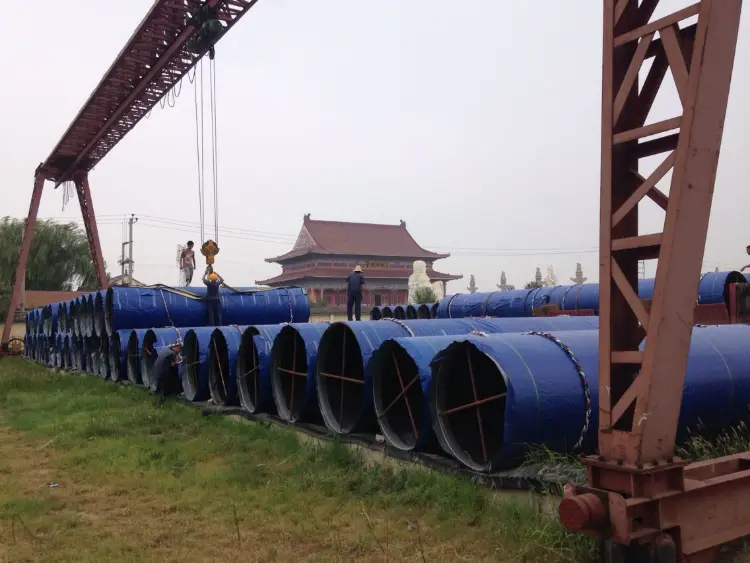
EN10219 S275J0H LSAW Pipe
EN10219 S275J0H LSAW Pipe: Comprehensive Material Properties and Applications
Detailed technical data of S275J0H steel for LSAW pipes conforming to EN10219, covering chemical composition, mechanical and thermal properties, global equivalents, and typical applications.
Cold-formed, Longitudinal Submerged Arc Welding (LSAW)
- Phone : +8618037372205
- Email : [email protected]
- WhatsApp: Contact via Whtsapp
- WeChat: +8618037372205
EN10219 S275J0H LSAW Pipe Introduction
S275J0H is a non-alloy structural steel grade specified in EN 10219 for cold-formed welded structural hollow sections, including LSAW (Longitudinal Submerged Arc Welded) pipes. It offers a minimum yield strength of 275 MPa and guarantees impact energy of 27 J at 0 °C (J0 designation). The H suffix indicates hollow section suitability. The steel exhibits good weldability, formability, and toughness, making it appropriate for static and dynamic loading in structures. Typical applications include building frames, bridges, offshore platforms, and machinery components. The material is delivered in the as-welded or normalized condition depending on thickness and customer requirements.
EN10219 S275J0H LSAW Pipe Chemical Composition
The chemical composition complies with EN 10219-2. Maximum values, except for aluminium which has a minimum when used as the sole grain-refining element. Other grain refiners (Nb, V, Ti) may be used instead, with limits shown. Carbon equivalent value (CEV) is limited for enhanced weldability.
| Element | Standard Value | Remarks |
|---|---|---|
| C | ≤ 0.20% | |
| Mn | ≤ 1.50% | |
| Si | ≤ 0.55% | |
| P | ≤ 0.035% | |
| S | ≤ 0.035% | |
| Al (total) | ≥ 0.020% | Minimum if Al is the sole grain-refining element |
| Nb | ≤ 0.05% | When used as an alternative grain refiner |
| V | ≤ 0.13% | When used as an alternative grain refiner |
| Ti | ≤ 0.05% | When used as an alternative grain refiner |
| CEV | ≤ 0.45% | Carbon equivalent (CEV = C + Mn/6 + (Cr+Mo+V)/5 + (Ni+Cu)/15) |
EN10219 S275J0H LSAW Pipe Thermal and Electrical Physical Properties
Typical physical properties for structural carbon steel at ambient temperature. These values are not specified in EN 10219 but are commonly accepted for design purposes. They may vary slightly with actual composition and processing.
| Property | Typical Value | Unit | Test Condition |
|---|---|---|---|
| Density (ρ) | 7850 | kg/m³ | At 20 °C |
| Modulus of Elasticity (E) | 210 | GPa | At 20 °C |
| Shear Modulus (G) | ≈ 80 | GPa | At 20 °C |
| Poisson's Ratio (ν) | 0.3 | — | |
| Coefficient of Thermal Expansion (α) | 12 × 10⁻⁶ | K⁻¹ | Between 20 °C and 100 °C |
| Thermal Conductivity (λ) | ≈ 50 | W/(m·K) | At 20 °C |
| Specific Heat Capacity (c) | ≈ 460 | J/(kg·K) | At 20 °C |
| Electrical Resistivity (ρₑ) | 0.15 – 0.25 | µΩ·m | At 20 °C |
EN10219 S275J0H LSAW Pipe Mechanical Properties
Minimum values as per EN 10219-1 for cold-formed hollow sections at room temperature, unless otherwise stated. The yield strength decreases with increasing wall thickness. Impact test temperature is 0 °C (longitudinal Charpy V-notch). Bend test uses mandrel diameter (D) related to wall thickness (t).
| Property | Standard Requirement | Unit | Test Condition |
|---|---|---|---|
| Yield Strength (ReH) | ≥ 275 | MPa | Wall thickness ≤ 16 mm |
| Yield Strength (ReH) | ≥ 265 | MPa | Wall thickness 16 < t ≤ 40 mm |
| Yield Strength (ReH) | ≥ 255 | MPa | Wall thickness 40 < t ≤ 65 mm |
| Tensile Strength (Rm) | 410 – 560 | MPa | All thicknesses |
| Elongation (A or A5) | ≥ 22 | % | Wall thickness ≤ 15 mm, longitudinal |
| Elongation (A or A5) | ≥ 21 | % | Wall thickness 15 < t ≤ 30 mm, longitudinal |
| Elongation (A or A5) | ≥ 19 | % | Wall thickness 30 < t ≤ 65 mm, longitudinal |
| Bend Test (Mandrel Diameter D) | D = 2t | — | Wall thickness ≤ 16 mm (180° bend) |
| Bend Test (Mandrel Diameter D) | D = 3t | — | Wall thickness > 16 mm (180° bend) |
| Impact Energy (KV²) | ≥ 27 | J | At 0 °C, longitudinal, full-size specimen (10×10 mm) |
| Impact Energy (KV²) | ≥ 27 | J | At 0 °C, longitudinal, sub-size specimen (if wall < 10 mm, adjusted minimum) |
EN10219 S275J0H LSAW Pipe Fully Equivalent Material Standards and Substitutable Grades
| Country / Region | Standard | Grade | Remarks |
|---|---|---|---|
| Europe | EN 10219 | S275J0H | Identical designation for cold-formed hollow sections; the reference grade for LSAW pipes |
| Europe | EN 10210-1 | S275J0H | Hot-finished hollow section; same chemical and mechanical requirements but different delivery condition. Higher compression resistance; often interchangeable when design permits |
EN10219 S275J0H LSAW Pipe Application Introduction
EN10219 S275J0H hollow sections are widely used in structural steelwork. Their good weldability and reliable impact toughness at 0°C make them suitable for dynamic loading in temperate climates. LSAW pipes are especially applied where large diameters and thick walls are needed. Typical processing includes cutting, welding, drilling, and galvanizing.
Product Applications: Building framework and steel columns, Bridge girders and arches, Offshore platform legs and bracing, Crane booms and heavy equipment chassis, Transmission and lighting poles
Processed into products: Welded tubular nodes and connections, Truss chords and web members, Piling sleeves and structural casings, Rollers, pulleys, and structural supports, Hydraulic cylinder bodies (when suitably machined)
Application industries: Civil and structural engineering, Construction and infrastructure, Offshore and marine structures, Mechanical and heavy machinery, Transmission towers and telecommunication structures
EN10219 S275J0H LSAW Pipe Suggested Similar or Substitute Materials
| Country / Region | Standard | Grade | Remarks |
|---|---|---|---|
| Europe | EN 10025-2 | S275J0 | Flat and long products (not hollow sections). Yield 275 MPa, impact at 0 °C. Suitable for structural components not requiring tubular shape |
| USA | ASTM A500 | Grade C | Cold-formed welded structural tubing. Yield 345 MPa (stronger), tensile 425 MPa. Commonly used substitute but strength mismatch should be checked |
| USA | ASTM A501 | A501 | Hot-formed structural tubing. Comparable strength but hot-formed. May be an alternative |
| Japan | JIS G3466 | STKR490 | Square/rectangular steel tubes. Tensile 490 MPa min, yield 325 MPa min. Different strength level; check design compatibility |
| International | ISO 630-2 | S275J0 | Structural steels for general purposes. Plate/bar products; not hollow sections. Similar chemistry and toughness class |
Notes:
- Welding: S275J0H has good weldability with low carbon equivalent (CEV ≤0.45). Preheating is generally not required for thicknesses below 30 mm; for thicker sections or high restraint, a preheat of 75–100 °C may be applied.
- Corrosion protection: Usually supplied unpainted; hot-dip galvanizing or painting is recommended for outdoor exposure. The steel is suitable for galvanizing.
- Dimensional tolerances: Conform to EN 10219-2, with tight tolerances on diameter, wall thickness, and straightness.
- Certification: Inspection documents according to EN 10204 type 3.1 or 3.2 are standard. Impact testing at 0 °C is mandatory.
- Share



