
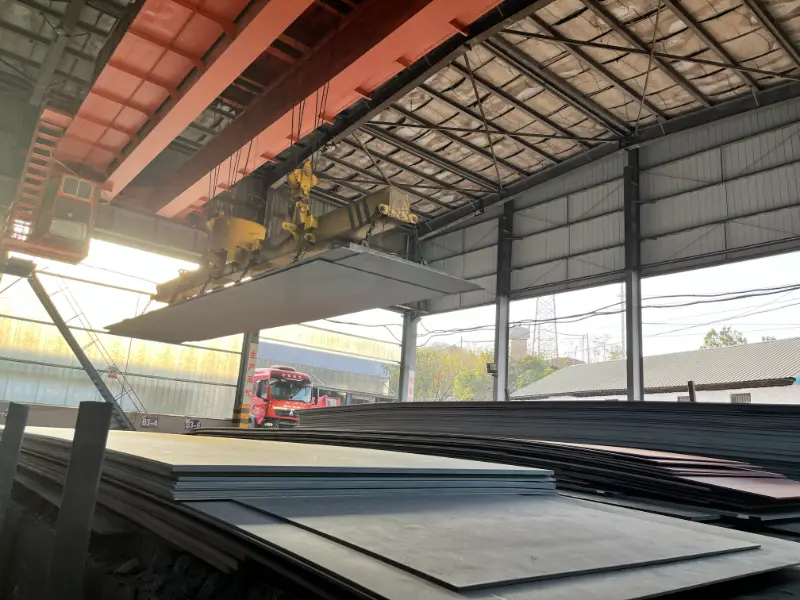
EN10025-6 S960Q High-Strength Structural Steel
EN10025-6 S960Q High-Strength Structural Steel - Quenched and Tempered Grade
S960Q is a high yield strength structural steel with minimum 960 MPa yield strength, used for heavy constructions, lifting equipment, and offshore structures where weight reduction is critical.
Cutting, cold forming, bending, welding (with suitable consumables and preheating), machining
- Phone : +8618037372205
- Email : [email protected]
- WhatsApp: Contact via Whtsapp
- WeChat: +8618037372205
EN10025-6 S960Q High-Strength Structural Steel Introduction
S960Q is a quenched and tempered structural steel grade defined in EN 10025-6. It offers a minimum yield strength of 960 MPa in thicknesses up to 50 mm, combined with good toughness at -20°C. Key characteristics:
- Ultra-high strength allows lighter designs
- Good weldability with low carbon equivalent (CEV max 0.82 for t≤50 mm)
- Excellent combination of strength, toughness and cold formability
- Delivered in quenched and tempered condition
It is widely applied in mobile cranes, bridges, mining equipment and offshore structural components.
EN10025-6 S960Q High-Strength Structural Steel Chemical Composition for S960Q
The chemical composition as per EN 10025-6:2019, Table 2 – S960Q (applicable for product thickness ≤ 150 mm). Elements not listed may be present as residuals. Nb+Ti+V ≤ 0.22% and Al ≥ 0.013% are required for fine grain practice. CEV = C+Mn/6+(Cr+Mo+V)/5+(Ni+Cu)/15 ≤ 0.82 for t ≤ 50 mm.
| Element | Standard Value (max %) | Remarks |
|---|---|---|
| Carbon (C) | 0.22 | max |
| Silicon (Si) | 0.86 | max |
| Manganese (Mn) | 1.80 | max |
| Phosphorus (P) | 0.025 | max |
| Sulfur (S) | 0.012 | max |
| Aluminium (Al) | 0.013 | min (total Al) |
| Niobium (Nb) | 0.07 | max |
| Vanadium (V) | 0.14 | max |
| Titanium (Ti) | 0.07 | max |
| Chromium (Cr) | 1.60 | max |
| Nickel (Ni) | 2.10 | max |
| Molybdenum (Mo) | 0.74 | max |
| Copper (Cu) | 0.55 | max |
| Nitrogen (N) | 0.016 | max |
| Boron (B) | 0.006 | max |
| Zirconium (Zr) | 0.17 | max (optional) |
EN10025-6 S960Q High-Strength Structural Steel Thermal and Electrical Physical Properties – S960Q
The physical properties listed are typical for quenched and tempered low-alloy steels at room temperature unless specified. Variation may occur depending on exact chemical composition and processing. Values should be used as guideline, not as guaranteed specifications. Thermal conductivity and electrical resistivity are for ambient temperature.
| Property | Standard (Typical) Value | Unit | Test Condition / Remarks |
|---|---|---|---|
| Density (ρ) | 7850 | kg/m³ | at 20°C |
| Modulus of elasticity (E) | 210 | GPa | at 20°C, static |
| Shear modulus (G) | 81 | GPa | at 20°C, calculated |
| Poisson's ratio (ν) | 0.3 | – | elastic range |
| Thermal expansion coefficient (α) | 12.0 | 10⁻⁶/K | 20 – 100°C |
| Thermal expansion coefficient (α) | 13.0 | 10⁻⁶/K | 20 – 200°C |
| Thermal expansion coefficient (α) | 14.0 | 10⁻⁶/K | 20 – 300°C |
| Thermal conductivity (λ) | 40 | W/(m·K) | at 20°C |
| Specific heat capacity (cp) | 460 – 500 | J/(kg·K) | at 20°C, typical |
| Electrical resistivity (ρₑ) | 0.25 | Ω·mm²/m | at 20°C, approximate |
EN10025-6 S960Q High-Strength Structural Steel Mechanical Properties – S960Q
Minimum tensile properties in quenched and tempered condition according to EN 10025-6:2019. The values are valid for longitudinal direction. For transverse direction, reduction on elongation may apply. Impact energy is based on Charpy-V test at -20°C. Thickness-dependent properties are listed. Bending test mandrel diameter (d) depends on thickness (t).
| Property | Standard Requirement | Unit | Test Condition / Thickness |
|---|---|---|---|
| Yield strength (ReH) | ≥ 960 | MPa | t ≤ 50 mm |
| Yield strength (ReH) | ≥ 900 | MPa | 50 < t ≤ 100 mm |
| Yield strength (ReH) | ≥ 850 | MPa | 100 < t ≤ 150 mm |
| Tensile strength (Rm) | 980 – 1150 | MPa | t ≤ 50 mm |
| Tensile strength (Rm) | 930 – 1100 | MPa | 50 < t ≤ 100 mm |
| Tensile strength (Rm) | 880 – 1050 | MPa | 100 < t ≤ 150 mm |
| Elongation (A5) | ≥ 10 | % | t ≤ 50 mm, longitudinal |
| Elongation (A5) | ≥ 10 | % | 50 < t ≤ 100 mm, longitudinal |
| Elongation (A5) | ≥ 9 | % | 100 < t ≤ 150 mm, longitudinal |
| Charphy-V impact energy (KV2) | ≥ 27 (longitudinal) | J | -20°C, t ≤ 150 mm |
| Bend test (mandrel diameter d) | 3t | – | t ≤ 16 mm, bending angle 180° |
| Bend test (mandrel diameter d) | 4t | – | 16 < t ≤ 50 mm, bending angle 180° |
| Bend test (mandrel diameter d) | 5t | – | 50 < t ≤ 100 mm, bending angle 180° |
| Bend test (mandrel diameter d) | 6t | – | 100 < t ≤ 150 mm, bending angle 180° |
EN10025-6 S960Q High-Strength Structural Steel Fully Equivalent Material Standards & Replaceable Designations
| Country / Region | Standard | Grade | Remarks |
|---|---|---|---|
| European Union | EN 10025-6:2019 | S960Q | Original designation, quenched and tempered |
| Germany | DIN EN 10025-6 | S960Q | Adopts EN standard |
| United Kingdom | BS EN 10025-6 | S960Q | Adopts EN standard |
| France | NF EN 10025-6 | S960Q | Adopts EN standard |
| Italy | UNI EN 10025-6 | S960Q | Adopts EN standard |
| Spain | UNE EN 10025-6 | S960Q | Adopts EN standard |
| International (ISO) | ISO 4952-2 / ISO 630-6 (proposed) | S960Q | Harmonized with EN; not a separate identical standard yet |
EN10025-6 S960Q High-Strength Structural Steel Application Introduction
S960Q is designed for weight-optimised structural parts subjected to extreme loads. Its high yield ratio and good toughness make it suitable for welded constructions in mobile and stationary machinery. Typical applications include:
Product Applications: Structural steel plates and wide flats for welded fabrications, Hot-rolled coils and cut-to-length sheets for cold-forming operations, Hollow sections and seamless tubes for load-bearing structures, Cut and welded subassemblies (boom segments, lifting eyes)
Processed into products: Boom sections for mobile cranes, Lower and upper chords of bridges, Mining truck dump bodies and frames, Offshore platform legs, High-strength bolted joints in steel structures, Heavy-duty lifting attachments (shackles, lugs), Press frames and cylinders
Application industries: Mobile crane manufacturing (telescopic booms, outriggers), Mining and earth-moving equipment (dump truck bodies, excavator arms), Offshore engineering (jack-up rig legs, structural nodes), Bridge building (long-span girders, high-strength bolted connections), Heavy transport vehicles (trailer chassis, axle components), Mechanical engineering (highly loaded machine frames, cylinders)
EN10025-6 S960Q High-Strength Structural Steel Similar / Alternative Grades with Comparable Performance
| Country / Region | Standard | Grade | Remarks |
|---|---|---|---|
| European Union | EN 10025-6 | S960QL | Quenched and tempered; improved low-temperature toughness (Charpy -40°C) |
| European Union | EN 10025-6 | S960QL1 | Quenched and tempered; enhanced low-temperature toughness (Charpy -60°C) |
| European Union | EN 10025-6 | S1100Q | Higher strength quenched and tempered grade (1100 MPa yield) |
| Germany | SEW 092 / DIN EN 10025-6 | S890Q | Slightly lower strength quenched and tempered grade (890 MPa) |
| China | GB/T 16270 | Q960D / Q960E | Quenched and tempered high strength steel; comparable strength, different toughness designations |
| Japan | JIS G 3128 | SHY 900 (*), SHY 700 | Yield 700 MPa max; no direct 960 MPa grade; similar application |
| USA | ASTM A514 / A517 | Grade E / S / F | Lower yield strength (~690 MPa) but similar alloy concept; not direct equivalent |
Notes:
Welding recommendations: Preheating (typically 100–175°C) may be required depending on thickness and carbon equivalent. Low-hydrogen electrodes and filler metals matching the strength class are essential. Post-weld heat treatment is generally not recommended for this grade. Forming: Cold-forming radii should consider spring-back; hot forming above 650°C followed by specified cooling. Corrosion protection: As a low-alloy steel, S960Q requires painting or galvanising for atmospheric exposure. Stress corrosion cracking resistance is adequate for normal conditions. Further processing: Machining after tempering delivers good accuracy. Flame cutting needs a preheating step for thicker plates.
- Share



