
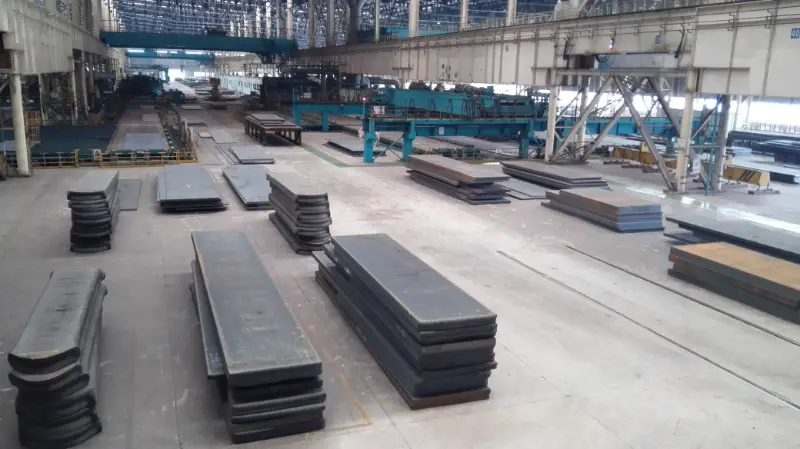
Alloy 800H (N08810) Austenitic Stainless Steel Plate and Coil
Alloy 800H (UNS N08810) Austenitic Stainless Steel: High-Temperature Strength and Oxidation Resistance
In-depth analysis of Alloy 800H (N08810) chemical composition, mechanical and thermal properties, equivalent grades, and industrial applications.
Hot working, cold working, welding, machining, forming
- Phone : +8618037372205
- Email : [email protected]
- WhatsApp: Contact via Whtsapp
- WeChat: +8618037372205
Alloy 800H Austenitic Stainless Steel Plate and Coil Introduction
Alloy 800H (UNS N08810) is an austenitic nickel-iron-chromium alloy with superior high-temperature strength and resistance to oxidation, carburization, and other forms of degradation. It is a higher-carbon variant of Alloy 800 (N08800), specifically designed for enhanced creep and stress-rupture properties in the temperature range of approximately 600°C to 950°C. Through controlled additions of aluminum and titanium, the alloy forms a fine, stable austenitic grain structure that remains intact after extended exposure to elevated temperatures. Typical delivery condition is solution annealed at 1120-1180°C followed by rapid cooling. This grade is widely used in industrial environments where structural integrity under thermal stress is critical, such as furnace components, petrochemical processing, and heat-treating equipment.
Alloy 800H Austenitic Stainless Steel Plate and Coil Chemical Composition
The chemical composition of Alloy 800H (UNS N08810) as specified by ASTM B409 ensures a precisely balanced content of nickel, chromium, and iron, along with controlled additions of aluminum and titanium to promote high-temperature stability. The carbon content is intentionally higher than in Alloy 800 to improve creep resistance. Trace elements are kept within strict limits to maintain corrosion resistance and weldability.
| Element | Standard Value (wt%) | Remarks |
|---|---|---|
| Carbon (C) | 0.05 – 0.10 | Strengthener for creep resistance |
| Manganese (Mn) | ≤ 1.50 | Deoxidizer |
| Silicon (Si) | ≤ 1.00 | Controlled for oxidation resistance |
| Phosphorus (P) | ≤ 0.045 | Impurity control |
| Sulfur (S) | ≤ 0.015 | Low sulfur for weldability |
| Chromium (Cr) | 19.0 – 23.0 | Primary oxidation resistance element |
| Nickel (Ni) | 30.0 – 35.0 | Base element, ensures austenitic structure |
| Aluminum (Al) | 0.15 – 0.60 | Grain size control, contributes to Al+Ti sum |
| Titanium (Ti) | 0.15 – 0.60 | Stabilizer, prevents intergranular corrosion |
| Aluminum + Titanium | 0.30 – 1.20 | Combined requirement for optimal properties |
| Copper (Cu) | ≤ 0.75 | Residual element |
| Iron (Fe) | Balance | Approximately 39.5% minimum |
Alloy 800H Austenitic Stainless Steel Plate and Coil Thermal and Electrical Physical Properties
The physical properties listed are typical for Alloy 800H in the solution-annealed condition and are derived from published material datasheets and industry references. These values assist in design calculations for thermal expansion, heat transfer, and electrical resistivity. Note that properties vary with temperature; values at elevated temperatures are available upon request.
| Property | Typical Value | Unit | Test Condition |
|---|---|---|---|
| Density (ρ) | 7.94 | g/cm³ | 20°C |
| Melting Range | 1357 – 1385 | °C | Liquidus-solidus |
| Relative Magnetic Permeability | < 1.02 | - | Annealed |
| Elastic Modulus (E) | 196 | GPa | 20°C |
| Shear Modulus (G) | 77 | GPa | 20°C (calculated) |
| Poisson's Ratio (ν) | 0.34 | - | 20°C |
| Thermal Expansion Coefficient (α) | 14.4 | 10⁻⁶/K | 20 – 100°C |
| Thermal Expansion Coefficient (α) | 15.8 | 10⁻⁶/K | 20 – 500°C |
| Thermal Expansion Coefficient (α) | 17.5 | 10⁻⁶/K | 20 – 1000°C |
| Thermal Conductivity (λ) | 11.5 | W/m·K | 20°C |
| Thermal Conductivity (λ) | 14.9 | W/m·K | 200°C |
| Thermal Conductivity (λ) | 19.3 | W/m·K | 400°C |
| Thermal Conductivity (λ) | 23.8 | W/m·K | 600°C |
| Thermal Conductivity (λ) | 28.4 | W/m·K | 800°C |
| Specific Heat Capacity (cp) | 500 | J/kg·K | 20°C |
| Electrical Resistivity (ρe) | 0.989 | µΩ·m | 20°C |
Alloy 800H Austenitic Stainless Steel Plate and Coil Mechanical Properties
Tensile properties for Alloy 800H plate and coil in the solution-annealed condition per ASTM B409. The alloy exhibits good ductility and moderate yield strength at ambient temperature, with excellent retention of strength at elevated temperatures. These values are the minimum requirements for standard products.
| Property | Standard Requirement | Unit | Test Condition |
|---|---|---|---|
| Tensile Strength (Rm) | ≥ 450 (65) | MPa (ksi) | Room temperature, annealed |
| Yield Strength (Rp0.2) | ≥ 170 (25) | MPa (ksi) | Room temperature, annealed |
| Elongation (A) | ≥ 30 | % | Gauge length 50 mm (2 in) |
Alloy 800H Austenitic Stainless Steel Plate and Coil Equivalent International Standards and Direct Replacements
| Country/Region | Standard | Grade | Remarks |
|---|---|---|---|
| USA | ASTM B409 / ASME SB-409 | UNS N08810 (800H) | Original specification |
| Europe | EN 10095 | 1.4876 (X10NiCrAlTi32-20) | Full chemical and mechanical equivalence |
| International | ISO 4954 | X10NiCrAlTi32-20 | Identical composition to EN variant |
| Germany | DIN 17742 / DIN 17750 | 1.4876 | Werkstoff number 1.4876 |
| China | GB/T 20878 | NS112 (0Cr20Ni32AlTi) | Approximate match; verify Al+Ti limits |
Alloy 800H Austenitic Stainless Steel Plate and Coil Application Introduction
Alloy 800H is employed where high-temperature strength and resistance to oxidation, carburization, and sulfidation are required. It is particularly effective in long-term service at temperatures from 600°C to 950°C, outperforming standard stainless steels and many lower-nickel alloys. Designers often select 800H for components exposed to cyclic heating and aggressive process gases in petrochemical and thermal processing industries.
Product Applications: Ethylene cracking furnace tubes, Steam methane reformer tubes, Heat exchanger tube bundles, Superheater and reheater tubing, Radiant tubes for batch and continuous furnaces, Combustion chambers and burner nozzles, Trays, baskets, and jigs for heat treatment
Processed into products: Furnace rolls and skids, Quench fixtures, Thermowell protection tubes, High-temperature fasteners (bolts, studs), Conveyor belts and chains, Shell and tube heat exchanger baffles, Tube supports and hangers
Application industries: Petrochemical and refinery, Heat treatment and furnace engineering, Power generation (conventional and nuclear), Chemical processing, Food processing (high-temperature baking), Automotive (exhaust systems)
Alloy 800H Austenitic Stainless Steel Plate and Coil Similar or Alternative Materials
| Country/Region | Standard | Grade | Remarks |
|---|---|---|---|
| USA | ASTM B409 | Alloy 800 (UNS N08800) | Lower carbon (≤0.10), similar base composition but inferior creep strength above 600°C; suitable for lower-temperature applications |
| USA | ASTM B424 | Alloy 825 (UNS N08825) | Contains molybdenum and copper for improved corrosion resistance in chemical environments; lower high-temperature strength than 800H |
| Japan | JIS G4312 | SUH310 (310 stainless) | Lower-cost austenitic Fe-Cr-Ni alloy; good oxidation resistance but significantly lower creep strength and carburization resistance |
| USA | ASTM B167 | Alloy 600 (UNS N06600) | Higher nickel content (≥72%), excellent corrosion resistance, but more costly and lower strength than 800H in carburizing atmospheres |
Notes:
Alloy 800H is typically welded using matching filler metals such as ERNiCr-3 (INCONEL 82) or ERNiCrMo-3 (INCONEL 625) for dissimilar joints. Preheating is not required, but post-weld heat treatment may be applied to relieve stresses. For service above 650°C, the design code ASME Boiler and Pressure Vessel Code Section VIII Div. 1 allows use of 800H in pressure parts. Enameling and acid cleaning processes are possible for specialized applications. Note that prolonged exposure between 540°C and 760°C can lead to sigma phase embrittlement; thus, operating practices must avoid slow cooling through this range.
- Share



