
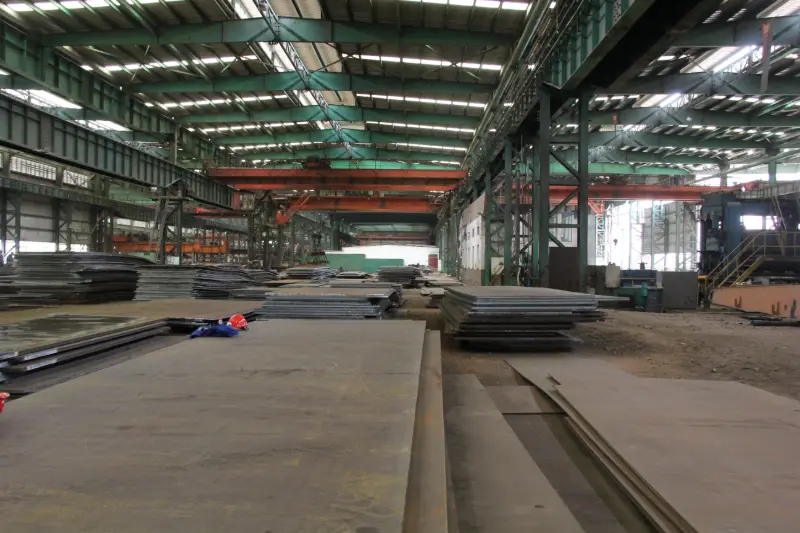
S890QL1 High-Strength Quenched & Tempered Steel
EN10025-6 S890QL1 | High-Strength Quenched & Tempered Steel for Extreme Structures
Explore S890QL1, a quenched and tempered fine-grain structural steel delivering minimum 890 MPa yield with guaranteed low-temperature toughness at -60°C. Ideal for heavy lifting, offshore, and mobile crane fabrications.
Hot rolling, cold forming (with precautions due to high strength), thermal cutting, welding (low hydrogen processes, preheat/interpass control), machining
- Phone : +8618037372205
- Email : [email protected]
- WhatsApp: Contact via Whtsapp
- WeChat: +8618037372205
S890QL1 High-Strength Quenched & Tempered Steel Introduction
S890QL1 is a high-strength structural steel grade defined in EN 10025-6, produced through quenching and tempering (Q+T) of fine-grain steels. It combines minimum 890 MPa yield strength with excellent low-temperature notch toughness down to -60°C (quality L1). The designation decodes as:
- S = structural steel
- 890 = minimum yield strength in MPa for thickness ≤50 mm
- Q = quenched and tempered delivery condition
- L1 = low-temperature impact quality at -60°C (30 J longitudinal)
Typical applications demand high strength-to-weight ratios, good weldability under controlled thermal cycles, and reliable brittle fracture resistance in harsh environments. The chemistry is low carbon equivalent (CEV) to facilitate welding, with alloying elements like Cr, Ni, Mo, and Nb for hardenability and grain refinement.
S890QL1 High-Strength Quenched & Tempered Steel Chemical Composition
The table provides the ladle/heat analysis limits for S890QL1 according to EN 10025-6:2019, Table 2. All values are maximum unless a range is stated. The steel is fully killed and fine-grain treated with Al, Nb, V, or Ti to achieve the required toughness and strength. Carbon equivalent (CEV) max. is approximately 0.65% for thickness ≤50 mm (according to Table 5).
| Chemical Element | Standard Value (max, % by mass) | Remarks |
|---|---|---|
| Carbon (C) | 0.20 | |
| Silicon (Si) | 0.80 | |
| Manganese (Mn) | 1.70 | |
| Phosphorus (P) | 0.020 | |
| Sulfur (S) | 0.010 | |
| Chromium (Cr) | 1.50 | |
| Nickel (Ni) | 2.0 | |
| Molybdenum (Mo) | 0.70 | |
| Niobium (Nb) | 0.06 | |
| Vanadium (V) | 0.12 | Sum of Nb+V+Ti ≤ 0.22% |
| Titanium (Ti) | 0.05 | |
| Copper (Cu) | 0.50 | |
| Nitrogen (N) | 0.015 | For fine-grain steels, enough Al or other N-binding elements are added |
| Boron (B) | 0.005 | |
| Aluminium (Al) total | ≥0.015 | Minimum for fully killed fine-grain practice |
S890QL1 High-Strength Quenched & Tempered Steel Thermal and Electrical Physical Properties
The following values are typical for quenched and tempered high-strength steels similar to S890QL1 at room temperature, unless a temperature range is specified. They are not mandatory in EN 10025-6 but serve as design guidance. Properties can vary with actual chemical composition and tempering temperature.
| Property | Typical Value | Unit | Test Condition / Remarks |
|---|---|---|---|
| Density (ρ) | 7.85 | kg/dm³ (g/cm³) | Room temperature |
| Elastic modulus (E) | 205 – 210 | GPa | Room temperature, longitudinal |
| Shear modulus (G) | ~80 | GPa | Calculated from E and ν |
| Poisson's ratio (ν) | 0.28 – 0.30 | -- | Room temperature, elastic range |
| Thermal expansion coefficient (α) | 11.5 – 12.5 | 10⁻⁶/K | Range 20°C to 100°C; values increase at higher temperatures |
| Thermal expansion coefficient (α) | 12.5 – 13.5 | 10⁻⁶/K | Range 20°C to 200°C |
| Thermal expansion coefficient (α) | 13.5 – 14.5 | 10⁻⁶/K | Range 20°C to 400°C |
| Thermal conductivity (λ) | 35 – 40 | W/(m·K) | At 20°C; reduces with increasing temperature |
| Specific heat capacity (cp) | 460 – 480 | J/(kg·K) | At 20°C; ≈500 J/(kg·K) at 300°C |
| Electrical resistivity (ρe) | 0.25 – 0.30 | μΩ·m | At 20°C |
S890QL1 High-Strength Quenched & Tempered Steel Mechanical Properties
The data below reflects the mandatory minimum/maximum values as per EN 10025-6:2019, Table 4, for S890Q grades (applicable to S890QL, S890QL1). Values apply to longitudinal test pieces from flat products in the quenched and tempered condition. Thickness range ≤50 mm. Impact energy values are guaranteed longitudinal Charpy V-notch; the L1 suffix demands a minimum of 30 J at -60°C.
| Property | Standard Required Value | Unit | Test Condition |
|---|---|---|---|
| Yield strength (ReH) | ≥890 | MPa | t ≤ 50 mm, transverse direction may have slightly lower values per agreement |
| Tensile strength (Rm) | 940 – 1100 | MPa | t ≤ 50 mm |
| Elongation after fracture (A) | ≥10 | % | Longitudinal, gauge length L0 = 5.65√S0; t ≤ 50 mm |
| Charpy V-notch impact energy (KV) | ≥30 | J | Longitudinal, at -60°C (L1 quality), average of three specimens |
| Charpy V-notch impact energy (KV) | ≥27 | J | Single minimum value at -60°C |
| Bending test (mandrel diameter) | bend at 180° over diameter 4t (t = thickness) | -- | Test to be performed on quenched and tempered condition, ≤50 mm thick |
| Bend angle | 180 | degree | No cracking for t ≤ 50 mm, mandrel diameter = 4t |
S890QL1 High-Strength Quenched & Tempered Steel Fully Equivalent Material Standards and Substitutable Grade Recommendations
Exact one-to-one equivalent standards for S890QL1 are rare. The following designations are considered technically equivalent or closely matched by standard systems, though individual steelmaker specific grades may differ. Always verify with the latest standard and supplier.
| Country/Region | Standard | Grade | Remarks |
|---|---|---|---|
| EU | EN 10025-6:2019 | S890QL1 | Original specification; L1 subtype for -60°C impact |
| International | ISO 630-6:2023 | S890Q | ISO equivalent but impact temperatures differ; check energy at -60°C |
| Germany | DIN EN 10025-6 | S890QL1 | Adopted EN standard; sometimes Werkstoff-Nr. 1.8983 for S890QL (no distinct number for L1) |
| UK | BS EN 10025-6 | S890QL1 | British adoption identical to EN |
| France | NF EN 10025-6 | S890QL1 | French adoption identical |
| Italy | UNI EN 10025-6 | S890QL1 | Italian adoption identical |
S890QL1 High-Strength Quenched & Tempered Steel Application Introduction
S890QL1 is engineered for lightweight, high-load structures operating in subzero environments. The combination of 890 MPa yield strength with -60°C impact toughness allows designers to reduce section thickness while maintaining safety against brittle fracture. It is supplied in the quenched and tempered condition and can be fabricated with controlled welding procedures (typically using matching or undermatching low-hydrogen consumables, with preheat and interpass temperature control to avoid hydrogen cracking and temper embrittlement). Post-weld heat treatment is normally not required. The steel can be cold-formed with large radii; hot forming above tempering temperature is not recommended.
Key industries:
Product Applications: Telescopic crane booms and lattice boom sections, Chassis and outrigger beams of mobile cranes, Heavy-duty mining dump truck frames, Offshore crane pedestals and A-frames, High-pressure hydraulic cylinders for extreme loads, Bridge girder flange and web plates, Telescopic handlers and aerial work platform masts
Processed into products: Boom sections (laser or plasma cut, then welded into box sections), Chassis rails, cross members, and reinforcements, Weld-on lifting lugs, pad-eyes, and padeye reinforcements, Bracket plates, hinge pins, and high-strength bolted connections, Cable guide sheaves and sheave housings, Structural nodes (cast, forged, or welded from thick plate), Hydraulic cylinder barrels and end caps
Application industries: Heavy mobile crane and lifting equipment manufacturing, Offshore oil & gas and wind energy (jack-ups, crane pedestals, structural nodes), Mining and earthmoving machinery, Transport engineering (truck frames, trailer chassis, concrete pump booms), Bridge construction (suspension and cable-stayed bridge segments, orthotropic decks), Pressure vessel and penstock construction (when strength and low-temperature toughness are critical), Aerospace ground support equipment
S890QL1 High-Strength Quenched & Tempered Steel Similar/Comparable Alternative Material Recommendations
When a lower or higher strength level is acceptable, or when different toughness requirements exist, the following grades may serve as substitutes. Always evaluate weldability and processing differs.
| Country/Region | Standard | Grade | Remarks |
|---|---|---|---|
| EU | EN 10025-6 | S890QL | Same strength, impact at -40°C (30 J) vs L1 -60°C; suitable for slightly warmer design temperatures |
| EU | EN 10025-6 | S960QL/QL1 | Higher minimum yield (960 MPa); lower ductility (~9% elongation); more careful welding required |
| EU | EN 10025-6 | S690QL1 | Lower yield (690 MPa) but better formability and higher toughness reserve; easier to weld |
| USA | ASTM A514/A514M | Grade S or F | Quenched & tempered to 690-830 MPa tensile; yield ~690 MPa; not equivalent to 890 MPa; need to check impact at -60°C |
| International | ISO 4950-3 (superseded) | E890DD | Older standard for high yield steel; similar strength but delivery condition may differ (DD = delivery condition at manufacturer's option) |
| EU | EN 10225:2009 | S890G1+Q (previously S890G1/QL1) | Weldable structural steel for fixed offshore structures; tighter chemistry and additional testing; suitable for offshore where EN 10025-6 is insufficient |
Notes:
- All mechanical properties relate to the quenched and tempered condition. Welding can alter the heat-affected zone; design should consider potential softening or hardening.
- Maximum permissible carbon equivalent (CEV) for S890QL1 is 0.65% for t ≤ 50 mm according to Table 5 of EN 10025-6. Actual values are normally lower to guarantee weldability.
- Delivery documents as per EN 10204, type 3.1 or 3.2 inspection certificate is common for this grade; specify clearly at the time of order.
- Surface condition: The order may specify requirements for surface quality according to EN 10163-2. Normal practice is class A, subclass 2 for plates without significant imperfections.
- Dimensional tolerances: Often supplied in accordance with EN 10029 for hot-rolled plates or EN 10051 for wide strip/coils; closer tolerances may be agreed.
- Ultrasonic testing per EN 10160 or equivalent is often required for critical applications; specify acceptance class (e.g., S1E1).
- Share



