
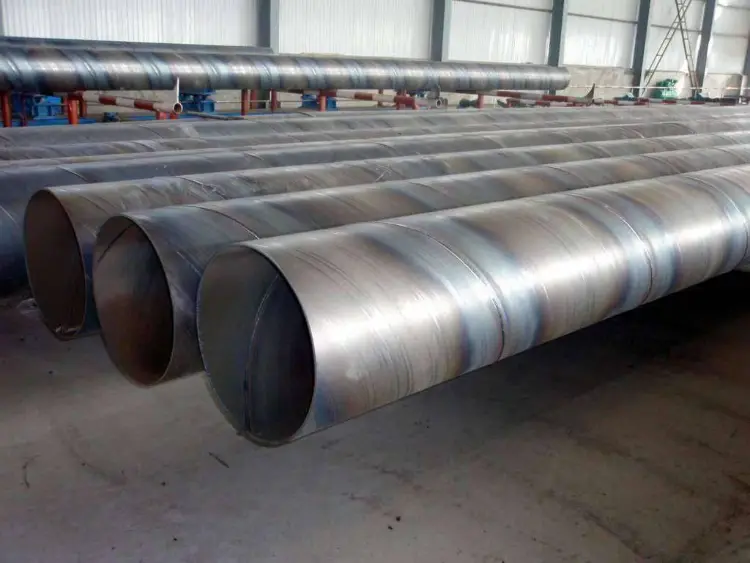
EN10025-6 S620Q SSAW Pipe
EN10025-6 S620Q SSAW Pipe: High Strength Quenched & Tempered Structural Steel Data Sheet
Comprehensive material data for EN10025-6 S620Q steel including chemical composition, mechanical properties, thermal & electrical properties, international equivalents, and application guidelines for SSAW pipe manufacturing.
Welding (submerged arc welding for SSAW pipe), cold forming (with limitations), machining, cutting, drilling
- Phone : +8618037372205
- Email : [email protected]
- WhatsApp: Contact via Whtsapp
- WeChat: +8618037372205
EN10025-6 S620Q SSAW Pipe Introduction
S620Q is a high strength, quenched and tempered structural steel specified in European standard EN 10025-6. It is designed for welded structures subjected to high static and dynamic loads, offering a minimum yield strength of 620 MPa in thicknesses up to 50 mm. The material exhibits excellent weldability with controlled carbon equivalent (CEV), good toughness at ambient temperature, and reliable performance in heavy engineering applications. Typical delivery condition is quenched and tempered (Q&T). In the form of SSAW (spiral submerged arc welded) pipe, S620Q is widely used for demanding pipeline, offshore, and structural projects where high strength-to-weight ratio and toughness are essential.
EN10025-6 S620Q SSAW Pipe Chemical Composition
Chemical composition according to EN 10025-6:2019 for S620Q. Values are maximum unless a range is indicated. Elements not listed may be present in trace amounts.
- Carbon equivalent (CEV) is controlled to ensure weldability: CEV = C + Mn/6 + (Cr+Mo+V)/5 + (Ni+Cu)/15, maximum CEV depends on thickness (typically ≤0.65%).
- For product thickness ≤50 mm the limits apply directly; for thicker products, slight adjustments to Mn may be permitted.
| Element | Content (max, wt%) | Remarks |
|---|---|---|
| Carbon (C) | ≤0.20 | Lower carbon improves weldability |
| Silicon (Si) | ≤0.80 | Deoxidizer, influences strength |
| Manganese (Mn) | ≤1.70 | Major strengthening; for thickness >50 mm may be increased up to 1.80 |
| Phosphorus (P) | ≤0.020 | Strict limit for toughness |
| Sulfur (S) | ≤0.010 | Strict limit to avoid hot cracking |
| Chromium (Cr) | ≤1.50 | Promotes hardenability |
| Nickel (Ni) | ≤2.0 | Improves toughness and hardenability |
| Molybdenum (Mo) | ≤0.70 | Increases hardenability and high-temperature strength |
| Copper (Cu) | ≤0.50 | Residual element; improves atmospheric corrosion resistance |
| Niobium (Nb) | ≤0.06 | Grain refiner, microalloying |
| Vanadium (V) | ≤0.12 | Precipitation strengthening |
| Titanium (Ti) | ≤0.05 | Nitrogen binder, grain refiner |
| Boron (B) | ≤0.005 | For selected thicknesses to ensure hardenability |
| Zirconium (Zr) | ≤0.15 | Optional microalloying, grain refinement |
| Nitrogen (N) | ≤0.015 | Bound by Ti, Al to prevent strain aging |
EN10025-6 S620Q SSAW Pipe Thermal and Electrical Physical Properties
Typical physical properties for quenched and tempered high strength structural steels at room temperature unless otherwise stated. These values are not mandatory but serve as engineering references. The properties are similar for all S620Q grades and are based on carbon-manganese low-alloy steels. Density (ρ) is for standard steel; slight variations may occur due to alloying elements.
| Property | Typical value | Unit | Test condition / Remarks |
|---|---|---|---|
| Density (ρ) | 7850 | kg/m³ | At 20 °C |
| Elastic modulus (E) | 210 | GPa | At 20 °C, static |
| Shear modulus (G) | ≈ 81 | GPa | Calculated from E and ν |
| Poisson's ratio (ν) | ≈ 0.3 | - | Elastic range, room temperature |
| Thermal expansion coefficient (α) | ≈ 12 × 10⁻⁶ | K⁻¹ | Between 20 °C and 100 °C |
| Thermal expansion coefficient (α) | ≈ 13 × 10⁻⁶ | K⁻¹ | Between 20 °C and 200 °C |
| Thermal expansion coefficient (α) | ≈ 14 × 10⁻⁶ | K⁻¹ | Between 20 °C and 300 °C |
| Thermal conductivity (λ) | ≈ 42 | W/(m·K) | At 20 °C, estimated for low alloy steel |
| Specific heat capacity | ≈ 460 | J/(kg·K) | At 20 °C, typical value |
| Electrical resistivity (ρe) | ≈ 0.25 × 10⁻⁶ | Ω·m | At 20 °C, typical for structural steel |
EN10025-6 S620Q SSAW Pipe Mechanical Properties
Minimum mechanical properties according to EN 10025-6 for S620Q in the quenched and tempered condition at ambient temperature. All tensile test values are for longitudinal specimens. For transverse specimens, elongation may be reduced by 2%. Impact test is performed on Charpy-V specimens in longitudinal direction.
- Thickness ranges may overlap; apply the most representative value based on product thickness.
- Bend test: d = bend diameter, a = specimen thickness. Requirement: no cracks after bending through 180°.
| Property | Required value | Unit | Test condition / Remarks |
|---|---|---|---|
| Yield strength ReH | ≥ 620 | MPa | Thickness ≤ 50 mm |
| Yield strength ReH | ≥ 580 | MPa | 50 mm < thickness ≤ 100 mm |
| Yield strength ReH | ≥ 560 | MPa | 100 mm < thickness ≤ 150 mm |
| Tensile strength Rm | 700 - 890 | MPa | Thickness ≤ 50 mm |
| Tensile strength Rm | 650 - 830 | MPa | 50 mm < thickness ≤ 100 mm |
| Tensile strength Rm | 620 - 800 | MPa | 100 mm < thickness ≤ 150 mm |
| Elongation after fracture A | ≥ 15 | % | L0 = 5.65√So, thickness ≤ 50 mm, longitudinal |
| Elongation after fracture A | ≥ 14 | % | 50 mm < thickness ≤ 100 mm |
| Elongation after fracture A | ≥ 13 | % | 100 mm < thickness ≤ 150 mm |
| Charpy impact energy KV | ≥ 27 | J | At +20 °C, longitudinal, nominal thickness ≤ 100 mm |
| Bend test (d=a) | No cracks | - | Bend angle 180°, thickness ≤ 25 mm, d = 3a for t > 25 mm up to 50 mm |
EN10025-6 S620Q SSAW Pipe Full Equivalent Standards & Recommended Substitute Grades
| Country/Region | Standard | Grade | Remarks |
|---|---|---|---|
| Europe | EN 10025-6 | S620Q | Base material, no suffix ensures +20°C impact requirement |
| Europe | EN 10025-6 | S620QL | When low-temperature toughness (-40°C) is needed |
| Europe | EN 10025-6 | S620QL1 | For -60°C impact requirement |
| International | ISO 4950-2 | E620 DQL | ISO designation, quenched and tempered, minimum yield 620 MPa |
| USA | ASTM A514/A514M | Grade B, H, F | Approximate strength, but different chemical limits and delivery conditions |
| USA | ASTM A517/A517M | Grade B, H, F | Quenched and tempered, used for pressure vessels; similar strength |
EN10025-6 S620Q SSAW Pipe Application Introduction
S620Q in the form of SSAW pipe is employed where high strength, good weldability, and moderate toughness at ambient temperature are required. It is particularly suited for large-diameter pipes and pressure conduits in heavy industries. The material can be cold formed to some extent, but fabrication normally involves submerged arc welding. Suitable for structural, offshore, and transport applications.
Product Applications: SSAW (spiral submerged arc welded) pipes, Longitudinal seam welded pipes (if from plates), Structural hollow sections, High pressure fluid conveyance pipes, Pile pipes for foundation, Penstock and sluice gates
Processed into products: Pipeline sections for sour service (with appropriate HIC testing), Offshore jacket legs and braces, Structural columns and beams in high-rise buildings, Crane main chords and lattice members, Hydraulic cylinder bodies (when formed and welded), Water turbine inlet pipes
Application industries: Oil & gas transmission (onshore and offshore pipelines), Civil engineering (bridge construction, steel structures), Offshore and marine (jackets, piles, riser pipes), Water and sewage (large diameter penstocks), Heavy machinery (crane booms, heavy lifting equipment), Renewable energy (wind turbine towers, foundation piles)
EN10025-6 S620Q SSAW Pipe Similar/Alternative Materials with Comparable Performance
| Country/Region | Standard | Grade | Remarks |
|---|---|---|---|
| Europe | EN 10025-6 | S690Q | Higher strength (690 MPa yield), suitable when weight reduction is critical, more stringent welding procedures |
| Europe | EN 10025-6 | S620QL | Same strength, but guaranteed impact energy at -40°C; recommended for cold climates |
| Europe | EN 10025-4 | S620M | Thermomechanically rolled condition; different delivery, suitable where forming is required |
| USA | ASTM A514/A514M | Grade B (100 ksi yield) | Similar strength, but compliance with EN welding standards may need verification |
| USA | ASTM A709/A709M | Grade 100/100W | Structural steel for bridges, yield strength 690 MPa, used in USA |
| Japan | JIS G 3128 | SHY685 | High yield strength steel for welded structures, 685 MPa yield |
Notes:
Welding: SSAW pipes from S620Q require preheating and interpass temperature control based on thickness and CEV. Welding consumables should match the strength and toughness. Post weld heat treatment (PWHT) is generally not recommended for Q&T steel to avoid temper embrittlement; if required, it must be performed below the tempering temperature (typically <580°C). Testing: Ultrasonic and radiographic inspection of the weld seam is mandatory for pressure applications. Corrosion: Not inherently corrosion resistant; coatings, cathodic protection or cladding may be required for aggressive environments. Forming: After quenching and tempering, cold forming may require special procedures to avoid strain ageing; hot forming would destroy the mechanical properties.
- Share



