
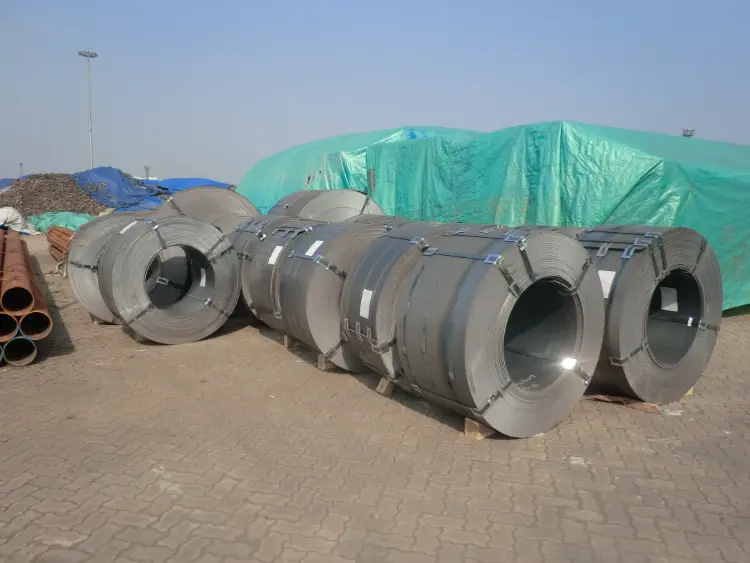
EN10025-5 S355J0W Weathering Steel Coil
EN10025-5 S355J0W Weathering Steel Coil: High-Strength, Atmospheric Corrosion Resistant Structural Steel for Durable Applications
S355J0W is a hot-rolled weather-resistant structural steel according to EN 10025-5 with minimum yield strength of 355 MPa and Charpy impact energy of 27 J at 0°C, ideal for bridges, buildings, and facades.
Hot rolling, cold forming, bending, welding, flame cutting, machining
- Phone : +8618037372205
- Email : [email protected]
- WhatsApp: Contact via Whtsapp
- WeChat: +8618037372205
EN10025-5 S355J0W Weathering Steel Coil Introduction
S355J0W is a normalized/rolled weldable fine-grain structural steel with improved atmospheric corrosion resistance, classified under EN 10025-5. It belongs to the family of weathering steels (often referred to as Corten steel) that form a stable, protective patina when exposed to the weather, eliminating the need for painting in many environments.
- High strength: Minimum 355 MPa yield strength for thicknesses up to 16 mm, reducing dead load and enabling slender designs.
- Weather resistance: Addition of copper, chromium, and nickel enhances resistance to corrosion, leading to lower maintenance costs.
- Good toughness: J0 quality ensures at least 27 J impact energy at 0 °C, suitable for structures with moderate low‑temperature requirements.
- Weldability: Low carbon equivalent (CEV typically ≤0.52) ensures good weldability without preheating for moderate thicknesses.
- Formability: Can be cold‑formed, hot‑formed, and welded using conventional methods, making it versatile for fabrication.
- Availability: Supplied as coils, sheets, and plates, often in the as‑rolled or normalized condition.
Typical applications include bridges, building envelopes, containers, railway vehicles, and transmission towers, where both structural integrity and aesthetic appearance are valued. Its patina develops over time, ranging from orange to dark brown, providing a natural, rustic look.
EN10025-5 S355J0W Weathering Steel Coil Chemical Composition
The chemical requirements are according to EN 10025-5:2019 for grade S355J0W. Values represent heat analysis. For product analysis, slight deviations are permitted as specified in the standard. The addition of Cu, Cr, and Ni provides atmospheric corrosion resistance, while low carbon content and controlled sulfur/phosphorus ensure good weldability and toughness.
| Element | Standard Limit (max, unless range specified) | Remarks |
|---|---|---|
| C (Carbon) | ≤0.19 | Affects strength and weldability; low level for good toughness |
| Si (Silicon) | ≤0.55 | Deoxidizer; contributes to strength |
| Mn (Manganese) | 0.45 – 1.60 | Enhances strength and hardenability; range given |
| P (Phosphorus) | ≤0.035 | Controlled for toughness and weldability |
| S (Sulfur) | ≤0.035 | Low sulfur for formability and weld quality |
| Cr (Chromium) | 0.35 – 0.85 | Key element for improved atmospheric corrosion resistance |
| Cu (Copper) | 0.20 – 0.60 | Provides weathering protection; may cause hot shortness if too high |
| Ni (Nickel) | ≤0.65 | Synergistic with Cu and Cr for corrosion resistance |
| Mo (Molybdenum) | ≤0.30 | Optional; can enhance strength and pitting resistance |
| Zr (Zirconium) | ≤0.15 | Microalloying element; grain refinement (optional) |
| Al (Aluminum) | ≥0.020 (total) or sufficient | For deoxidation and grain refinement; if added |
| N (Nitrogen) | ≤0.012 | Bound with Al or other elements to prevent aging |
| Others (V, Nb, Ti) | Not specified | May be added for grain refinement; consult with manufacturer |
EN10025-5 S355J0W Weathering Steel Coil Physical and Thermal Properties
The following physical properties are not specified in EN 10025-5 but are typical for low‑alloy structural steels and can be used for design calculations. Values are at room temperature unless otherwise noted. Slight variations exist depending on the exact heat treatment and microstructure. These data are provided for general guidance.
| Property | Typical Value | Unit | Test Condition / Reference |
|---|---|---|---|
| Density (ρ) | 7.85 | g/cm³ | 20 °C; typical of carbon-manganese steel |
| Young's Modulus (E) | 210 | GPa | 20 °C; tension |
| Shear Modulus (G) | ≈81 | GPa | Calculated from E and Poisson's ratio |
| Poisson's Ratio (ν) | 0.3 | – | Elastic range |
| Thermal Expansion (α) | 12.0 × 10⁻⁶ | /K | 20–100 °C average |
| Thermal Expansion (α) | 12.5 × 10⁻⁶ | /K | 20–200 °C |
| Thermal Expansion (α) | 13.0 × 10⁻⁶ | /K | 20–300 °C |
| Thermal Conductivity (λ) | ≈35 | W/(m·K) | At 20 °C; decreases with temperature |
| Specific Heat Capacity (cp) | ≈460 | J/(kg·K) | 20–100 °C average |
| Electrical Resistivity (ρe) | ≈0.22 | μΩ·m | At 20 °C |
EN10025-5 S355J0W Weathering Steel Coil Mechanical Properties
Mechanical properties are specified in EN 10025-5:2019 for S355J0W steel. The yield strength (ReH) and tensile strength (Rm) depend on product thickness. Elongation is measured on proportional test pieces (L0=5.65√S0) in the longitudinal direction. Impact energy (KV) is determined on Charpy V‑notch specimens at 0 °C. Bending test requirements ensure ductility for cold forming.
| Property | Standard Requirement | Unit | Test Condition / Thickness Range |
|---|---|---|---|
| Yield Strength (ReH) | ≥355 | MPa | Nominal thickness ≤ 16 mm |
| Yield Strength (ReH) | ≥345 | MPa | 16 mm < t ≤ 40 mm |
| Yield Strength (ReH) | ≥335 | MPa | 40 mm < t ≤ 63 mm |
| Yield Strength (ReH) | ≥325 | MPa | 63 mm < t ≤ 80 mm |
| Yield Strength (ReH) | ≥315 | MPa | 80 mm < t ≤ 100 mm |
| Tensile Strength (Rm) | 470 – 630 | MPa | Nominal thickness ≤ 100 mm |
| Tensile Strength (Rm) | 450 – 600 | MPa | 100 mm < t ≤ 150 mm (indicative) |
| Elongation (A) | ≥22 | % | Longitudinal, t ≤ 40 mm; L0=5.65√S0 |
| Elongation (A) | ≥21 | % | 40 mm < t ≤ 63 mm |
| Elongation (A) | ≥20 | % | 63 mm < t ≤ 100 mm |
| Elongation (A) | ≥20 | % | Transverse values approx. 2–3% lower |
| Impact Energy (KV) | ≥27 | J | At 0 °C, Charpy V‑notch, longitudinal |
| Bending (Mandrel Diameter) | ≤2t | – | t ≤ 16 mm, bend angle 180° |
| Bending (Mandrel Diameter) | ≤3t | – | 16 mm < t ≤ 40 mm |
EN10025-5 S355J0W Weathering Steel Coil Full‑Equivalent Material Standards and Substitute Grades
These international standards define grades chemically and mechanically equivalent to S355J0W. They can be considered direct substitutes in most applications. Minor differences in alloying ranges or impact test temperatures should be verified for the specific project.
| Country/Region | Standard | Grade Designation | Notes |
|---|---|---|---|
| Europe | EN 10025-5 | S355J0W | Original source; J0 for 0 °C impact |
| Germany (DIN) | DIN EN 10025-5 | S355J0W | Identical adoption of EN |
| USA (ASTM) | ASTM A588/A588M | Grade B (or C, depending on thickness and chemistry) | Closest match; Grade B has similar yield (345 MPa, 50 ksi) and weathering elements; impact toughness not always specified |
| Japan (JIS) | JIS G 3114 | SMA490AW (or SMA490AP for painted use) | 490 MPa tensile class; AW for atmospheric corrosion resistance; W suffix indicates weathering; SMA490AW has similar tensile range and Charpy requirement at 0°C |
| China | GB/T 4171 | Q355NHD (or Q355NH) | Q355 corresponds to 355 MPa yield; NHD indicates high atmospheric corrosion resistance; impact testing at 0°C available upon agreement |
| ISO | ISO 4952 | Fe355W-1A | International standard for improved atmospheric corrosion resistance; Fe355 is 355 MPa min yield; -1A suffix for chemical variants |
EN10025-5 S355J0W Weathering Steel Coil Application Introduction
S355J0W weathering steel is engineered for uncoated (bare) exposure in atmospheric conditions, developing a protective rust layer that reduces further corrosion. It is used where both structural performance and aesthetic appearance are important. Proper design must allow wet-dry cycles for patina formation; prolonged wetness can lead to accelerated corrosion.
Product Applications: Steel bridges (girders, beams, decking), Weathering steel facades and cladding, Sculptures and public art, Railway wagons and locomotive frames, Container corner castings and side panels, Transmission and telecommunication towers, Light poles and sign gantries, Agricultural silos and water tanks
Processed into products: H‑beams, I‑beams, and columns for frames, Welded plates for bridge box girders, Cold‑formed C and Z profiles for purlins, Cut and bent plates for gusset connections, Pressed parts for railway underframes, Flanges and stiffeners for welded joints, Architectural perforated panels and sunscreens
Application industries: Civil engineering and infrastructure, Architectural and building construction, Bridge engineering, Railway and rolling stock manufacturing, Shipping container and port equipment, Tower and mast construction, Industrial and agricultural storage
EN10025-5 S355J0W Weathering Steel Coil Near‑Equivalent / Similar Performance Materials
These grades have similar strength and weathering characteristics but may differ in impact toughness, delivery condition, or precise chemistry. They can be considered for alternative sourcing or when a specific property (e.g., lower‑temperature toughness) is required.
| Country/Region | Standard | Grade Designation | Characteristics and Comparison |
|---|---|---|---|
| Europe | EN 10025-5 | S355J2W | Impact min 27 J at −20 °C; otherwise identical chemistry and strength; preferred for colder climates |
| Europe | EN 10025-5 | S355K2W | Impact min 40 J at −20 °C (or even lower); higher toughness; used in critical structural components |
| Europe | EN 10025-5 | S355J0WP | Higher phosphorus (0.06-0.15%) for enhanced atmospheric corrosion resistance; more limited weldability; used in non‑welded or less‑critical welded structures |
| USA (ASTM) | ASTM A242 | Type 1 | Yield strength ≥345 MPa; weathering steel with high‑copper content; older standard but still referenced; impact toughness optional |
| USA (ASTM) | ASTM A709 | 50W | Bridge steel; 345 MPa (50 ksi) yield; weathering type; includes Charpy requirements; popular for bridge girders |
| Russia | GOST 19281 | 10KhSND | Low‑alloy structural steel with Cr, Ni, Cu; approx. 390 MPa yield; used in harsh environments |
Notes:
- Patina formation: The protective oxide layer develops over 1–3 years, depending on climate. Design details should avoid crevices and water traps.
- Weldability: With a CEV typically ≤0.52, S355J0W is weldable without preheat for thicknesses up to ~30 mm in ambient conditions. Use matching or undermatched welding consumables (e.g., AWS E70C‑6M H4) to maintain weathering properties.
- Fatigue: Fatigue behavior is similar to conventional S355 steels, but the patina may mask crack initiation sites – regular inspections recommended.
- Service temperature: The 0 °C impact guarantee makes it suitable for structures in temperate climates, but not for severe arctic conditions; then consider S355J2W or K2W.
- Delivery condition: Coil products are usually supplied as‑rolled; for heavy plates, normalizing improves toughness and uniformity.
- Share



