
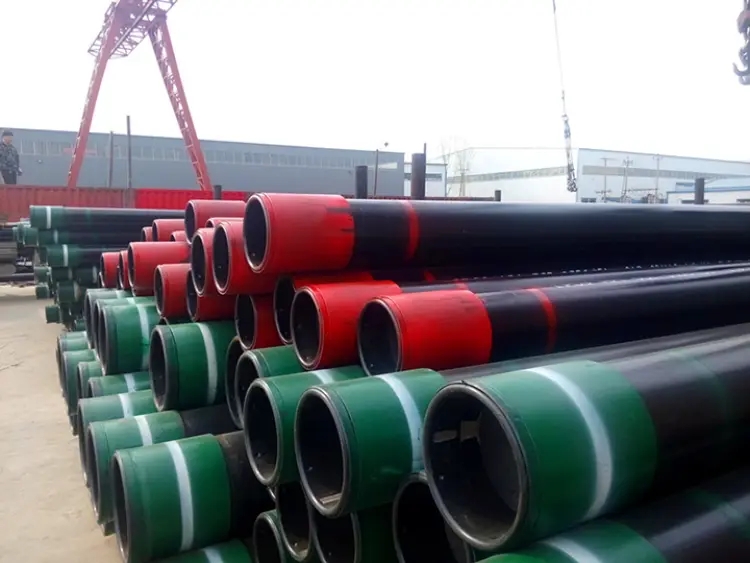
EN10025-2 S355JR LSAW Pipe
EN10025-2 S355JR LSAW Pipe: Material Data, Equivalents & Applications
Comprehensive material analysis for S355JR steel according to EN10025-2, used in LSAW (Longitudinal Submerged Arc Welded) pipes. Includes chemical composition, mechanical properties, physical characteristics, equivalent grades, and application insights.
Hot rolling, thermomechanical rolling, normalizing, welding (including submerged arc welding for LSAW pipes), cutting, forming, and machining.
- Phone : +8618037372205
- Email : [email protected]
- WhatsApp: Contact via Whtsapp
- WeChat: +8618037372205
EN10025-2 S355JR LSAW Pipe Introduction
EN10025-2 S355JR is a non-alloy structural steel grade widely specified for welded tubular products, especially LSAW (Longitudinal Submerged Arc Welded) pipes used in onshore and offshore structural applications. With a minimum yield strength of 355 MPa in thicknesses up to 16 mm, it provides an excellent balance of strength, ductility, and weldability. The JR quality designation guarantees a minimum impact energy of 27 J at +20 °C (longitudinal), making it suitable for ambient-temperature service. S355JR is typically supplied in the hot-rolled or normalized condition and complies with the European standard EN 10025-2:2004. Its controlled carbon equivalent (CEV ≤ 0.45% for t ≤ 40 mm) ensures reliable field welding without the need for preheating under normal conditions. The steel is also characterized by fine grain practice and full deoxidation (typically aluminium-killed), resulting in homogeneous mechanical properties. In LSAW pipe form, S355JR is used for fluid transportation, piling, building structures, and mechanical components.
EN10025-2 S355JR LSAW Pipe Chemical Composition
The following table presents the ladle analysis limits for S355JR according to EN 10025-2:2004. Elements not listed are not intentionally added; residual contents are limited by the sum of Nb+V+Ti ≤ 0.22% and Cr+Mo+Ni ≤ 0.80%, unless otherwise agreed. The carbon equivalent (CEV) is calculated using the formula CEV = C + Mn/6 + (Cr+Mo+V)/5 + (Ni+Cu)/15 and must meet the indicated maximum depending on product thickness.
| Element | Maximum Value (wt%) | Remarks |
|---|---|---|
| C | ≤ 0.24 | Applies for nominal thickness ≤ 100 mm |
| Si | ≤ 0.55 | Silicon content typical for deoxidation |
| Mn | ≤ 1.60 | Manganese improves strength and weldability |
| P | ≤ 0.035 | Phosphorus maximum |
| S | ≤ 0.035 | Sulfur maximum |
| Cu | ≤ 0.55 | Copper residual limit |
| N | ≤ 0.012 | Nitrogen content for aluminium-killed steel |
| CEV | ≤ 0.45 (t ≤ 40 mm) ≤ 0.47 (40 < t ≤ 100 mm) | Carbon equivalent limit ensures good weldability |
EN10025-2 S355JR LSAW Pipe Thermal and Electrical Physical Properties
The following physical properties are typical reference values for S355JR (low carbon structural steel) at room temperature unless otherwise indicated. These properties are not specified in EN 10025-2 but are derived from published technical data for similar non-alloy steels. They are suitable for engineering calculations involving heat transfer, thermal expansion, and electrical resistance. Variations may occur depending on exact composition and processing condition.
| Property | Typical Value | Unit | Conditions |
|---|---|---|---|
| Density (ρ) | 7850 | kg/m³ | 20 °C |
| Elastic Modulus (E) | 210 | GPa | 20 °C |
| Shear Modulus (G) | 81 | GPa | 20 °C, calculated from E and ν |
| Poisson's Ratio (ν) | 0.3 | — | Elastic range, 20 °C |
| Thermal Expansion Coefficient (α) | 11.5 – 12.5 × 10⁻⁶ | K⁻¹ | 20 °C to 100 °C average |
| Thermal Expansion Coefficient (α) | 12.5 – 13.5 × 10⁻⁶ | K⁻¹ | 20 °C to 200 °C average |
| Thermal Conductivity (λ) | 50 – 54 | W/(m·K) | 20 °C |
| Specific Heat Capacity (c) | 460 – 480 | J/(kg·K) | 20 °C to 100 °C range |
| Electrical Resistivity (ρe) | 0.14 – 0.18 × 10⁻⁶ | Ω·m | 20 °C |
EN10025-2 S355JR LSAW Pipe Mechanical Properties
Mechanical properties according to EN 10025-2:2004 for S355JR in hot-rolled or normalized condition. Tensile testing is performed on longitudinal specimens with a gauge length L₀ = 5.65√S₀. Bend test requirements apply for flat products up to 100 mm thickness. Impact energy is measured on Charpy V-notch specimens at +20 °C (JR quality). Values are guaranteed for the as-delivered condition and are dependent on product thickness.
| Property | Specified Value | Unit | Test Conditions |
|---|---|---|---|
| Yield Strength (ReH) | ≥ 355 | MPa | Nominal thickness ≤ 16 mm |
| Yield Strength (ReH) | ≥ 345 | MPa | 16 < t ≤ 40 mm |
| Yield Strength (ReH) | ≥ 335 | MPa | 40 < t ≤ 63 mm |
| Yield Strength (ReH) | ≥ 325 | MPa | 63 < t ≤ 80 mm |
| Yield Strength (ReH) | ≥ 315 | MPa | 80 < t ≤ 100 mm |
| Yield Strength (ReH) | ≥ 295 | MPa | 100 < t ≤ 150 mm |
| Yield Strength (ReH) | ≥ 285 | MPa | 150 < t ≤ 200 mm |
| Yield Strength (ReH) | ≥ 275 | MPa | 200 < t ≤ 250 mm |
| Tensile Strength (Rm) | 470 – 630 | MPa | 3 mm ≤ t ≤ 100 mm |
| Tensile Strength (Rm) | 450 – 600 | MPa | 100 < t ≤ 250 mm |
| Elongation (A) | ≥ 22 | % | t ≤ 40 mm, L₀ = 5.65√S₀ |
| Elongation (A) | ≥ 21 | % | 40 < t ≤ 63 mm |
| Elongation (A) | ≥ 20 | % | 63 < t ≤ 100 mm |
| Elongation (A) | ≥ 18 | % | 100 < t ≤ 150 mm |
| Elongation (A) | ≥ 16 | % | 150 < t ≤ 250 mm |
| Impact Energy (KV) | ≥ 27 | J | Longitudinal, +20 °C, Charpy V-notch |
| Bend Test (Mandrel Diameter) | 1a | — | t ≤ 16 mm, 180° bend, no cracks |
| Bend Test (Mandrel Diameter) | 2a | — | 16 < t ≤ 100 mm, 180° bend |
EN10025-2 S355JR LSAW Pipe Equivalent Material Standards and Substitutable Grades
| Country / Region | Standard | Grade | Remarks |
|---|---|---|---|
| International | ISO 630-2 | S355JR | Direct equivalent, identical technical delivery conditions |
| European Union | EN 10025-2 | S355JR | Original specification, basis for all equivalents |
| China | GB/T 1591 | Q355B | Comparable yield strength at 355 MPa, similar composition, impact at +20 °C |
| United States | ASTM A572/A572M | Grade 50 [345] Type 1 | Minimum yield 345 MPa (50 ksi); close match in structural applications, slight differences in Mn and CEV |
| Japan | JIS G3106 | SM490A | Yield 325–365 MPa, equivalent weldability and toughness, suitable for welded structures |
| Russia | GOST 5520 | 09G2S | Common Russian grade, comparable strength and chemical composition |
| Germany (historical) | DIN 17100 | St52-3 | Obsolete predecessor, replaced by S355JR under EN 10025 |
EN10025-2 S355JR LSAW Pipe Application Introduction
S355JR LSAW pipes are a versatile choice for load-bearing structures, fluid transportation, and heavy fabrication. The combination of moderate strength, reliable impact toughness at room temperature, and outstanding weldability makes the material suitable for a wide range of industries and products. Typical applications include:
Product Applications: Longitudinally submerged arc welded (LSAW) pipes for oil, gas, and water transmission, Structural hollow sections (circular, square, rectangular) for construction, Piling pipes for foundation systems, Fabricated beams, columns, and trusses, Pressure vessel shells (with appropriate design and additional tests), Penstocks and hydro-power components
Processed into products: Pipe spools and fittings (flanges, elbows, tees), Bridge girders and composite roadway decks, Tower flanges and L-flanges for wind turbines, Jacket legs, pile sleeves, and structural nodes for offshore platforms, Chassis frames for heavy vehicles, Rolling stock undercarriage components, Gantry crane main beams and supporting columns, Hydraulic cylinder bodies (thick-wall tubes)
Application industries: Civil construction and infrastructure (buildings, bridges, stadiums), Oil and gas (onshore/offshore pipelines, risers, casing), Marine and offshore engineering (platform substructures, piles, jackets), Water supply and sewage (large-diameter transmission pipes), Renewable energy (wind turbine towers, solar structure supports), Heavy machinery and transportation (crane booms, chassis, rail components), Shipbuilding (secondary structures, deck components)
EN10025-2 S355JR LSAW Pipe Similar / Closely Related Alternative Materials
| Country / Region | Standard | Grade | Remarks |
|---|---|---|---|
| EU | EN 10025-2 | S355J0 | Impact requirement at 0 °C instead of +20 °C; otherwise identical strength and chemistry |
| EU | EN 10025-2 | S355J2 | Impact at -20 °C, more stringent toughness; otherwise same base properties |
| EU | EN 10025-3 | S355N/NL | Normalized rolled, similar strength, improved notch toughness (N) or low-temperature (NL) |
| EU | EN 10025-4 | S355M/ML | Thermomechanically rolled, similar strength, higher toughness options |
| China | GB/T 1591 | Q345B | Historically closest Chinese grade; slightly lower conventional yield, often used as alternative |
| US | ASTM A572 | Grade 42 / 50 | Grade 50 is the nearest match; Grade 42 may be considered if lower strength is acceptable |
| India | IS 2062 | E350BR | Similar yield (350 MPa min), good weldability, B indicates impact testing at +20 °C |
Notes:
Heat treatment: S355JR is normally delivered in the as-rolled or normalized condition; additional heat treatments (stress relieving, normalizing) may be applied to LSAW pipes per customer requirements.
Testing and certification: Inspection documents according to EN 10204 type 2.2 or 3.1 are standard. Additional tests such as ultrasonic examination, radiographic testing of welds, and through-thickness tensile testing can be specified for demanding applications.
Welding: Excellent weldability with all common arc welding processes (SAW, SMAW, GMAW, FCAW). Preheating is generally not required for thicknesses below 30 mm when CEV ≤ 0.45.
Corrosion resistance: As a non-alloy carbon steel, S355JR requires protective coatings (painting, galvanizing, or thermal spray) for corrosive environments. For mildly corrosive service, increased corrosion allowances in design are applied.
Formability: Suitable for cold forming with a minimum bending radius of 2t for thickness up to 16 mm; hot forming is recommended for tight radii or thicker sections.
- Share



