
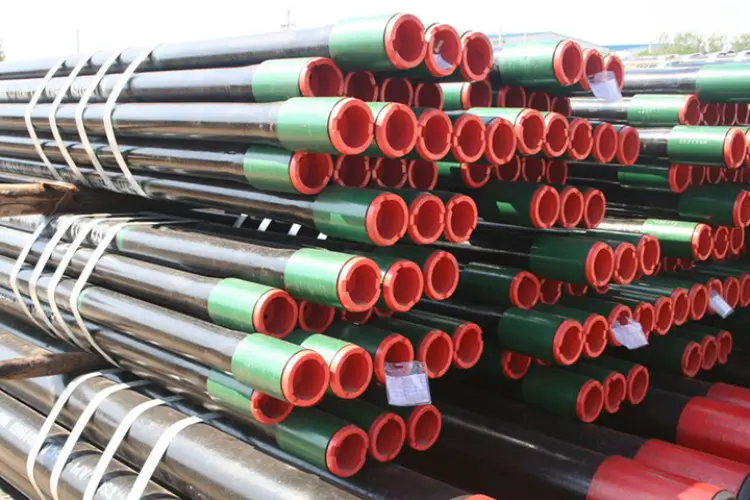
EN10025-2 S355J0 Steel for LSAW Pipe
EN10025-2 S355J0 Steel for LSAW Pipe: Properties, Equivalents, and Applications
Detailed data sheet for EN10025-2 S355J0 non-alloy structural steel used in LSAW pipe manufacturing, including chemical composition, mechanical and physical properties, equivalent grades, and application examples.
Hot rolling, controlled rolling, thermomechanical rolling, normalising; subsequent processes: LSAW welding, cutting, cold forming, bending, drilling
- Phone : +8618037372205
- Email : [email protected]
- WhatsApp: Contact via Whtsapp
- WeChat: +8618037372205
EN10025-2 S355J0 Steel for LSAW Pipe Introduction
S355J0 is a hot-rolled, weldable non-alloy structural steel defined in EN 10025-2:2004. It is characterised by a minimum yield strength of 355 MPa for thicknesses ≤ 16 mm and guaranteed impact toughness of at least 27 J at 0 °C (J0 quality). The steel offers excellent weldability, good formability, and reliable low-temperature toughness, making it suitable for demanding structural applications.
When used for LSAW (Longitudinal Submerged Arc Welded) pipes, S355J0 plates are formed into large-diameter pipes through cold forming or UOE process, then welded longitudinally. The resulting pipes are widely employed in oil and gas transmission, offshore structures, piling, and heavy civil engineering. The material is typically supplied in as-rolled, normalised, or thermomechanically rolled condition, depending on the required thickness and application. Its combination of strength, ductility, and notch toughness ensures safe performance under static and dynamic loads.
EN10025-2 S355J0 Steel for LSAW Pipe Chemical Composition
The ladle analysis limits according to EN 10025-2:2004, Table 3 for grade S355J0 (applicable to thickness ≤ 100 mm). Higher thicknesses may have adjusted limits. Values are maximum unless a range is stated. The steel can be fully or semi-killed, normally with aluminium content ≥ 0.020% total. Typical microalloying elements (Nb, V, Ti) may be added optionally to achieve strength and toughness requirements, but the standard does not mandate specific contents below prescribed limits.
| Element | Specified Value (max %) | Remarks |
|---|---|---|
| C | 0.20 | For thicknesses ≤ 16 mm; for >16 mm up to ≤ 40 mm max 0.20; >40 mm max 0.22 (product analysis may vary) |
| Mn | 1.60 | Minimum not specified, typical 1.0–1.6 % |
| Si | 0.55 | For rimmed steels lower, but S355J0 is typically killed |
| P | 0.030 | Maximum |
| S | 0.030 | Maximum |
| Cu | 0.55 | Maximum; if higher, agreement required |
| N | 0.012 | Maximum; if higher, sufficient Al or other nitrogen binding elements required |
| Others (Cr, Ni, Mo, etc.) | Trace/Residual | Not specified limits unless agreed; typically <0.30 % each |
EN10025-2 S355J0 Steel for LSAW Pipe Thermal and Electrical Physical Properties
Typical physical properties for structural carbon-manganese steels similar to S355J0 at room temperature and common elevated temperatures. These values are not part of the delivery standard but serve as design guidelines. Variations may occur depending on exact chemical composition and heat treatment. Density is close to pure iron. Elastic moduli decrease with increasing temperature. Thermal expansion and conductivity are in the normal range for ferritic steels. Resistivity increases with alloy content but remains within the typical interval for mild steel.
| Property | Typical Value | Unit | Test Condition / Remarks |
|---|---|---|---|
| Density (ρ) | 7.85 | g/cm³ | At 20 °C |
| Modulus of elasticity (E) | 210 | GPa | At 20 °C; decreases to ~190 GPa at 200 °C, ~170 GPa at 400 °C |
| Shear modulus (G) | 81 | GPa | At 20 °C; calculated from E and Poisson's ratio |
| Poisson's ratio (ν) | 0.3 | – | Elastic range, at ambient temperature |
| Coefficient of thermal expansion (α) | 12.0 × 10⁻⁶ | /K | Between 20 °C and 100 °C; typical linear expansion for carbon steel |
| Thermal conductivity (λ) | 50 | W/(m·K) | At 20 °C; decreases to ~45 W/(m·K) at 200 °C, ~36 W/(m·K) at 500 °C |
| Specific heat capacity (cp) | 460 | J/(kg·K) | At 20 °C; increases with temperature, ~570 J/(kg·K) at 400 °C |
| Electrical resistivity (ρe) | 0.20 – 0.25 | μΩ·m | At 20 °C; increases with temperature and alloy content |
EN10025-2 S355J0 Steel for LSAW Pipe Mechanical Properties
Mechanical properties at ambient temperature for flat and long products of grade S355J0. Data derived from EN 10025-2:2004, Table 7 (for flats) and Table 8 (for longs). Yield strength decreases with increasing thickness. The tensile strength range remains constant up to 63 mm thickness, then drops slightly. Minimum elongation after fracture (A) is based on a gauge length proportional to the test piece. Impact energy (KV) tested on Charpy V-notch specimens at 0 °C, minimum 27 J, usually transversal orientation. Bend test diameter ratio (d = mandrel diameter, a = thickness) varies with steel grade and thickness.
| Property | Required Value | Unit | Test Condition / Remarks |
|---|---|---|---|
| Yield strength (ReH) | 355 min | MPa | Thickness ≤ 16 mm |
| Yield strength (ReH) | 345 min | MPa | Thickness 16 < t ≤ 40 mm |
| Yield strength (ReH) | 335 min | MPa | Thickness 40 < t ≤ 63 mm |
| Yield strength (ReH) | 325 min | MPa | Thickness 63 < t ≤ 80 mm |
| Yield strength (ReH) | 315 min | MPa | Thickness 80 < t ≤ 100 mm |
| Tensile strength (Rm) | 470 – 630 | MPa | Thickness ≤ 100 mm; for 100 < t ≤ 150 mm: 450 – 590; 150 < t ≤ 250 mm: 440 – 580 |
| Elongation after fracture (A) | 22 min | % | Flat products t ≤ 16 mm (gauge length L0 = 5.65√S0); for 16 < t ≤ 40 mm: 22; 40 < t ≤ 63 mm: 21; 63 < t ≤ 80 mm: 20; 80 < t ≤ 100 mm: 20 |
| Impact energy KV (0 °C) | 27 min | J | Charpy V-notch, longitudinal or transversal, generally transversal (T) for wide flats; average of 3 tests, individual min 21 J |
| Bend test (mandrel diameter d) | 1a | – | For thickness ≤ 16 mm; bend angle 180°; for 16 < t ≤ 100 mm: d = 2a; for 100 < t ≤ 250 mm: d = 3a |
EN10025-2 S355J0 Steel for LSAW Pipe Exact Equivalent Material Standards and Replaceable Grades
| Country/Region | Standard | Grade | Remarks |
|---|---|---|---|
| International | ISO 630-2 | S355J0 | Identical technical delivery conditions; mechanical and chemical requirements aligned |
| Germany | DIN EN 10025-2 | S355J0 | Formerly DIN 17100 St52-3U (approximate), now fully harmonised |
| France | NF EN 10025-2 | S355J0 | No former identical, but A50-2 or E355 may be comparable |
| United Kingdom | BS EN 10025-2 | S355J0 | Direct adoption; replaces BS 4360 Grade 50C |
| USA | ASTM A572/A572M | Grade 50 (345 MPa) | Yield strength similar (345 MPa or 355 MPa depending on thickness); impact test temperature at –21 °C (Type 1) required by supplementary agreement; S355J0 often accepted as alternative with confirmation |
| Japan | JIS G 3106 | SM490A | Similar strength (min YS 325–365 MPa); SM490A has guaranteed impact energy at 0 °C (27 J min); chemical composition differs slightly |
| China | GB/T 1591-2018 | Q355D / Q345D | Q355D comparable (min YS 355 MPa, impact at –20 °C); Q345D slightly lower strength but widely used substitution |
EN10025-2 S355J0 Steel for LSAW Pipe Application Introduction
S355J0 is a versatile structural steel widely utilised across multiple sectors. Its guaranteed toughness at 0 °C and good weldability make it a reliable choice for welded structures, particularly LSAW pipes. Below are typical industries, products, and components where S355J0 LSAW pipes and plates are specified.
Product Applications: LSAW (longitudinal submerged arc welded) pipes from 16″ to 64″+ diameter, Welded structural hollow sections (square, rectangular, circular), Built-up plate girders and box columns, Spiral welded pipes when plate coils are slit and formed (though less common for S355J0), Offshore jacket structures and topside modules
Processed into products: Pipe spools and fittings (tees, elbows, reducers) for pipeline systems, Flanges and connectors welded to LSAW pipe ends, Piling shoes and connectors for foundation tubes, Cut-to-size plates for base plates, stiffeners, and gusset plates, Structural nodes and transition pieces in offshore wind jackets, Guide rails, wear plates, and support brackets in machinery
Application industries: Oil and gas (transmission pipelines, gathering lines, drill risers), Offshore and marine engineering (jacket legs, braces, piles, decks), Civil construction (bridges, stadiums, high-rise building columns, foundation piles), Water treatment and desalination (large-diameter water mains, penstocks), Renewable energy (wind turbine towers, monopiles, transition pieces), Mining and heavy machinery (structural frames, conveyor supports, drill masts), Shipbuilding (hull stiffeners, deck panels, hatch coamings)
EN10025-2 S355J0 Steel for LSAW Pipe Similar / Substitute Material Recommendations
| Country/Region | Standard | Grade | Remarks |
|---|---|---|---|
| European Union | EN 10025-2 | S355JR | Identical base chemistry and strength, but impact guaranteed at +20 °C (27 J) instead of 0 °C; may be suitable for non-critical low-temperature applications |
| European Union | EN 10025-2 | S355J2 | Higher toughness: 27 J at –20 °C; otherwise identical mechanical and chemical requirements; preferred for lower service temperatures |
| European Union | EN 10025-2 | S355K2 | Impact toughness at –20 °C, but also lower CEV and guaranteed Z-quality options; used for heavier sections and offshore environments |
| European Union | EN 10025-3 | S355N, S355NL | Normalised fine-grain steels; comparable strength with improved –20 °C (NL) or –50 °C (NL) toughness; often specified for LSAW pipes in sour service |
| USA | ASTM A572/A572M | Grade 55 (380 MPa) | Slightly higher yield strength; requires evaluation of weldability and ductility for substitution |
| International | API 5L | X52 (PSL1/PSL2) | Pipe grade with yield strength 360 MPa; for LSAW line pipe, often produced from S355 or similar structural steel; PSL2 introduces mandatory toughness testing |
Notes:
For sour service (H₂S-containing environments) or applications requiring improved through-thickness properties, additional requirements such as HIC/SSC testing per NACE MR0175 and Z-quality (Z15, Z25, Z35) per EN 10164 should be specified. When S355J0 is used for LSAW pipes, the weld seam must meet the same toughness criteria; supplementary welding procedure qualifications and NDT (UT/RT) are normally mandatory. Unless otherwise agreed, the steel surface shall be as-rolled; pickled and oiled or blast-cleaned finishes are available upon request.
- Share



