
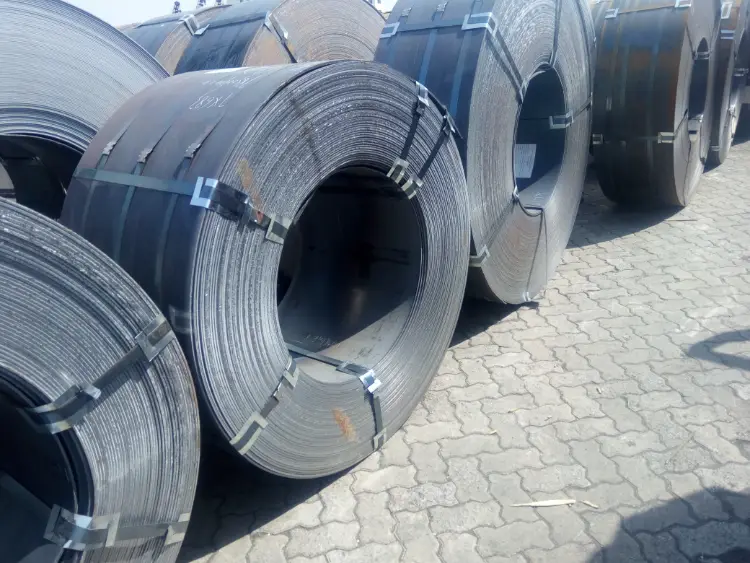
API 5L X65 Pipeline Steel Coil
API 5L X65 Pipeline Steel Coil - High-Strength Line Pipe Material for Oil & Gas
Comprehensive datasheet of API 5L X65 (L450) pipeline steel coil for sour service and sweet service line pipe applications per API 5L 45th Edition / ISO 3183.
Hot rolling, TMCP, normalising, spiral forming, ERW, SAW welding
- Phone : +8618037372205
- Email : [email protected]
- WhatsApp: Contact via Whtsapp
- WeChat: +8618037372205
API 5L X65 Pipeline Steel Coil Introduction
API 5L X65 (L450) pipeline steel coil is a high-strength low-alloy (HSLA) steel designed for longitudinal or spiral welded line pipe in oil and gas transmission systems. It meets the requirements of API Specification 5L, 45th Edition (2012), which is equivalent to ISO 3183:2012. The grade is designated X65 in PSL 1 and X65M or L450M in PSL 2 when supplied in thermomechanically rolled condition. It offers a minimum yield strength of 450 MPa (65 ksi) with excellent toughness and weldability, suitable for sour service under supplementary requirements. Typical delivery condition is as-rolled, normalised, or TMCP (thermo-mechanical controlled process) coil, depending on order specifications. Note: The original query "API 5CT-2011 M65" likely refers to X65 line pipe steel under API 5L; API 5CT covers casing/tubing and does not include M65 grade.
API 5L X65 Pipeline Steel Coil Chemical Composition – API 5L X65 PSL 2
The chemical composition is based on heat analysis for PSL 2 pipe with wall thickness ≤ 25 mm (0.984 in). For wall thickness > 25 mm, limits may be adjusted per standard. Elements not listed are not intentionally added.
- CEIIW ≤ 0.43% typical for SMLS pipe; CEPcm ≤ 0.25% typical for weldable grades.
| Element | Max (%) | Remarks |
|---|---|---|
| Carbon (C) | 0.18 | For PSL 2 welding; 0.26 max for PSL 1 |
| Silicon (Si) | 0.40 | Typical 0.15–0.35 |
| Manganese (Mn) | 1.65 | Depending on CE agreement; 1.45 max for PSL 1 |
| Phosphorus (P) | 0.025 | 0.030 for PSL 1 |
| Sulfur (S) | 0.015 | 0.030 for PSL 1 |
| Niobium (Nb) | 0.05 | Optional microalloy; V+Nb+Ti ≤ 0.15 |
| Vanadium (V) | 0.08 | May be present |
| Titanium (Ti) | 0.06 | For sulfide shape control |
| Aluminium (Al) total | 0.060 | Deoxidation; typical 0.015–0.060 |
| Nitrogen (N) | 0.012 | Unless otherwise agreed |
| Boron (B) | 0.001 | Residual only |
| Copper (Cu) | 0.50 | Ni, Cr, Mo residual ≤ 0.50 each |
| Nickel (Ni) | 0.50 | Combined Cu+Ni+Cr+Mo ≤ 1.0 unless agreed |
| Chromium (Cr) | 0.50 | Residual |
| Molybdenum (Mo) | 0.50 | Residual |
API 5L X65 Pipeline Steel Coil Physical & Thermal Properties
The following physical properties are typical for HSLA pipeline steel, grade X65, and may vary with actual composition and condition. These are not mandatory in the API 5L standard but are widely accepted for design calculations.
- Values at elevated temperatures are linear approximations.
| Property | Typical Value | Unit | Test Condition / Remarks |
|---|---|---|---|
| Density (ρ) | 7.85 | g/cm³ | Room temperature |
| Elastic Modulus (E) | 207 | GPa | At 20°C |
| Shear Modulus (G) | 80 | GPa | Calculated from E and ν |
| Poisson's Ratio (ν) | 0.29 | — | Within elastic range |
| Thermal Expansion Coefficient (α) | 11.7 | 10⁻⁶/°C | 20–100°C; up to 12.5 at 300°C |
| Thermal Conductivity (λ) | 45 | W/(m·K) | At 20°C; decreases to approx. 36 at 400°C |
| Specific Heat Capacity (c) | 475 | J/(kg·K) | At 20°C; approx. 550 at 500°C |
| Electrical Resistivity (ρₑ) | 0.22 | µΩ·m | At 20°C |
API 5L X65 Pipeline Steel Coil Mechanical Properties – API 5L X65 Line Pipe
Tensile and toughness properties for pipe body (base metal) tested at room temperature unless specified. Transverse specimens required for welded pipe. Charpy impact tests are mandatory for PSL 2; energy values depend on wall thickness and pipe diameter. Bend tests apply to strips or plates. For coil/skelp supplied to pipe mills, tensile properties are verified after pipe forming.
| Property | Required Value | Unit | Test Condition |
|---|---|---|---|
| Yield Strength (Rt0.5) | 450 – 600 | MPa | Transverse; 0.5% total extension under load |
| Tensile Strength (Rm) | 535 – 760 | MPa | Transverse |
| Yield to Tensile Ratio (Rt0.5/Rm) | ≤ 0.93 | — | Applies to PSL 2 pipe; optional for coil |
| Elongation (Af, 50 mm gauge) | ≥ 22 (typical) | % | Based on 5.65√S₀, minimum determined by formula |
| Elongation (Af) Formula | ≥ 1,940/A₀⁰.² | % | A₀ = cross-sectional area in mm², σb in MPa |
| Charpy V-notch Impact (KV) | ≥ 27–40 (transverse) | J | At 0°C or -10°C, depending on diameter & thickness |
| Charpy V-notch Impact (KV) min avg | ≥ 27 J | J | For 10 x 10 mm specimen; for sub-size proportional |
| Shear Area in DWTT (if applicable) | ≥ 85% at 0°C | % | Drop-weight tear test for gas pipes ≥ DN 500 > 12 mm wall |
| Bend Test (Mandrel Diameter) | No cracking or opening | — | 180° bend; mandrel diameter = 3 x thickness for t ≤ 12.7 mm |
| Hardness (Max, HV10) | ≤ 250 (base metal) | HV | Applies for sour service supplementary requirements; HIC/SSC testing |
API 5L X65 Pipeline Steel Coil Equivalent Grade Standards & Replaceable Designations
| Country/Region | Standard | Grade / Designation | Remarks |
|---|---|---|---|
| International | ISO 3183:2012 | L450 (PSL 2: L450M, L450Q) | Identical technical delivery conditions |
| Europe | EN 10208-2:2009 | L450MB | Corresponds to L450M (TMCP), pipe for combustible fluids |
| Canada | CSA Z245.1-18 | Grade 450 Cat II | Line pipe standard; equivalent mechanical properties |
| Russia / CIS | GOST R 52079-2003 (Type K52) | K52 (К52) | Approximate strength match, delivery as per API 5L |
| China | GB/T 9711-2017 | L450 / X65 | Identical to ISO 3183, petroleum and natural gas industries |
| Brazil | ABNT NBR 15827 | API 5L X65 | Based on API 5L adoption |
| Australia / NZ | AS/NZS 2885.1 | API 5L X65 | Referenced material in pipeline design code |
| India | IS 1239 Pt 2 / IS 3589 | API 5L X65 equivalent | Used for heavy-duty water and hydrocarbon lines |
API 5L X65 Pipeline Steel Coil Application Introduction
API 5L X65 coil is primarily converted into large-diameter line pipe for the transmission of oil, gas, and water. It can be formed into longitudinally welded (ERW/LSAW) or spiral welded (SSAW/HSAW) pipes. The steel is weldable with standard procedures and performs well in both sweet and mild sour environments when supplementary HIC/SSC requirements are applied. Coil dimensions typically range from 6 mm to 25.4 mm in thickness and up to 2100 mm in width.
Product Applications: Spiral submerged arc welded (SSAW) pipes, Electric resistance welded (ERW) pipes, Longitudinal straight seam welded pipes (LSAW), Line pipe fittings (elbows, tees, reducers), Pressure vessel shells (when supplementary certification obtained)
Processed into products: Pipeline mainline sections (cross-country pipelines), Riser pipes and offshore flowlines, Compressor station piping manifolds, Pump station discharge headers, Caissons and conductor pipes, Structural tubulars in offshore platforms
Application industries: Oil & gas exploration and production, Pipeline construction (onshore and offshore), Water transmission and distribution, Mining and slurries transport, Structural applications (piling, columns)
API 5L X65 Pipeline Steel Coil Comparable Materials – Similar Strength & Application
| Country/Region | Standard | Grade | Description & Typical Use |
|---|---|---|---|
| International | API 5L | X60 / L415 | Lower yield strength (415 MPa), used where 65 ksi is not required; good weldability. |
| International | API 5L | X70 / L480 | Higher strength (480 MPa yield), for high-pressure transmission, requires more stringent welding. |
| Europe | EN 10025-4 | S420ML / S460ML | Thermomechanical rolled structural steels with yield 420–460 MPa; not for line pipe but structural applications. |
| China | GB/T 1591-2018 | Q420MD / Q460MD | Low-alloy high-strength structural plates, strength range similar to X65 but without line pipe certification. |
| International | API 5CT | N80 Type 1 / L80 Type 1 | Casing/tubing grades with yield approx. 552–655 MPa, different chemistry and application; not direct substitute. |
Notes:
- The grade designation "M65" does not exist in API 5CT-2011; it is commonly a misinterpretation for X65 in API 5L for pipeline steel coil. This datasheet provides correct API 5L X65 info.
- For sour service (SSC/HIC) applications, the steel must be tested to NACE MR0175/ISO 15156 with appropriate hardness control (≤ 250 HV) and HIC testing per NACE TM0284.
- Delivery condition, notch toughness test temperature, and weldability certification should be clearly specified in purchase orders.
- Actual mechanical properties may differ for formed pipe due to Bauschinger effect; pipe mill must demonstrate compliance with final pipe specification.
- Share



